
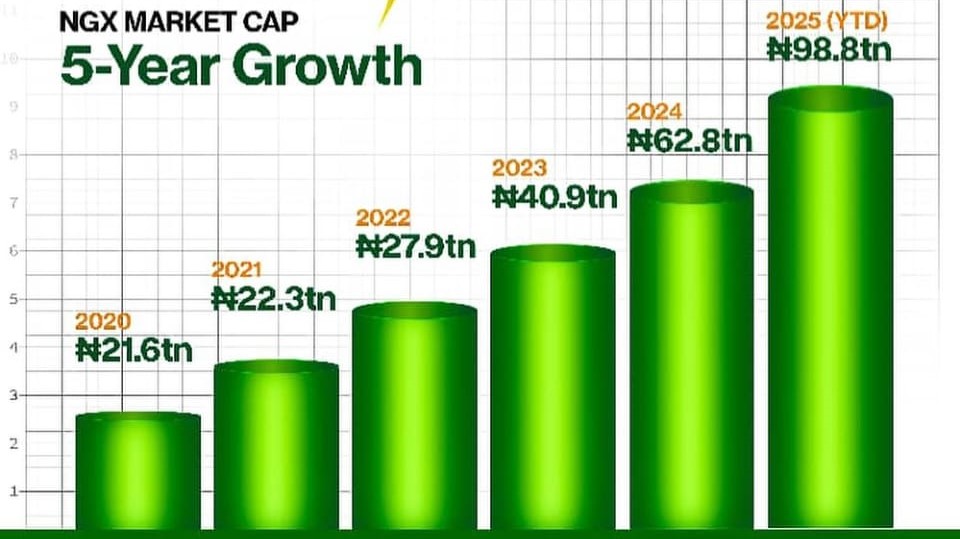
The Nigerian stock market is expected to maintain its momentum in 2026, with analysts forecasting that the market capitalisation will reach N300 trillion.
The market has already surpassed the N100 trillion mark, driven by economic reforms, banking sector recapitalisation, and increased retail participation. Despite political risks and global uncertainties, experts remain cautiously optimistic about the market’s future, noting factors such as moderating inflation, improved GDP growth, and stable foreign exchange rates.
Trading for the year 2026 opened with a market capitalisation of N99.376 trillion. By January 5, 2026, it crossed the N100 trillion milestone, reaching N101.52 trillion.
As of January 9, 2026, the market capitalization closed at N103.776 trillion, recording a year-to-date growth of N4.4 trillion. Additionally, the NGX All-Share Index experienced a year-to-date growth of 4.3 per cent, closing at 162,298.08 points on January 9, 2026.
The vice president of Highcap Securities, David Adonri stated that while the market capitalisation currently exceeds N100 trillion, this is just the beginning.
“Projections suggest it could grow to N300 trillion, especially with the anticipated listings of major companies such as Dangote Refinery, Dangote Petrochemicals, Dangote Fertiliser, NNPC, Flutterwave, and others. These listings could potentially triple the existing market cap,” he said.
Adonri emphasised that if current expectations are met, the market could experience even greater growth than previously observed.
Comparing Nigeria’s market capitalisation approximately $50 to $60 billion, to other African nations, Adonri noted, “the Johannesburg Stock Exchange market capitalisation is about $1 trillion, and this disparity is largely due to the fact that many major companies in Nigeria are not yet listed. However, with the anticipated influx of these large firms into the market, Nigeria is expected to close the gap with other leading markets in Africa.”
The managing director of Morgan Capital, Rotimi Olubi highlighted that “in early January 2026, Nigeria’s stock market reached a significant milestone as the Nigerian Exchange (NGX) market capitalisation surpassed N100 trillion. This achievement follows a remarkable 2025, during which the All-Share Index (ASI) posted a return of 51.19 per cent, outperforming major global indices like the S&P 500 and FTSE 100.”
Olubi added that “the current momentum in the market can be attributed to several key drivers. Economic reforms, particularly the removal of fuel subsidies and the unification of foreign exchange rates, have positively influenced investor sentiment by enhancing market transparency.
“Furthermore, the Central Bank’s mandate for banking sector recapitalisation led to the raising of over N3 trillion in 2025, significantly boosting trading volumes. Retail participation surged, growing from less than one million investors in 2023 to over six million by 2025, aided by advancements in technology and digital platforms like NGX Invest.”
However, Olubi warned that sustaining this momentum comes with challenges, saying, “The market remains concentrated, with the top 10 companies accounting for over 62 per cent of the total market value, posing systemic risks. Additionally, concerns over political stability as the 2027 general elections approach could lead to capital outflows from both foreign and local investors.”
“Macroeconomic volatility, particularly high inflation and currency fluctuations, continues to exert pressure on long-term growth, although the naira’s modest stability at the end of 2025 is crucial yet vulnerable to external shocks.
“Looking ahead, most analysts express cautious optimism for 2026, projecting GDP growth to accelerate to approximately 4.2 per cent to 4.4 per cent. However, they stress that the government must maintain stable fiscal policies and improve the business environment to ensure long-term stability and attract foreign direct investment.”
The national chairman of the New Dimension Shareholders Association, Patrick Ajudua emphasized that “the Nigerian stock market has the potential to maintain its momentum and surpass the N100 trillion capitalization mark. This can be achieved by remaining committed to positive economic reforms and transformation processes that have led us to this benchmark.”
Ajudua noted that “with many banks successfully meeting their recapitalization goals, a stabilized exchange rate, and improved foreign reserves, efforts are underway to attract more foreign investors. Moreover, the positive financial results of listed firms have bolstered investor confidence, positioning the market for further growth.”
The president of the Independent Shareholders Association of Nigeria (ISAN), Moses Igbrude also highlighted the significant growth potential of the Nigerian capital market, emphasizing that this growth is just beginning to unfold.
Igbrude also noted that the ongoing recapitalization of the banking sector, along with similar measures in the insurance sector, will further enhance the market’s growth and sustainability.
He stressed that the shift from foreign to local investors has significantly altered the market dynamics, indicating a more resilient homegrown economy that can withstand political fluctuations.
He mentioned the forthcoming listing of the Dangote refinery on the exchange, which is expected to boost equity capitalizations in the market further.
A total of 521 digital lender companies are now under the regulatory oversight of the Federal Competition and Consumer Protection Commission (FCCPC) following the expiration of the January 5 deadline for compliance with Nigeria’s new digital lending regulations.
The figure reflects a significant expansion in regulatory submissions as the FCCPC moves to sanitise Nigeria’s fast-growing digital credit market under the Digital, Electronic, Online and Non-Traditional Consumer Lending Regulations, 2025.
The Commission had directed all digital lenders—whether app-based, online, or operating through other non-traditional channels—to register with the FCCPC and comply with the new rules on or before January 5, 2026. With the deadline now elapsed, FCCPC records show that 457 companies have received full approval, while 35 others were granted conditional approval.
In addition, 29 digital lenders licensed by the Central Bank of Nigeria (CBN) remain subject to FCCPC oversight under the new framework. Despite the surge in registered companies, the Commission disclosed that 103 loan apps operated by unregistered entities have been placed on its watchlist for potential regulatory action.
The FCCPC has repeatedly warned that any digital lender operating outside its approval framework risks sanctions, including delisting from digital platforms, monetary penalties, and possible prosecution.
Industry analysts say the rise to 521 registered digital lenders highlights both the scale of Nigeria’s consumer credit market and the growing complexity of regulation in the sector. A Lagos-based financial analyst, Mr. Adewale Adeoye, said enforcement could become increasingly challenging as the number of players expands.
“The FCCPC’s mandate cuts across all sectors of the economy, and digital lending is just a fraction of that responsibility. Monitoring over 500 registered lenders alone requires substantial capacity, especially when hundreds of others are still operating illegally,” Adeoye said.
He added that the regulations also extend FCCPC oversight beyond loan apps to lenders operating without apps, further stretching supervisory capacity.
Similarly, the President of the Money Lenders Association (MLA), Mr. Gbemi Adelekan, acknowledged that enforcement may prove overwhelming due to the sheer number of operators. He noted that the guidelines also bring IT platforms supporting digital lenders under FCCPC oversight, adding another layer of complexity.
“We have raised these concerns with the Commission, and they say they are prepared. They have been responsive so far, but when more complaints and disputes