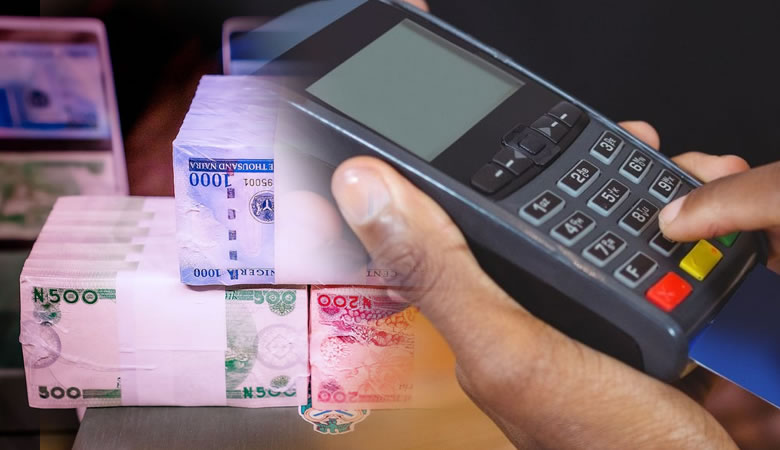
Many Nigerians are turning their attentions away from Automated Teller Machines (ATM) of banks leaning more to using the services of banking agents popularly known as point of sale (PoS) operators.
Checks by NATIONAL ECONOMY revealed that in many areas of the country, rural and urban alike, particularly in residential areas bank customers have developed a stronger preference for PoS operators over the use of ATMs even when they are available and ready to dispense cash.
Thus PoS operators now play a central role in day-to-day cash access for individuals and small businesses. From bus stops and markets to residential neighbourhoods, PoS stands have become the first port of call for customers seeking physical cash.
Rising unemployment in the country, as well as the rapid entry of fintech companies into the agency banking space, has led to more people venturing into the business.
PoS operators interviewed described a steady rise in transaction volumes, particularly during weekends and at month-end periods. Many said they handle not just small cash withdrawals but large cash in and cash out transactions, transfers and bill payments almost continuously throughout the day.
This is evident in the latest data release by the Central Bank of Nigeria (CBN) which showed that use of PoS rose significantly in the first six months of last year.
According to the data, while the volume of transactions via PoS rose by 20 per cent when compare to what was recorded for the first half of 2024, the value of transaction saw a steeper rise of 71.3 per cent.
In total, transaction value via the use of PoS rose from N85.914 trillion between January and June 2024 to N147.199 trillion in the comparable period of 2025, while the value rose to 7.723 billion from 6.395 billion.
With Nigeria’s population projected to be around 240 million, data from three Nigeria Inter Bank Settlement System (NIBSS) show that the proliferation of Point of Sale (PoS) terminals has grown to one per 41 persons in the country.
NIBSS data as at the first quarter of 2025 showed that the ratio of PoS-to-person in the country has been improving rising to 1 per 41 persons compared to one PoS per 43 persons in December of 2024 and one PoS per 89 persons as of March 2024.
The rising adoption of PoS is despite the surge in cash withdrawals further reaffirming Nigerians’ continued dependence on physical cash even after the Central Bank of Nigeria (CBN) raised ATM charges.
CBN data show that Nigerians withdrew N36.34 trillion from ATMs between January and June 2025, almost three times the N12.21 trillion recorded in the same period of 2024.
The rise was not limited to value alone as transaction volume climbed to 858.8 million withdrawals in the six-month period, compared with 496.47 million a year earlier, an increase of nearly 73 per cent.
The increase came despite a revised fee regime introduced in March, aimed at discouraging excessive cash usage. The CBN had effective March 1, 2025, put an end to the three free withdrawals every month on cash collected on the Automated Teller Machine (ATM) of another bank.
Consequently, not-on-us withdrawals which is the when customers make withdrawals at another bank will now attract a charge of N100 per N20,000 withdrawn from an ATM located within the bank.
For off-site ATMs, not located within the banking premises, bank customers will be charged N100 and an additional N500 surcharge for every N20,000 withdrawal, if the ATM is not the issuer of the card used. This brings the off-site not-on-us charge to N600 per N20,000 withdrawal.
A PoS agent operating inIkeja area of Lagos said customers rarely ask about ATM locations anymore. “Most people come straight here because they are not sure the ATMs will pay,” she said, explaining that her busiest hours are early mornings and evenings when workers need cash for transport and household expenses.
She said the availability of ATMs and banks around the vicinity does not necessarily impact her business as “some people just like the convenience of being able to get the cash that they need on their way instead of having to go an queue at the bank to use the ATM.”
Another PoS operator in Ayobo area of Lagos, Johnson, noted that bank customers have no choice as they will have to take transport to visit the nearest bank, a cost they may still incur as ATM charges. “So people just resort to the available option which is PoS. Our charges are still affordable and less than taking transport to go to the bank,” he said.

Thursday, September 24, 2026
Parallel Cash System Expands As PoS Agents Drive Liquidity