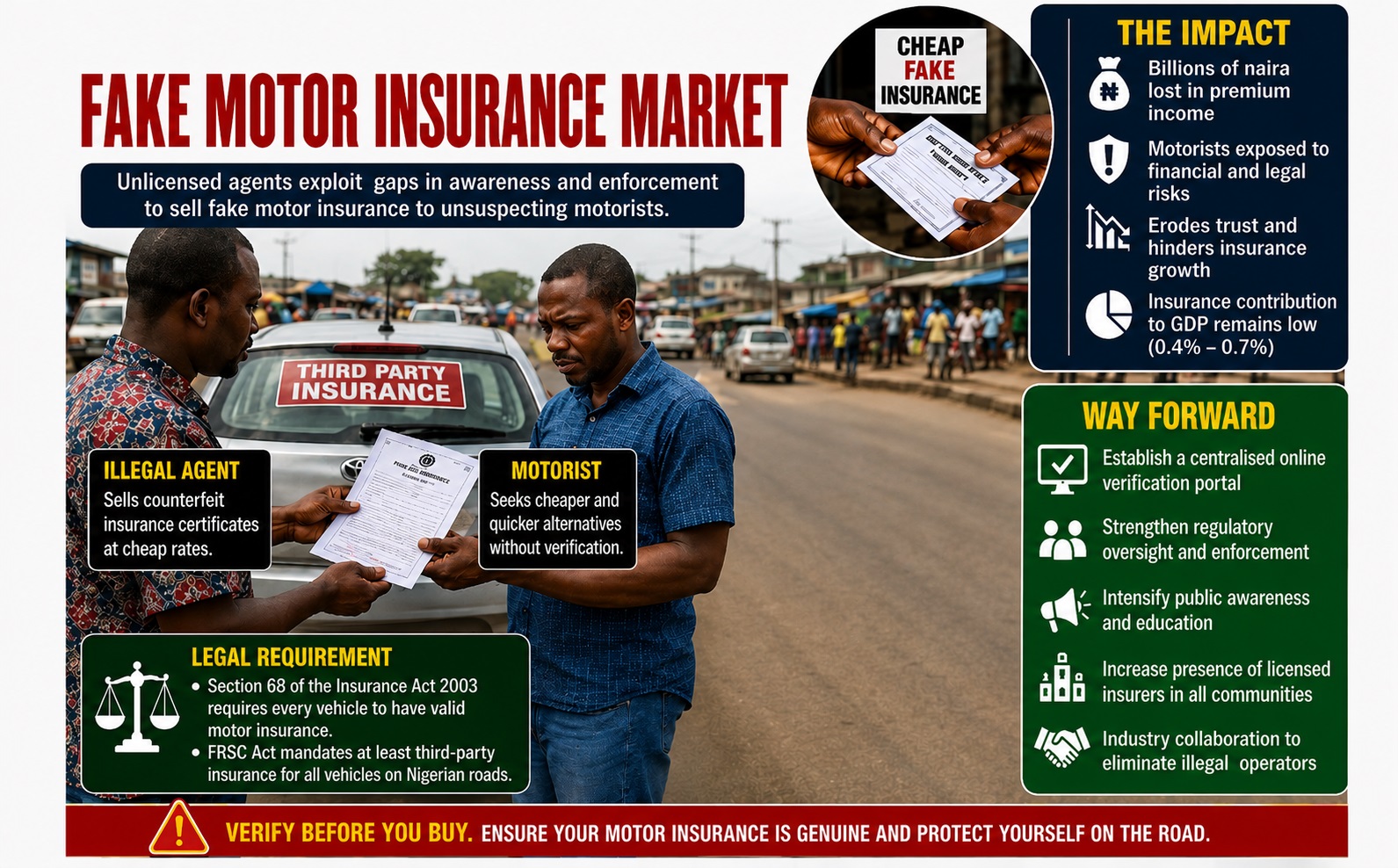
Despite the introduction of digital verification platforms and sustained regulatory interventions, fake motor insurance remains widespread across Nigeria, driven largely by networks of unlicensed agents who continue to exploit gaps in public awareness and enforcement.
The persistent trade in counterfeit motor insurance has become a major concern for industry stakeholders, with illegal operators, popularly known as “ghost brokers,” supplying fake insurance certificates to motorists seeking cheaper and quicker alternatives to genuine policies.
These unauthorised agents often issue counterfeit documents disguised as valid insurance cover, depriving legitimate insurers of billions of naira in premium income annually while exposing vehicle owners to significant financial and legal risks.
The problem continues to weigh on the insurance industry’s growth, with the sector’s contribution to Nigeria’s Gross Domestic Product (GDP) remaining relatively low at between 0.4 and 0.7 per cent despite improvements recorded in premium generation and other business segments.
Under Section 68 of the Insurance Act 2003, every vehicle operating on Nigerian roads is required to carry valid motor insurance. The Federal Road Safety Corps (FRSC) Act also mandates motorists to obtain at least third-party motor insurance coverage.
While genuine third-party motor insurance policies are sold at rates approved by the National Insurance Commission (NAICOM), fake operators continue to flood the market with counterfeit certificates that closely resemble authentic documents but are offered at significantly reduced prices.
Such activities are particularly prevalent around motor parks, vehicle registration centres and licensing offices.
To address the challenge, NAICOM has intensified public awareness campaigns and enforcement efforts under the Nigerian Insurance Industry Reform Act (NIIRA) 2025.
The initiative seeks to strengthen public confidence in insurance through recapitalisation, improved digital services and more efficient claims management processes.
Industry experts argue that the widespread circulation of fake insurance policies has contributed significantly to the sector’s low penetration levels by eroding consumer trust and diverting business away from licensed operators.
A staff member of an insurance company, who preferred anonymity, expressed concern over the sophistication of unauthorized agents and urged motorists to verify policies before making payments.
The managing director and chief executive officer of ECL Asset Management Limited, Charles Fakrogha, stressed the importance of collaboration among stakeholders to strengthen the insurance ecosystem and improve compliance with insurance regulations.
According to him, insurance remains a critical tool for risk management and economic recovery during unforeseen events, making it essential for vehicle owners and businesses to obtain genuine coverage.
Fakrogha advocated the establishment of a centralised online verification portal that would enable policyholders to confirm the authenticity of insurance certificates in real time.
He noted that such a platform would improve transparency, protect consumers from fraud and reinforce confidence in the insurance market.
He also emphasised the need for stronger regulatory oversight, insisting that only licensed insurance companies and accredited brokers should be permitted to operate in the market.
“Regulatory bodies and industry professionals must work diligently to ensure only authorised firms and licensed brokers are allowed to operate, safeguarding the public’s trust in the insurance system,” he said.
Fakrogha added that greater awareness, stricter enforcement and industry-wide collaboration would help improve Nigeria’s insurance landscape and deliver wider economic benefits.
Meanwhile, the insurance industry has launched a renewed campaign against fake motor insurance operators and rate undercutting, with NAICOM and the Association of Registered Insurance Agents of Nigeria (ARIAN) adopting a tougher stance against illegal practices undermining the sector.
Speaking at the 21st meeting of the Insurers Committee, Chairman of the Communication and Stakeholders’ Management Sub-Committee of the Committee and Deputy Chairman of the Nigerian Insurers Association (NIA), Mrs. Ebelechukwu Nwachukwu, disclosed that both NAICOM and ARIAN had stepped up efforts to tackle fake third-party motor insurance and unethical pricing practices.
She commended ARIAN for its commitment to addressing the menace and urged all stakeholders to treat the issue with urgency.
Nwachukwu also called on insurance companies to establish a stronger presence in underserved communities across the country, noting that the absence of licensed operators in many locations has created opportunities for illegal agents and touts to flourish.
“The absence of genuine insurance operators in many communities has created room for illegal agents and touts to thrive,” she said.
Industry stakeholders believe that expanding access to legitimate insurance services, strengthening verification systems and intensifying enforcement actions will be crucial to dismantling the networks sustaining Nigeria’s thriving fake motor insurance market.
Thursday, September 24, 2026
Fake Insurance Crisis Raises Fresh Consumer Protection Fears