Nigerian photographer Titilayo Olufemi returns with another compelling use of the camera to evoke emotions. Presented at Afriart Gallery, Kampala, from March 21 to May 20, 2023, Fragments of Passing Light brought together a series of photographs that reject the stability traditionally associated with landscape photography. Trees blur into vertical currents, foliage dissolves into luminous streaks, and gardens become fields of movement and colour. Throughout the exhibition, Olufemi pursues a single proposition: that the landscape is experienced not through stillness, but through motion, memory, and spiritual presence.
The photographs are united by a visual language of intentional camera movement. White arcs sweep across dense green canopies. Tree trunks stretch into elongated columns of light. Leaves dissolve into rhythmic passages of colour. Yet the exhibition is less concerned with abstraction than with what abstraction allows Olufemi to reveal. The blur is not an effect imposed upon the landscape; it is the means through which the landscape becomes something other than scenery. What emerges is a world that appears alive, unstable, and continually in the process of becoming.
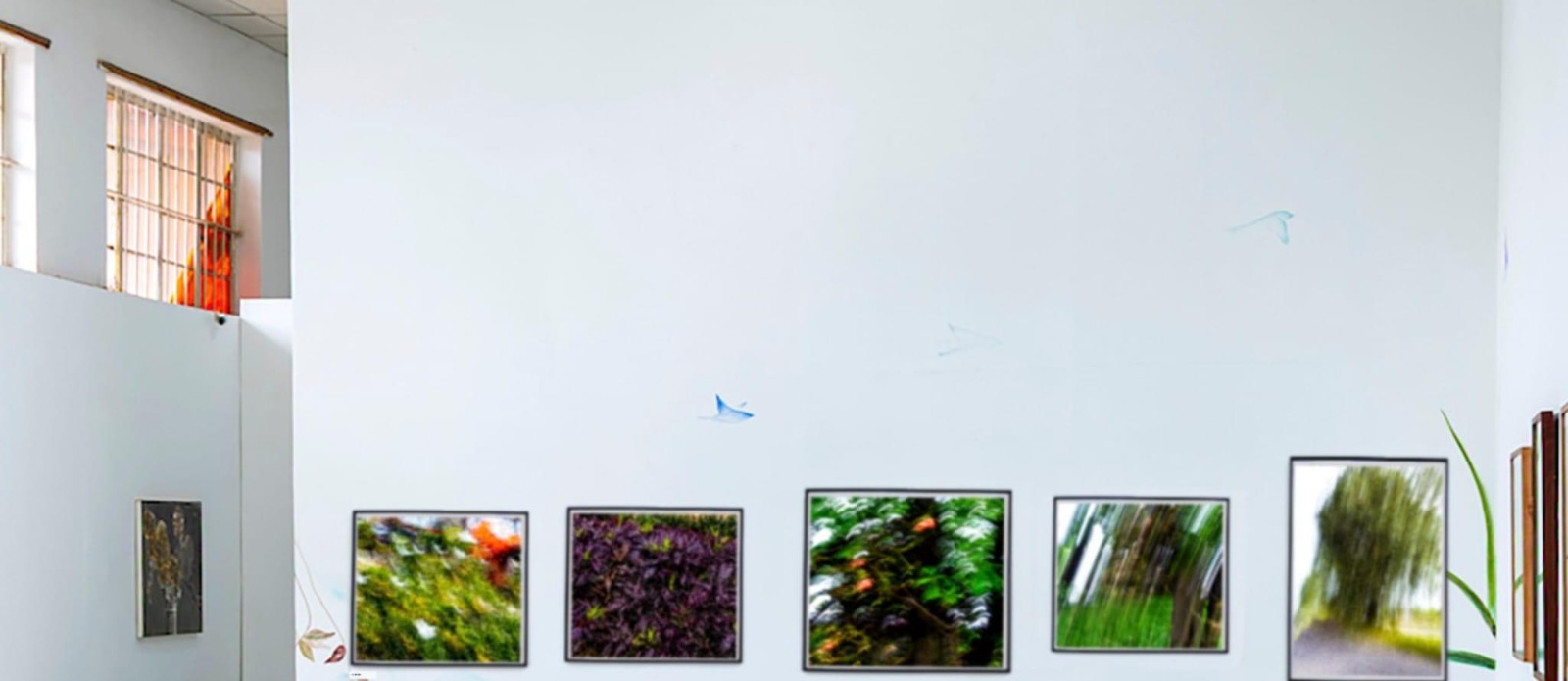
Several photographs operate through a productive tension between recognition and disappearance. In one work, a large tree remains partially intact while its surrounding branches dissolve into vertical cascades of green and white. The image hovers between representation and dissolution, allowing viewers to recognize the subject while simultaneously witnessing its transformation. Another photograph, dominated by repeated white gestures traversing a dense canopy, recalls both botanical growth patterns and abstract drawing. The landscape appears to generate its own visual language.
The exhibition’s strongest works retain traces of the physical world while refusing to be governed by it. This distinction is important. Contemporary photographic abstraction often risks reducing landscape to formal spectacle, where blur and movement become ends in themselves. Olufemi largely avoids this trap because the photographs never fully abandon their subjects. The viewer remains aware of trees, leaves, branches, and gardens, even as those forms are stretched beyond ordinary perception. The images derive their power from the tension between what is seen and what escapes visibility.
A photograph of purple foliage punctuated by emerging green shoots provides an instructive counterpoint within the exhibition. Unlike the surrounding works, it remains closely attached to material form. Its relative stillness introduces a pause within the exhibition’s rhythm of movement. The image functions almost as an anchor, reminding viewers that the transformations occurring elsewhere originate within the physical world before extending into sensation, memory, and atmosphere.
What ultimately distinguishes Fragments of Passing Light is its spiritual dimension. Olufemi avoids symbolic references and narrative devices, yet the photographs repeatedly suggest the presence of forces operating beyond immediate visibility. Trees become conduits of energy. Light assumes a material density. Motion functions less as distortion than as revelation. Rather than presenting nature as an object to be observed, the photographs propose it as a field of relationships in which human perception participates.
This proposition becomes most apparent in the exhibition’s recurring treatment of vertical movement. Again and again, trees exceed their physical boundaries, extending into luminous currents that evoke growth, memory, and transcendence. Such gestures transform the landscape from a location into a state of experience. The camera records neither an objective scene nor a subjective fantasy but something situated between the two: an encounter with the living rhythms of the natural world.
The title Fragments of Passing Light offers perhaps the clearest key to the exhibition. A fragment is incomplete. Passing light is transient. Together they suggest a vision of landscape built not upon certainty but upon fleeting moments of recognition. Olufemi’s photographs do not attempt to fix nature within a stable image. Instead, they acknowledge that seeing itself is partial, temporary, and constantly changing.
The result is a body of work that shifts the conversation away from landscape as representation and toward landscape as experience. If many photographers seek clarity, Olufemi seeks something more elusive: the point at which perception gives way to sensation, and where the visible world becomes inseparable from memory, movement, and spirit.