
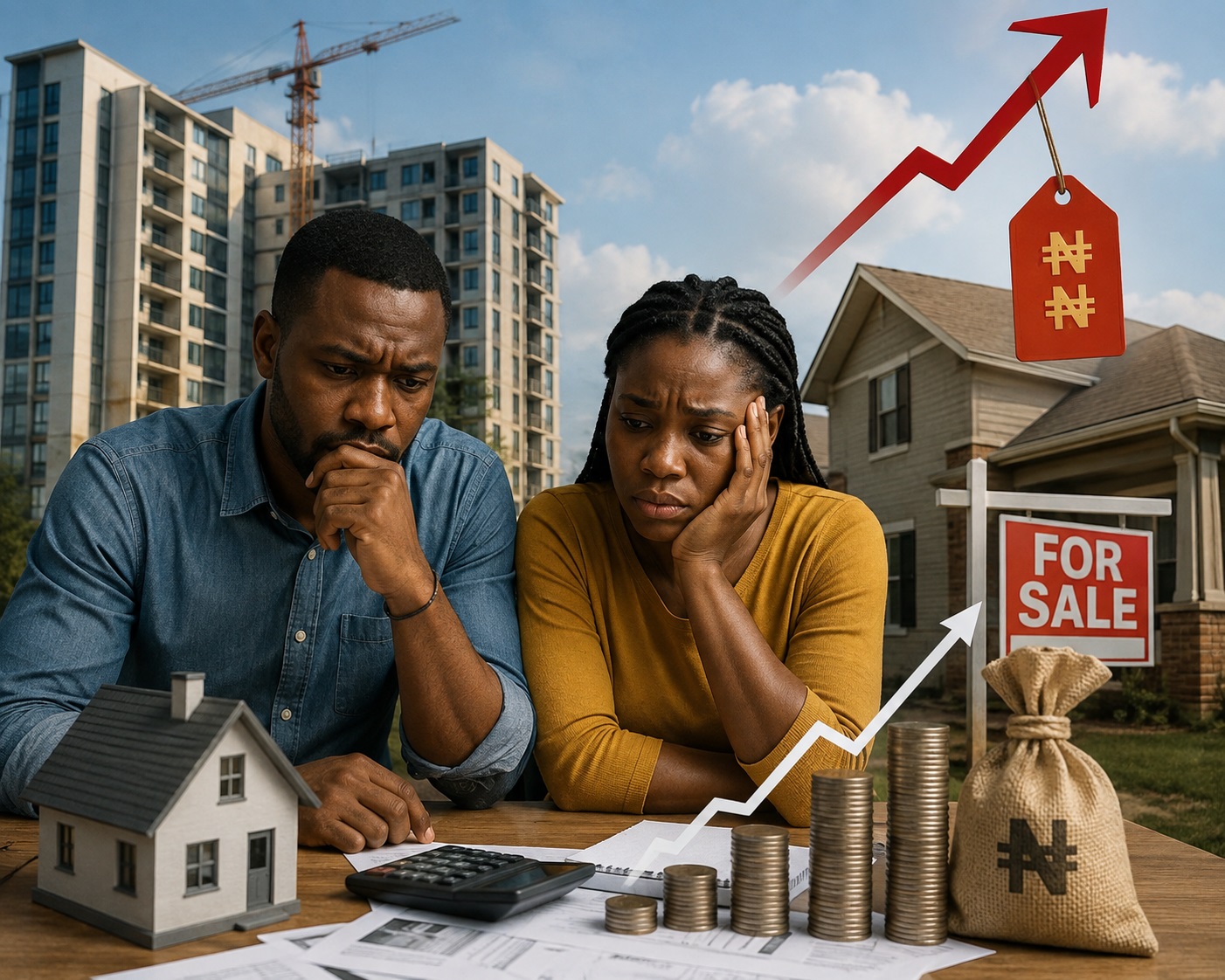
For generations, home ownership has symbolised financial security and personal achievement for millions of Nigerians. For workers in the country’s middle-income bracket, the expectation was straightforward: secure stable employment, save consistently, obtain a mortgage and gradually repay the loan while building equity in a family home. Although never easy, the journey to owning a house was once considered attainable through discipline and long-term planning.
That expectation is fading rapidly. Across Nigeria’s major cities, the cost of owning a home has climbed far beyond the reach of many salaried workers. Inflation has remained stubbornly high, the naira’s depreciation has driven up the cost of imported building materials, while domestic construction inputs continue to record frequent price increases. At the same time, income growth has failed to keep pace, leaving many prospective homeowners unable to bridge the widening affordability gap.
The result is a housing market where mortgage financing is becoming more accessible in some respects, yet the homes available for purchase are becoming increasingly unaffordable. This contradiction now lies at the centre of Nigeria’s housing challenge.
Despite ongoing reforms by government and key institutions, affordability remains the missing link. Mortgage providers have introduced new financing options, improved digital services and expanded loan products, but these efforts are being undermined by soaring property prices and declining purchasing power.
Housing analysts estimate that Nigeria still faces a housing deficit running into millions of units, while rapid urbanisation continues to intensify demand. Every year, thousands of families relocate to cities such as Abuja, Lagos, Kano, Port Harcourt and Ibadan in search of employment and better opportunities. Unfortunately, housing supply has not expanded at the same pace, creating intense pressure on existing accommodation and driving both rents and property values upward.
Surveyor Ngadi Rachael Nwakanma from the Lead City University, Ibadan, shared her experience that virtually every component of housing delivery has become more expensive. She argued that the prices of cement, steel reinforcement, roofing materials, electrical fittings, plumbing accessories, tiles and finishing products have all risen sharply over the past few years. Added to these she said are escalating transportation costs, rising energy prices, expensive land acquisition processes and lengthy approval procedures.
The Survey student said these cumulative expenses inevitably find their way into the final selling price of every housing unit, leaving buyers to shoulder the burden.
LEADERSHIP findings reveals that for many middle-class workers earning between ₦300,000 and ₦700,000 monthly, purchasing a home has become increasingly difficult. Even where mortgage facilities are available, the required equity contribution, monthly repayments and other associated expenses often exceed what many households can reasonably afford.
The managing director and chief executive officer of the Federal Mortgage Bank of Nigeria (FMBN) , Shehu Usman Osidi, has repeatedly emphasised that improving access to affordable housing remains one of the country’s biggest development priorities. According to him, expanding mortgage availability alone will not solve the problem if the cost of houses continues to outstrip the earnings of ordinary Nigerians.
He has also advocated stronger collaboration among governments at all levels, private developers, financial institutions, organised labour and other stakeholders to create sustainable financing models capable of delivering affordable homes to a wider segment of the population.
In recent years, the Federal Mortgage Bank of Nigeria (FMBN), has recorded notable progress in strengthening the country’s mortgage system. Collections under the National Housing Fund have improved significantly, while mortgage loan disbursements have risen as more contributors access housing finance.
The Bank has equally diversified its product offerings to address the varying needs of contributors. These include Rent-to-Own, Home Renovation Loans, Rent Assistance Loans, Diaspora Mortgage Loans and non-interest mortgage facilities designed to make home financing more inclusive.
Technology has also transformed service delivery. Online mortgage applications, digital banking platforms and USSD-based services have simplified access for contributors, reduced paperwork and improved operational efficiency, enabling customers to interact with the Bank more conveniently.
Even with these institutional gains, the affordability challenge remains unresolved because housing prices continue to rise much faster than household incomes.
One significant advantage enjoyed by contributors under the National Housing Fund Scheme is access to mortgage loans at single-digit interest rates through the Federal Mortgage Bank of Nigeria. These concessionary rates make repayment considerably easier than what is obtainable in most other segments of the financial market.
Outside the FMBN framework, however, the picture is markedly different. Most commercial banks and many private mortgage finance institutions provide housing loans at double-digit interest rates, often exceeding 15 per cent, with relatively shorter repayment periods. Such financing significantly increases monthly repayment obligations, making home ownership difficult for many middle-income families.
Housing finance specialists therefore argue that while FMBN remains Nigeria’s most affordable mortgage institution, its resources alone cannot satisfy the enormous demand for housing finance. They contend that expanding access to long-term, low-cost funding through stronger public-private partnerships and capital market participation is essential if mortgage financing is to become truly accessible to a larger number of Nigerians.
Discussions at the recent Africa International Housing Show reinforced concerns that Nigeria’s housing challenge extends beyond the availability of mortgages. Participants drawn from the public and private sectors agreed that financing, land administration, infrastructure development and macroeconomic stability must all improve simultaneously if affordable housing is to become a reality for millions of Nigerians.
Stakeholders at the forum observed that no single institution can resolve the country’s housing deficit in isolation. They stressed that deeper collaboration between government, developers, mortgage institutions, pension fund administrators, capital market operators and development finance institutions is essential to unlock the long-term funding needed to support affordable housing delivery.
An Abuja based Property Developer Engr. Abdullahi, said rising construction costs remain one of the biggest obstacles to delivering homes at prices that average Nigerians can afford. He explained that fluctuating prices have made it increasingly difficult to maintain stable selling prices.
“Every project is affected by rising production costs. Cement, reinforcement rods, finishing materials, transportation and labour hardly remain at the same price for long. Developers are forced to review prices because construction costs continue to change,” he said.
A mortgage professional with the Infinity Mortgage Finance Bank, who declined to be addressed by name also queried that the poor structure of Nigeria’s financial system was a major challenge to it’s mortgage finance.
She said unlike many developed economies where borrowers can repay mortgages over 20 to 30 years at relatively low interest rates, housing finance in Nigeria is still constrained by expensive credit and comparatively shorter repayment periods adding that the consequence is higher monthly repayment obligations that discourage many prospective homeowners.
Further discussions at the recently conducted Housing Show in Abuja also revealed that despite the fact that mortgage lending depends heavily on long-term capital, yet many financial institutions rely largely on short-term customer deposits. This mismatch between the tenure of available funds and the long repayment cycle required for housing finance continues to restrict the expansion of the mortgage market.
LEADERSHIP findings also point to land administration as another major contributor to rising housing costs. Obtaining land titles, securing Certificates of Occupancy, processing governors’ consent, paying multiple statutory charges and navigating lengthy approval procedures often add significant costs to housing projects before construction even begins.
According to industry analysts, these administrative expenses ultimately become part of the purchase price paid by homebuyers.
Infrastructure deficits further complicate the situation. In many private housing estates, developers provide roads, drainage systems, electricity networks, water supply and security infrastructure without corresponding public investment. The cost of providing these essential services is eventually built into the selling price of each housing unit.
As home ownership becomes increasingly difficult, many Nigerians are resigning themselves to a lifetime of renting.
An Abuja-based accountant who has contributed to the National Housing Fund for over a decade said he remains hopeful but increasingly concerned about the widening affordability gap.
“I’ve contributed to the NHF for years believing it would eventually help me become a homeowner. While the mortgage options are encouraging, the prices of available houses continue to rise much faster than my income,” he said.
A secondary school teacher in a Lagos government school by name Mobolaji Afolabi shared a similar experience.
“Every salary review is quickly overtaken by rising property prices. No matter how much I save, buying a house seems to move further out of reach each year,” she lamented.
Across online housing forums and social media platforms, LEADERSHIP discovered that similar frustrations continue to emerge. Many contributors say they are willing and financially able to service mortgage repayments but struggle to raise the required equity contribution. Others argue that although mortgage products have improved, the market simply lacks enough affordable homes that match the earning capacity of middle-income workers.
Government authorities insist that efforts are underway to improve the situation.
The federal government has continued to promote the Renewed Hope Housing Programme alongside broader social housing initiatives and public-private partnerships aimed at increasing housing supply across the country.
The Federal Mortgage Bank of Nigeria has also expanded collaboration with the Federal Government Staff Housing Loans Board to improve access to housing finance for public servants while introducing additional mortgage products targeted at different categories of contributors.
Even so, housing economists maintain that expanding the number of houses alone will not resolve the affordability challenge unless broader economic conditions also improve. They argue that reducing inflation, stabilising the exchange rate, lowering construction finance costs, simplifying land administration and strengthening workers’ purchasing power are equally important if home ownership is to become attainable once again.
While increasing housing supply remains an important objective, experts insist that affordability must become the central focus of Nigeria’s housing policy. Building more houses will have limited impact if the majority of workers cannot afford to buy them or qualify for sustainable mortgage repayments.
Analysts argue that restoring affordability requires coordinated economic reforms that extend beyond the housing sector. They recommend sustained efforts to tame inflation, stabilise the foreign exchange market, reduce the cost of construction finance and simplify land administration processes that continue to add unnecessary costs to housing development.
They also advocate stronger incentives for local manufacturers of building materials. Expanding domestic production of cement, roofing materials, sanitary fittings, doors, tiles and other construction inputs, they argue, would reduce dependence on imports and minimise the impact of exchange rate volatility on housing costs.
A first class economic tutor and staff of the Central Bank of Nigeria resident in Abuja, who said he should be addressed only as Dr. Aminu also explained that beyond government intervention, institutional investors such as pension fund administrators, insurance companies and development finance institutions should play a greater role in providing long-term capital for housing finance. He said such funding would enable mortgage institutions to extend repayment periods while maintaining relatively affordable interest rates.
The economist suggested that industry operators should equally support targeted tax incentives for developers that commit substantial investments to genuinely affordable housing projects. He explained that reducing taxes, levies and regulatory charges for such developments would ultimately lower selling prices and expand access to home ownership.
Although the Federal Mortgage Bank of Nigeria continues to provide one of the most affordable mortgage windows through its single-digit National Housing Fund loans, stakeholders agree that the institution cannot, on its own, bridge Nigeria’s enormous housing financing gap. Most commercial banks and private mortgage lenders still operate with double-digit lending rates and shorter repayment tenures, making mortgage repayment significantly more expensive for average income earners.
For many middle-class Nigerians, the dream of owning a home has therefore become less about willingness to repay a mortgage and more about the widening disconnect between earnings and property prices. Thousands of workers who maintain stable employment and contribute regularly to the National Housing Fund now find that the houses available on the market have moved beyond what their incomes can reasonably support.
Without decisive reforms, the country risks creating a housing market dominated by long-term tenants rather than homeowners. Such an outcome carries wider economic implications, including reduced household wealth creation, increased pressure on urban rental markets and growing social inequality.
The challenge before policymakers is therefore not simply to expand mortgage financing but to ensure that affordable housing is available for the very people those mortgages are designed to serve. Achieving that balance will require consistent policies, stronger public-private collaboration, improved infrastructure, efficient land administration and a more stable macroeconomic environment.
Nigeria’s housing finance system has undoubtedly evolved in recent years. Mortgage products have become more diversified, technology has improved access to services and institutional reforms have strengthened confidence in the sector. Yet these achievements will have limited impact if the average teacher, civil servant, nurse, police officer or young professional continues to find home ownership beyond financial reach.
Until the cost of building homes begins to align more closely with the earning capacity of ordinary Nigerians, the promise of affordable housing will remain elusive. Restoring that balance may ultimately determine whether the next generation sees home ownership as an achievable milestone or merely an increasingly distant aspiration.