
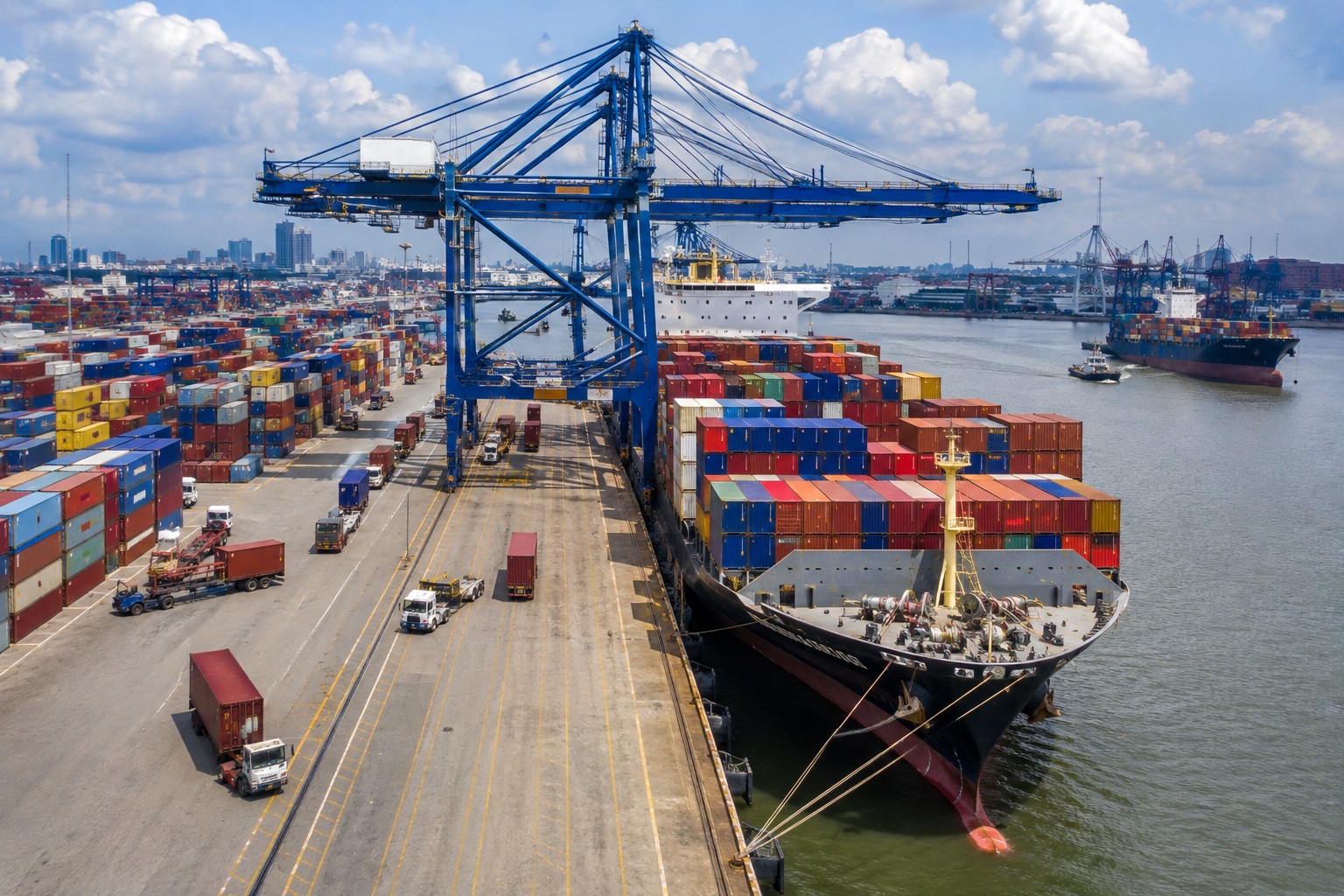
A container entering Nigeria can accumulate charges long before it reaches an importer’s warehouse. Clearing agents say some payments are official and receipted, while others are allegedly demanded outside the formal system, adding to shipping, terminal, inspection and storage costs.
Among the allegations are demands of ₦600,000 to ₦700,000 over labelling issues and ₦45,000 in unreceipted charges for moving a 40-foot container. Separately, a study by the Maritime Anti-Corruption Network (MACN) and QBIS found corruption adds 15.2 per cent to transport and logistics costs for bulk imports into Nigeria.
Together, the figures illustrate the cost problem facing Nigeria’s ports: it is not necessarily one large fee, but a series of charges and delays that can raise the final cost of getting goods into the country.
The financial gap is already visible in comparisons with neighbouring ports.
The Importers Association of Nigeria (IMAN) says clearing a 20-foot container in Benin Republic costs between ₦7 million and ₦8 million, compared with ₦14 million to ₦15 million at Apapa Port.
For a 40-foot container, IMAN estimates the cost at ₦13 million to ₦14 million in Benin Republic, compared with ₦19 million to ₦20 million at Apapa.
Those estimates, provided by the association, are not a like-for-like independent tariff comparison. But they point to a widening concern among importers over the total cost of using Nigerian ports.
Where the money goes
Clearing agent Adepoju Ishola said the process involves several regulatory agencies, each with its own inspection or clearance requirements.
He alleged that some officials of the Standards Organisation of Nigeria (SON) and the National Agency for Food and Drug Administration and Control (NAFDAC) sometimes demand payments beyond prescribed charges.
His claims could not be independently verified from the material available.
Ishola said SON officials normally record samples taken from containers on sample forms. Where no sample is taken, he alleged that agents could be asked to pay ₦15,000 for an examination report confirming that no sample was collected.
The issue becomes more expensive when labelling deficiencies are identified.
Imported products are expected to carry information including country of origin, manufacturing date, expiry date and the address of the country of manufacture.
Ishola alleged that when such information is missing, some importers could face demands of ₦600,000 to ₦700,000.
“If they are missing, they collect between N600,000 and N700,000,” he alleged.
He acknowledged that labelling deficiencies can trigger an official process and prescribed payment, but alleged that some agents and importers instead negotiate informal settlements.
That distinction is important. An official regulatory penalty is a known business cost. An alleged unofficial payment is not only difficult to budget for but also creates uncertainty over what a shipment will ultimately cost.
Ishola also alleged that quarantine-related activities can involve additional unofficial payments, despite having official payment channels.
Another alleged charge arises during container movement.
Ishola said agents moving a 40-foot container from a terminal to the port gate could be asked for ₦45,000 without an official receipt.
He contrasted that with an ₦7,000 inspection fee, which he said is official and receipted.
“For a 40-foot container, inspection fee is N7,000 and it is receipted,” he said.
Delays become another bill
The cost of a container is also affected by how long it remains inside the clearance system.
Okogbue Eke, President of the Patriots Anti-Corruption Initiative, alleged that delays in delivery-order issuance, cargo examination, release procedures and truck call-up add costs for importers.
He also alleged that some agents make unofficial payments to secure earlier examination dates.
Eke cited an instance in which an agent allegedly paid ₦30,000, after making the required official payment, to obtain an earlier examination date.
Okwuosa Humphrey, Vice National President of the group, separately alleged that delays by some shipping companies in electronically transmitting delivery orders to terminal operators can prevent same-day cargo delivery.
That can expose importers to additional demurrage, he said.
Humphrey also alleged that holds placed on consignments sometimes force agents to move between offices before cargo can be released.
For an importer, the financial effect is straightforward: every additional day can create another bill.
The corruption premium
The MACN-QBIS study provides a broader measure of the problem.
It found that corruption increases transport and logistics costs for bulk imports into Nigeria by 15.2%.
The study estimated the additional burden at $5.90 per tonne, $182,300 per vessel and $162.9 million annually.
It separately estimated that corruption adds about 0.8% to total import costs, excluding profit.
The two percentages measure different things. The 15.2% figure relates specifically to transport and logistics costs for bulk imports, while the 0.8% estimate covers total import costs.
The study also identified delays, demurrage and additional inventory requirements as important indirect costs associated with maritime corruption.
That helps explain why simply comparing official port tariffs may not capture the full cost of importing through Nigeria.
The competitive threat
IMAN’s Joseph Ajoku said the cost burden is encouraging some importers to consider ports in Benin Republic, Ghana, Togo and Burkina Faso.
He also alleged that shipping lines contribute to the burden through delayed refunds of container deposits, unapproved charges and other financial practices.
If cargo shifts to neighbouring ports, Nigeria loses more than the immediate port fee. Cargo diversion can affect Customs revenue, terminal activity, trucking, warehousing and other businesses connected to maritime trade.
Aliyu Yaradua, IMAN’s National Secretary-General, said the pressure is already being felt by importers.
He said high exchange rates and rising port charges have left some traders unable to clear their consignments, increasing the risk of prolonged cargo stays and overtime auctions.
Many importers, he added, borrowed at high interest rates to finance their businesses and are now struggling with repayments and other expenses.
“If importers decide to stop importing goods, government revenue will drop heavily within weeks,” Yaradua said.
A system built around delay
The complaints point to a structural issue rather than a single offending charge.
A shipment can begin with Customs duties and regulatory fees, followed by terminal and shipping charges. It may then incur inspection, container movement and documentation costs. If the process is delayed, demurrage can add another layer. Stakeholders allege that unofficial payments can appear at some of those stages.
Each cost may be manageable on its own. Their accumulation is what makes the final bill difficult to predict.
Eke urged the Nigerian Shippers’ Council, Nigeria Customs Service and other agencies to investigate the alleged unofficial payments and delays.
He also called for an investigation into alleged manual blocking of jobs in some Customs units, saying the practice undermines the One-Stop-Shop system.
For Nigerian ports, the issue is therefore bigger than whether individual tariffs are high.
It is whether an importer can bring a container into Nigeria, calculate the cost in advance, clear it within a predictable period and pay only authorised charges.
The answer will increasingly influence where cargo lands in West Africa.
As neighbouring ports compete for the same trade, every additional charge and every day of delay increases the incentive for importers to look elsewhere.