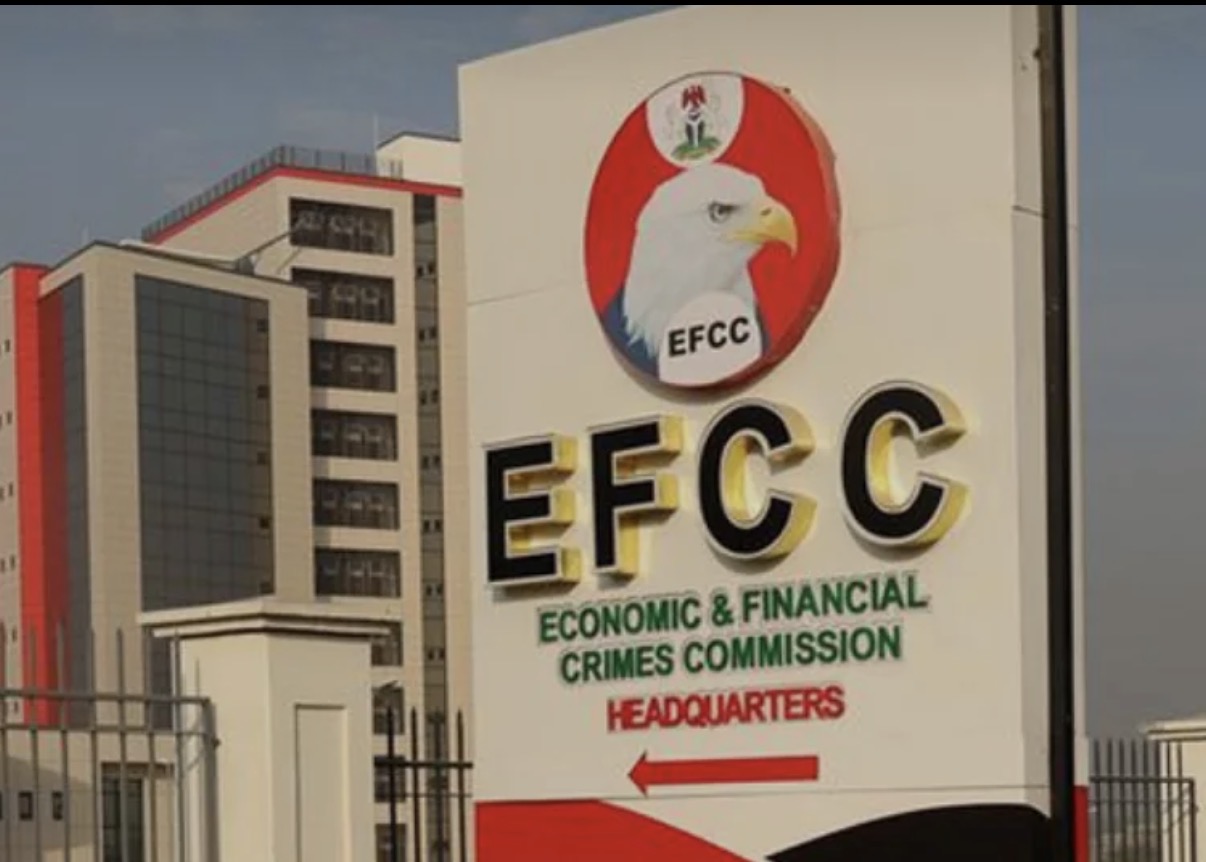
The Economic and Financial Crimes Commission (EFCC) has accused former Central Bank of Nigeria (CBN) Governor, Godwin Emefiele, of creating an alleged system through which individuals and businesses seeking foreign exchange were compelled to make payments before accessing the funds.
An EFCC investigator, Alvan Gurumnaan, made the allegation on Thursday while testifying before the Lagos State Special Offences Court sitting in Ikeja, where Emefiele is standing trial on corruption-related charges.
Gurumnaan, a prosecution witness before Justice Rahman Oshodi, alleged that the former CBN governor used staff members and associates to collect millions of dollars from companies seeking foreign exchange and payment of contract fees.
He cited the case of a company whose officials allegedly paid about $17 million to Emefiele through a former CBN staff member, Monday Osazuwa, who reportedly admitted receiving the money during the EFCC investigation.
According to the witness, Osazuwa told investigators that he sometimes handed the money to the second defendant, Herry Omoile, for onward delivery to Emefiele, while on other occasions, he allegedly took the money directly to the former CBN governor.
Gurumnaan said the EFCC uncovered the alleged arrangement while investigating complaints from importers and other Nigerians who experienced difficulties accessing foreign exchange for legitimate business and personal needs.
He further alleged that another company, Source Computer, was compelled to provide money for Emefiele before it could receive payment for its contracts.
The investigator also told the court that the commission uncovered several properties allegedly acquired by Emefiele through proxies and associates, which he said were beyond what the former CBN governor could legitimately afford from his earnings.
He said the investigation traced some of the alleged transactions to a lawyer, Ifeanyi Omeje, whose office was searched, leading to the recovery of more than $2 million in cash.
According to him, Omeje, who served as secretary to several companies, admitted to investigators that he acted as a front for Emefiele.
Gurumnaan listed some of the properties allegedly linked to the former CBN governor to include two sets of twin duplexes in Lekki Phase 1 and two mansions on Queen’s Drive, Ikoyi, Lagos.
He also disclosed that investigators discovered a factory under construction in Emefiele’s hometown of Agbor, Delta State, which had been forfeited to the Federal Government following court proceedings.
Other properties allegedly traced to the former CBN governor included a block of eight flats on Adekunle Lawal Street, Ikoyi, which the witness said originally belonged to the Nigerian Security Printing and Minting Company, where Emefiele served as board chairman, before it was sold to him.
The investigator further told the court that the EFCC recovered a warehouse in Agbor and another in Ogun State, on the outskirts of Lagos, allegedly belonging to Emefiele.
He said the Ogun State warehouse contained several containers with an estimated value running into hundreds of billions of naira.
Gurumnaan also identified an 11-storey building containing about 94 luxury flats, an industrial park under construction in Lagos and an estate comprising approximately 750 houses in Abuja’s Lokogoma area among the assets allegedly linked to the former CBN governor.
The witness maintained that Emefiele was given an opportunity to respond to some of the findings during the investigation but failed to explain several properties and transactions uncovered by the commission.
He added that various courts had ruled in favour of the EFCC in asset-forfeiture proceedings involving properties allegedly linked to the former CBN governor.
Emefiele and his co-defendant, Omoile, are facing a 26-count charge bordering on alleged acceptance of gratification, receiving gifts through agents, corruption and fraudulent receipt of property.
The EFCC also accused Emefiele of allegedly conferring corrupt advantages on associates, contrary to the Corrupt Practices and Other Related Offences Act, 2000.
The charges were filed on April 3 by the anti-graft agency’s prosecutor, Rotimi Oyedepo (SAN).
Both defendants pleaded not guilty to the charges.
The court adjourned the case until November 13 for continuation of trial.