
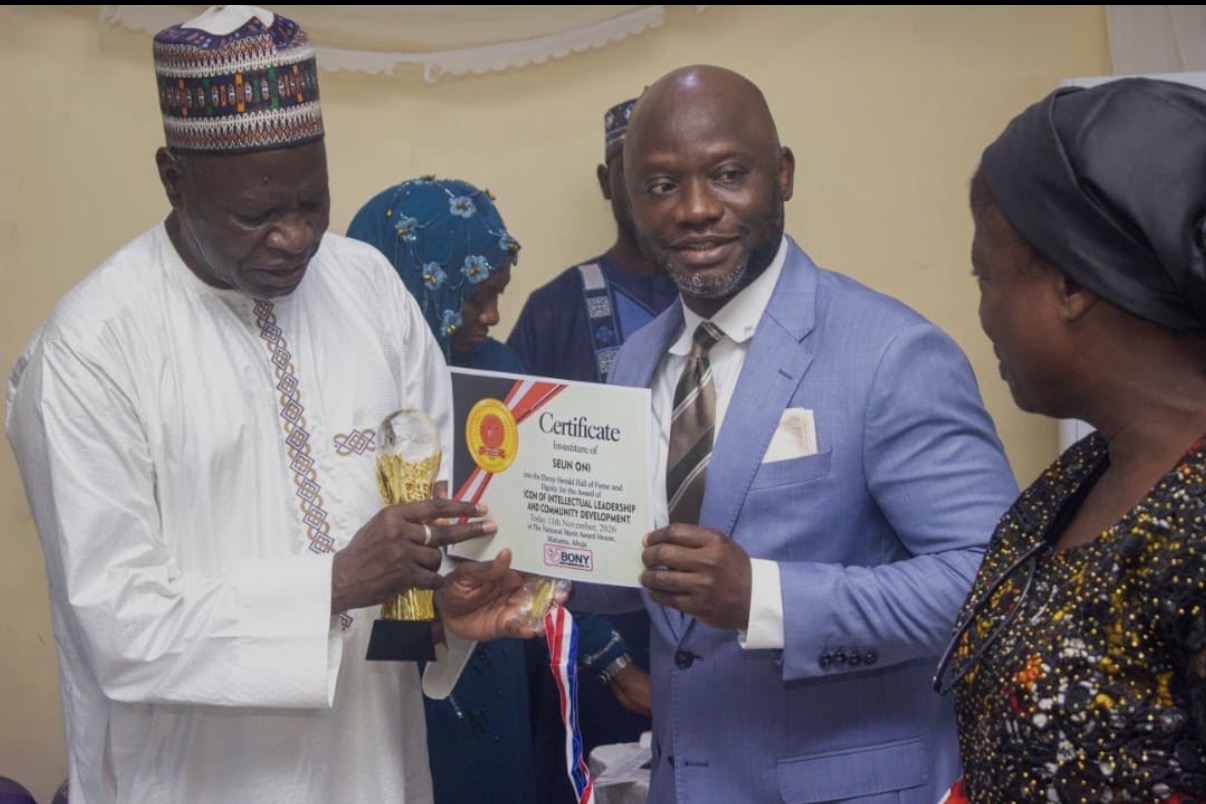
A corporate restructuring expert and traditional title holder, Seun Oni, has called for stronger institutions, ethical leadership and a renewed commitment to core values, saying Nigeria’s business sustainability challenges extend beyond economic factors such as inflation, exchange rates and government regulations.
Oni, the Oluomo of Erijiyan Ekiti, said integrity, competent management, transparency and accountability were essential to building sustainable businesses and institutions.
He spoke while reflecting on his recent recognition as Icon of Intellectual Leadership and Community Development at the Ebony Herald 2026 Lecture, describing the award as a renewed responsibility to contribute to knowledge sharing, ethical leadership and grassroots development.
With more than two decades of experience across the aviation, banking, oil and gas, and power sectors, Oni said Nigerian entrepreneurs had demonstrated remarkable resilience but needed both external and internal stability to preserve enterprise value.
He explained that while exchange rates, interest rates and regulatory policies influenced business performance, internal factors such as integrity, effective governance, operational discipline and competent leadership were equally important.
Oni also emphasised the role of humility and faith in achieving lasting success, describing what he called the “God factor” as an important dimension of outcomes that could not be fully explained by strategy, skill, effort or market conditions.
“Some may call it luck, but one of my professors at Wharton referred to it as the God factor. It encompasses outcomes that cannot be fully explained by strategy, skill, effort, or market conditions alone,” he said.
Reflecting on his professional journey, Oni traced his career from studying Computer Science at Obafemi Awolowo University to beginning his banking career at Standard Trust Bank in 1998.
He recalled that Tony Elumelu’s decision to assign him to Commercial Banking, despite recommendations for an information technology role, became a turning point in his career.
According to him, the experience reinforced the importance of recognising potential beyond academic qualifications when building effective organisations.
His subsequent exposure to AT&T Wireless in the United States during its merger with Cingular, alongside senior positions at Standard Chartered Bank, United Bank for Africa and First City Monument Bank, further shaped his leadership philosophy.
He said his executive education at Wharton and IMD Switzerland also strengthened his belief that sustainable organisations must be built on integrity, competence, transparency, accountability, effective communication and sound risk management.
On his 2016 conferment as Oluomo of Erijiyan Ekiti, Oni described the honour as a personal and humbling experience linked to his maternal lineage from the Odigbo kingmaker family of Erijiyan Ekiti.
He said traditional and corporate leadership shared a common responsibility of service, despite differences in their structures and functions.
Oni also highlighted his contributions to community development, including support for the multi-billion-naira Ijesaland Geriatric Centre, affiliated with the Obafemi Awolowo University Teaching Hospitals Complex, and the construction of the ultra-modern palace of the Owa Obokun of Ijesaland.
He explained that his support for the geriatric centre was influenced by his personal experience of taking his parents to Lagos for medical care before his mother died there.
He said the palace project was equally important because of its role in preserving cultural heritage and traditional institutions.
The corporate expert further disclosed that he had sustained annual outreach programmes for elderly women and Christmas celebrations for schoolchildren in Ilesa for more than 15 years.
He attributed his commitment to community support to his modest upbringing as the son of a cocoa trader, recalling how his family experienced financial difficulties during his childhood.
He said those experiences taught him the importance of generosity, compassion and sharing with others.
Advising young graduates, Oni urged them to combine strong academic foundations with practical skills, professional networking and good character.
He stressed that while competence could create opportunities, integrity and reputation determined long-term success.
“Your reputation becomes one of your most valuable assets. Guard it carefully,” he advised.
On Nigeria’s future, Oni expressed a desire for a country where opportunities were not determined by birthplace or personal connections, but where every child had access to quality education, healthcare and security.
He said national development required leaders to build strong institutions that would outlive their tenure, rather than concentrate solely on physical infrastructure.
He added that lasting national progress must begin with stronger families, responsible leadership and institutions capable of creating opportunities for future generations.