Nigeria’s broader economic transformation is under threat as its manufacturing sector struggles with high energy costs, supply chain inefficiencies, forex volatility, and limited access to finance, experts warn. Analysts say that unless structural reforms, technology adoption, and export-led strategies under the African Continental Free Trade Area (AfCFTA) are effectively implemented, the sector may fail to deliver the growth needed to drive national prosperity in 2026.
Data from the Manufacturers Association of Nigeria (MAN) and KPMG underscores the challenge. Manufacturing operates at below 50 per cent of installed capacity, while its GDP contribution has steadily declined from 9.2 per cent in 2018 to 8.6 per cent in 2024. Growth has remained sluggish, averaging just over 1 per cent in the past five years. Meanwhile, Nigeria’s manufacturing exports—currently a fraction of total exports—lag behind regional peers such as South Africa, Egypt, and Ghana.
Experts point to a persistent gap between policy announcements and enforcement. Executive Orders 003 and 005, which prioritised Made-in-Nigeria goods, were widely applauded but poorly implemented.
The current Nigeria First policy faces similar challenges, with Ministries, Departments, and Agencies continuing to favour imported products due to weak enforcement. “Without firm enforcement mechanisms and accountability, government procurement—potentially the largest guaranteed market for local manufacturers—fails to provide the intended stimulus,” noted analysts.
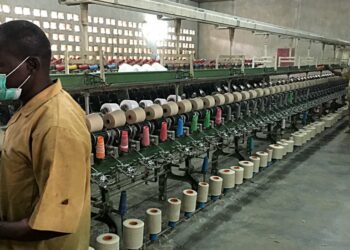
Cost competitiveness also remains a major hurdle. Manufacturers face rising energy tariffs, unreliable power, and poor transport infrastructure, making local goods more expensive than imports. The textile sector illustrates this vividly: locally-produced cotton fabrics struggle against cheaper polyester imports, leading to factory closures and job losses.
“Industries must deepen backward integration and cut debt reliance to ease forex pressure and high interest costs,” said Dr. Muda Yusuf, Director/CEO of the Centre for the Promotion of Private Enterprise (CPPE). PwC added that Nigerian businesses must leverage AfCFTA to diversify income, scale faster, and capture opportunities across high-growth African sectors.
The sector contributed just 9.1 per cent to GDP in 2025 and contracted by 2.4 per cent last year, costing businesses trillions of naira in lost revenue. Experts project that with strategic reforms, investment in technology and renewable energy, workforce upskilling, and export-led growth, manufacturing could expand by 15–20 per cent in 2026, potentially adding 1.5 percentage points to GDP.
PwC emphasised that companies must embrace export-led strategies under AfCFTA. “Businesses should make bold investment decisions in emerging African markets, including financial services, oil and gas, and ICT; adapt funding strategy to positive yields and FX outlook; explore export-led growth opportunities; embed digital and AI capabilities to lift productivity and reduce costs; and integrate tax into every strategic decision,” it said.
The firm urged businesses to review their 2026 business plan assumptions to incorporate extreme scenarios of macroeconomic shocks including energy shocks, capital flows reversals and 2027 election related risks.
PwC noted that there is need to recognise changing industry assumptions and pace of disruption to a current business model driven by regulatory, competition and technology changes and also embrace business model reinvention by rethinking how value is created, delivered and captured in response to changing customer needs and market dynamics.
It added that organisations should embed digital and AI capabilities across core operations to structurally lift productivity, reduce costs, and accelerate data-driven decision-making; actively monitor and contribute to policy discussions and systematically assess how new regulations and reforms will affect them, and integrate tax into every strategic decision, expansion, supply chain, and workforce planning.
Pwc further said that “as the Nigeria Tax Act aligns with global standards, businesses must adopt a proactive approach to ensure compliance, minimise risk, and maximise fiscal efficiency.”
Logistics inefficiencies also pose challenges. A logistics industry expert Mr Timothy Obiozor, said the biggest constraint for African manufacturers is not demand but financing and logistics. “If Nigerian firms cannot access affordable export finance and efficient port processes, AfCFTA benefits will be captured by countries with more efficient systems,”he warned.
The president of Lagos Chamber of Commerce and Industry (LCCI), Engr. Leye Kupoluyi, pointed out that “the challenge for 2026 is to move beyond stability and translate macroeconomic reforms into broad-based prosperity. A particular area of focus should be the intentional effort towards boosting credit to the private sector through the banks, even as we expect to see more rates easing by the Central Bank of Nigeria.
“With disciplined policy execution, enhanced security, infrastructure expansion, and a strong focus on inclusivity, Nigeria can make 2026 the year when the benefits of reform are finally felt by businesses and households alike.”
For Dr Muda Yusuf, business managers and owners need to prioritise to ensure resilience in 2026, by leveraging technology to reduce cost and ensure competitiveness. Yusuf also called on industries to deepen backward integration to reduce forex exposure, reduce debt financing and the burden of high interest rate.
He insisted on the adoption of efficient energy solutions to reduce the pressure of high energy cost.
Yusuf stated further that “Nigeria’s manufacturing revival hinges on managing structural risks while sustaining macroeconomic stability. If reforms in power, trade, and development finance are effectively implemented, the sector’s growth prospects and competitiveness will be significantly enhanced in 2026 and beyond.”
The director-general of Manufacturers Association of Nigeria (MAN), Mr. Segun Ajayi-Kadir, on his part, noted that “manufacturing remains the heartbeat of sustainable recovery and the catalyst for inclusive growth. No economy has ever prospered on consumption alone. Nations rise by producing what they consume and exporting what they produce.
With the federal government allocating about ₦500 billion to manufacturing incentives, experts say 2026 will be a make-or-break year. How effectively Nigeria leverages AfCFTA to expand exports, deepen regional value chains, and reduce structural costs will determine whether the country emerges as a continental manufacturing powerhouse or remains constrained by high costs and limited competitiveness.