
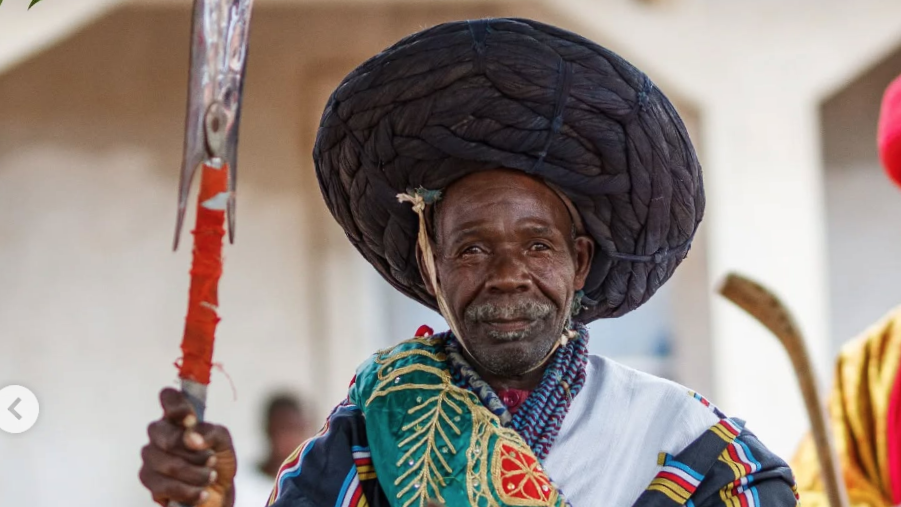
Gabriel Otu’s Riders of Resonance offers a distinctive lens on the Kano Durbar, privileging moments of pause over spectacle. Exhibited from November 27–29, 2024, at the Society for Nigerian Artists (SNA) Anambra Annual Exhibition, the series examines the Durbar not merely as a public event but as a psychological and bodily condition experienced by its participants.
In one striking image, a rider clad in layered green and white, his face partially veiled with lace, fills the frame. The tight cropping focuses attention on his guarded gaze, using concealment to suggest that ceremonial identity is both mediated and controlled. Another photograph presents a rider adorned with an expansive sculptural headpiece. Earth-toned textiles press against the picture plane, his calm yet fatigued expression reflecting endurance rather than display. Otu borrows from classical portraiture central framing, frontal address, yet resists grandeur, acknowledging status while quietly noting its demands.
A third work amplifies material density, with ornate embroidery and decorative horse trappings nearly overwhelming the rider beneath them. Here, excess is deliberate, demonstrating how ceremony both elevates and consumes. Across the series, Otu consistently avoids panoramic views, crowds, or contextual exposition. By narrowing his focus, he transforms a public ritual into intimate encounters, assuming the viewer possesses an understanding of the Durbar.
Texture and color operate as primary emotional registers. Coarse fabrics, polished leather, and metallic ornaments are rendered with tactile precision. Otu’s palette, deep greens, reds, whites, and earthy tones—balances historical resonance with contemporary restraint, lending an archival gravity without romanticization.
Otu’s work aligns with African photographers like Samuel Fosso and Rotimi Fani-Kayode, for whom portraiture negotiates identity rather than offering full disclosure. His riders are measured and deliberate, holding their ceremonial roles with quiet fortitude.
Ultimately, Riders of Resonance is a study in suspension: the Durbar persists not through spectacle, but through the presence and endurance of those who embody it. Tradition is enacted in stillness and responsibility, captured by Otu with psychological insight and compositional rigor.