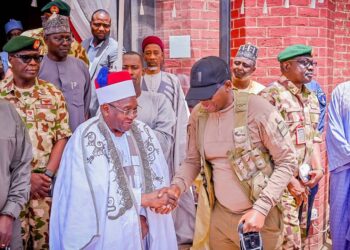

The Amanyanabo of Elem Kalabari, Alhaji Mujahid Asari-Dokubo, has said that he found peace and personal discipline in Islam, describing his conversion as the outcome of a long intellectual and spiritual journey.
Asari-Dokubo, also known as Da Amakiri Tubo, spoke with reporters on the final day of Ramadan, recounting his religious background, search for meaning, and eventual embrace of Islam.
He said he was raised in a deeply Christian environment, influenced by his grandmother, a devout Anglican who maintained a daily prayer routine and participated actively in church and traditional Kalabari religious practices.
According to him, religious activities were frequent during his upbringing, including daily devotions and participation in church programmes. Despite this, he said, he gravitated toward the Baptist Church rather than Anglicanism and became actively involved as a youth member and Sunday school teacher.
He noted that he also attended Deeper Life Bible Church and later emerged as president of the Students Christian Movement at Baptist High School in Port Harcourt. He said he however remained spiritually unfulfilled.
Asari-Dokubo identified the 1982 Sabra and Shatila massacre during the Lebanon War as a turning point that led him to question his Christian faith. He said he wrote to Deeper Life founder, William Kumuyi, asking why God would favour one group over another.
He said the question marked the beginning of his gradual disengagement from Christianity.
In the years that followed, he explored other belief systems, including a brief encounter with Islam in Port Harcourt, which he said did not immediately lead to conversion due to limited guidance at the time.
While studying at the University of Calabar, he returned to Christian fellowship and became prominent in the Baptist Students Fellowship. He also joined the Movement for a Progressive Nigeria, a Marxist-Leninist student group, but said it did not provide spiritual satisfaction.
Asari- Dokubo cited the Iranian Revolution as a major influence that deepened his interest in Islam, prompting extensive reading and research. He said he relied on available materials, including encyclopaedias and books sourced locally.
He said he eventually converted to Islam on September 17, 1988, at the Bokobiri Mosque in Calabar.