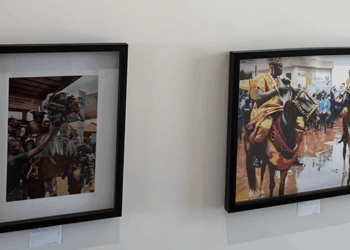
In Hustle & Grace – Portraits from the Streets of Lagos, photographer Gabriel Otu turns ordinary street enterprise into a compelling study of balance, resilience and quiet dignity. Exhibited in People and Places at the Ikom Gallery Collaboratory, Calabar (5–30 September 2022), the series marks a reflective homecoming for the Cross River–born artist, who revisits Lagos not as spectacle but as a living, breathing organism shaped by its people.
Shot along the city’s crowded traffic corridors, Otu’s portraits elevate familiar scenes of informal commerce, bottled drinks, roasted nuts, sachet water, into visual meditations on endurance. Rather than chase the chaos of Lagos, he slows its pulse, revealing the poise, discipline and artistry etched into the routines of vendors who keep the city afloat.
Everyday Labour, Monumental Presence
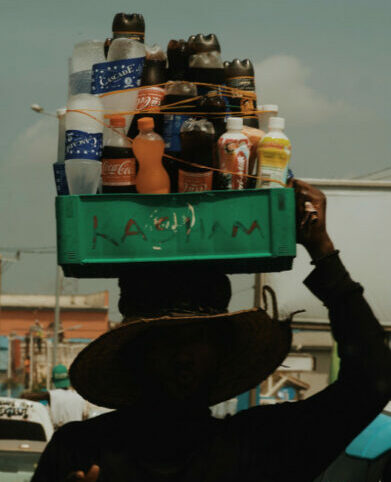
Otu’s most striking images depict his subjects mid-stride, balancing goods with an almost sculptural precision. In one photograph, a tower of drinks rises from a vendor’s head like an improvised skyline. His silhouette, partially hidden, shifts the viewer’s attention away from individual identity toward the shared experience of Lagos’s informal workforce.
A second image, featuring a nut seller in muted teal, softens the city’s edges. Her inward gaze, harmonizing with the pale sky, distills a moment of rare calm, an interior life briefly visible within the city’s relentless movement.
A third portrait shows a young water seller paused amid gridlocked traffic. Sunlight grazes his face; dust settles on his shirt. There is no sentimentality here, only a clear-eyed depiction of determination in a city where aspiration is both burden and fuel.
A Painterly, Cinematic Eye
While the scenes are wholly rooted in the real, Otu’s sensibility remains unmistakably fine-art. Warm palettes, sculptural shadows and carefully controlled natural light lend the images a painterly intimacy. His use of selective focus creates pockets of stillness within the urban rush, granting his subjects a contemplative presence rarely associated with street labour.
This visual approach places him alongside a growing generation of African photographers, Andrew Esiebo, Yagazie Emezi, Aisha Augie-Kuta, who are reframing everyday life with emotional nuance and formal clarity.
Seeing the City Through Its People
What anchors Hustle & Grace is its commitment to visibility. Street vendors, though essential to the rhythm of Lagos, often remain unseen in cultural narratives. Otu challenges this by granting them the composure and dignity traditionally reserved for formal portraiture.
His photographs highlight three intertwined ideas:
· Labour as choreography—the body balancing economy, gravity, and survival.
· Human agency in urban flux—people shaping the city as much as it shapes them.
· The vitality of informal economies—not as a deficit, but as creativity and endurance.
Without moralising, Otu allows the quiet heroism of everyday hustle to emerge naturally from the frame.
A Refined Contribution to Contemporary African Photography
More than documentation, Hustle & Grace functions as a living archive of Lagos’s human architecture, its vendors, its rhythms, its improvisational instincts. As part of Otu’s homecoming exhibition in Cross River State, the series bridges personal memory with regional identity, offering a Lagos defined not by scale but by people.
Through disciplined composition and an unmistakable tenderness toward his subjects, Otu turns the familiar into images of lasting cultural weight. In doing so, he strengthens his position among the most attentive visual storytellers of his generation.