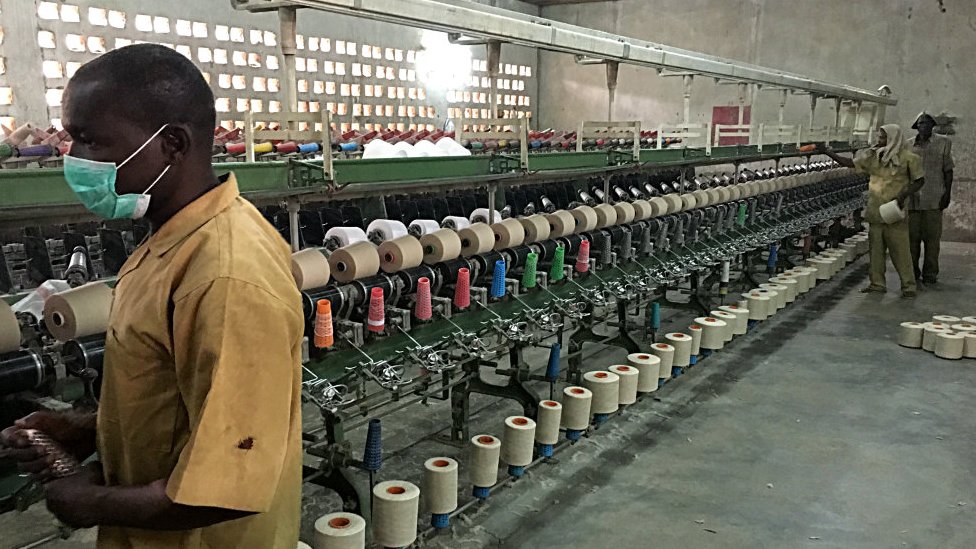
Across Nigeria’s industrial corridors, a growing number of factories are turning into “ghost plants” — production facilities operating far below capacity or standing idle — underscoring the mounting pressures confronting a sector expected to power the country’s industrial transformation. An industry once seen as the backbone of the country’s industrial ambitions.
Data released by the Manufacturers Association of Nigeria (MAN) show that capacity utilisation — a key indicator of how much installed machinery and factory space are actually used — improved slightly to 61.3 per cent in the first half of 2025, from 57.6 per cent in the second half of 2024. Yet the marginal improvement masks a more troubling reality: nearly four out of every 10 factories remain under-utilised, with large portions of installed production capacity sitting idle.
The situation reflects a sector caught between weak consumer demand and sharply rising production costs, a combination that has forced many manufacturers to scale down operations.
In 2024, the value of unsold manufactured goods surged by 87.5 per cent to ₦2.14 trillion, up from about ₦1.14 trillion in 2023, according to MAN. The surge signalled deteriorating consumer purchasing power as inflation eroded household incomes, leaving factories with mounting stockpiles.
The inventory pressure has persisted. By the first half of 2025, unsold goods still stood at ₦1.04 trillion, underscoring the lingering demand constraints facing the sector nearly two years after inventories first began climbing sharply.
Across Nigeria’s key industrial corridors — Lagos, Ogun, Aba, Kano and Kaduna — manufacturers say production schedules have been trimmed as companies attempt to prevent further build-up of unsold stock. In several cases, factories have reduced operating shifts or temporarily shut down some production lines.
The broader performance indicators for the sector also reveal underlying fragility. While the nominal value of manufacturing output jumped 34.9 per cent to ₦33.43 trillion in the second half of 2024, much of the increase reflected price inflation rather than stronger production volumes.
In real terms, manufacturing output expanded by only about 1.7 per cent in 2024, highlighting the sector’s limited physical growth despite the apparent surge in value.
Employment and financing trends further illustrate the stress within the industry. In the first half of 2025, manufacturers shed about 18,935 jobs, a sharp increase from roughly 10,891 job losses recorded in the same period of 2024.
At the same time, access to finance has tightened significantly. Average lending rates climbed to about 36.6 per cent, while total credit to manufacturers declined to ₦7.72 trillion, raising borrowing costs and limiting the ability of firms to expand production or modernise equipment.
Energy remains one of the sector’s most punishing cost pressures. With electricity supply from the national grid unreliable, manufacturers increasingly depend on diesel-powered generators, pushing operational costs sharply higher and eroding already thin profit margins.
Foreign exchange constraints have compounded the challenge. Persistent volatility and limited access to dollars continue to disrupt the importation of critical raw materials and machinery, particularly for industries such as pharmaceuticals, electronics and heavy manufacturing that depend heavily on imported inputs.
Structural bottlenecks across the logistics chain further strain operations. Port congestion, high transportation costs and multiple taxation regimes continue to weigh on manufacturers’ balance sheets, undermining efficiency and competitiveness.
In response, many firms have accelerated efforts to source more inputs locally. MAN data show that local sourcing of raw materials increased to 57.1 per cent in 2024, from 52 per cent in 2023. While the shift reflects an effort to reduce exposure to foreign exchange shocks, industry operators say local alternatives often remain insufficient to replace specialised imported inputs.
Industry leaders warn that without decisive policy intervention, the manufacturing sector’s struggles could deepen.
Segun Ajayi-Kadir, director-general of MAN, said stabilising the operating environment is critical to restoring productivity and growth, urging government action to improve energy reliability, foreign exchange access and credit availability.
Francis Meshioye, president of MAN, said persistent inflation, exchange-rate volatility and rising energy tariffs continue to squeeze manufacturers’ margins and undermine their ability to expand production.
Economists have echoed those concerns. Muda Yusuf, chief executive officer of the Centre for the Promotion of Private Enterprise (CPPE), described weak capacity utilisation as evidence of deeper structural problems facing Nigeria’s industrial sector.
Similarly, Dele Oye, president of the Nigerian Association of Chambers of Commerce, Industry, Mines and Agriculture (NACCIMA), warned that sustained manufacturing constraints could undermine the country’s economic diversification ambitions.
Economist Dr Geoffery Imole, told NATIONAL ECONOMY that improved infrastructure and macroeconomic stability are prerequisites for long-term industrial expansion.
According to him, a strong manufacturing base is essential for job creation and inclusive growth, while
Also commenting, Development Economist Dr Godwin Igwilo, argued that coordinated fiscal and policy reforms were necessary to restore investor confidence and unlock manufacturing investment.
The persistence of idle capacity comes at a time when Nigeria’s broader economy is sending mixed signals. Expansion in services and agriculture has helped sustain overall economic growth, with non-oil activity pushing GDP growth close to 4 per cent toward the end of 2025.
Manufacturing, however, has lagged behind — weighed down by cost pressures, financing constraints and fragile demand.
As Nigeria moves deeper into 2026, the sector faces a stark reality: high production costs, weak consumer purchasing power, limited access to affordable credit and structural inefficiencies continue to constrain factories that should be driving industrial output, exports and employment.
For many industry operators, the spread of idle plants and under-utilised machinery has become a defining feature of the current landscape — a stark reminder that without bold policy action, Nigeria’s industrial ambitions risk remaining overshadowed by the growing spectre of ghost factories.

Monday, March 30, 2026
Manufacturers Decry 40% Idle Capacity, Surging Unsold Goods