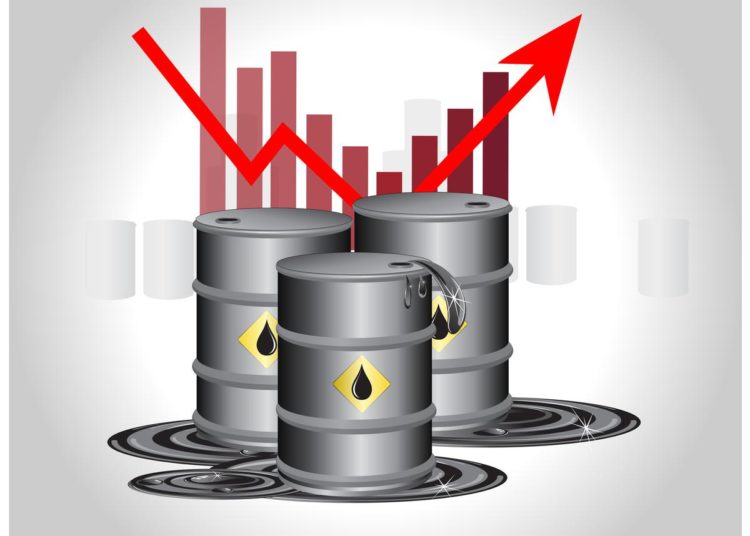
The surge in oil prices amid the US and Israel’s war on Iran is expected to improve the current account balances of Nigeria, both global and local industry analysts have predicted.
If oil stays at about $85 a barrel, Nigeria will see their current account balance improve, Bloomberg Economics Yvonne Mhango wrote in a report.
According to a report by Bloomberg Economics report, the rise in oil prices will strengthen the current account positions of the country.
Yvonne Mhango, said if oil “stays at about $85 a barrel, Nigeria among other countries in the sub-region will see their current account balance improve.
“For most African economies, higher oil prices mean weaker currencies and renewed inflationary pressure, which could put rate hikes back on the table,” she said.
According to the publication, inflation will be the biggest risk for most nations.
Citing Central Energy Fund data, Bloomberg Economics said in South Africa, fuel costs are set to increase in April, while traders move to price in a chance of an interest-rate hike later this month.
According to the publication, South Africa will see its current account balance hit by 1 per cent of gross domestic product (GDP).
Bloomberg Economics said Angola’s current account balance could benefit by as much as 3.3 percent of GDP, noting that Nigeria will not only gain from crude sales, but also fuel exports.
Also, analysts in Nigeria share similar opinions saying that the Middle East crisis presents a mixture of economic fortunes for the country.
In a swift move to ensure minimal economic backlash the Finance Minister Wale Edun convened the Economic Management Team to review how the U.S.-Israeli conflict with Iran could affect oil prices, capital flows and logistics costs.
The government is monitoring escalating tensions in the Middle East as it assesses potential risks to the country’s economic stability, the finance ministry said.
During the review session, the ministry said volatility in global energy markets, including possible disruptions around the Strait of Hormuz, is already pushing up crude prices and could raise domestic costs for fuel, diesel, cooking gas and fertiliser.
It warned that sustained instability may add pressure on inflation and living costs. Officials are tracking crude price movements, exchange rate pressures, capital flows, fiscal risks and reserve levels.
Nigeria enters the period with strengthening fundamentals, the ministry said, citing 4.07 per cent Gross Domestic Product (GDP) growth in the fourth quarter of 2025.
The Government said it will keep policies under review to shield households and businesses and maintain investor confidence.
Blaiz Udunze, a public affairs analyst in an opinion shared with NATIONAL ECONOMY, said that Nigeria, is getting a temporary fiscal boost, knowing fully well that prices now surpass the benchmark used in the 2026 national budget. The high oil prices gain is further amplified by two major domestic policy shifts, as the first is the removal of fuel subsidy projected to free nearly $10 billion annually for public investment, and a new Executive Order by President Bola Tinubu aimed at boosting oil and gas revenues flowing into the Federation Account by eliminating wasteful deductions allowed under the Petroleum Industry Act.
The combination of these developments could significantly increase government revenue over the next few years, but history shows that such windfalls, if not well managed, often go toward short-term spending rather than creating lasting national wealth.
Also, Kunle Odusola-Stevenson in a position shared with our correspondent, said the current crude oil price surge offers a potential fiscal reprieve for Nigeria.
According to him, If Brent prices remain near $80–$90 per barrel over the coming months and Nigeria manages to lift output modestly, and supported by deepwater developments such as the Egina field, the country could realise an additional $10–15billion in revenue over the next year.
For an economy navigating currency volatility, high debt service and stubborn inflation, such an inflow would be significant. It could strengthen foreign reserves, ease pressure on the naira and create room for targeted investment.
However he said, “Higher oil prices also feed into domestic inflation through transport costs and imported fuel. Petrol prices, already elevated after the removal of subsidies, could rise further, placing additional strain on households.
“The broader question therefore is not whether Nigeria will benefit from higher oil prices, but whether it will manage the proceeds differently this time.”
Meanwhile the surge in petrol prices close N1,300 per litre across the country has once again exposed the fragile foundations of the country’s economic structure. Reports indicating that businesses are bracing for a new inflation shock following adjustments in fuel prices have reignited a familiar national debate about the sustainability of Nigeria’s energy policies and the broader implications for economic stability. For many Nigerians already grappling with rising food prices, stagnant wages, and declining purchasing power, the latest increase represents more than just another market adjustment; it signals the deepening pressures within an economy struggling to find equilibrium.
Fuel prices occupy a critical position within Nigeria’s economic ecosystem and unlike many commodities whose impact may remain confined to specific sectors, petrol functions as a foundational input that influences nearly every aspect of economic activity.
From transportation and manufacturing to agriculture and retail distribution, fuel costs shape the operational realities of businesses and the daily lives of ordinary citizens. When petrol prices rise, the effects cascade rapidly through the economy, triggering increases in transportation fares, food prices, production costs and service charges.
The current development appears to have been triggered by an adjustment in the ex-depot price of Premium Motor Spirit by the Dangote Refinery, which reportedly raised its gantry price to approximately N1,175 per litre. This adjustment has translated into pump prices approaching N1,300 in several filling stations across the country. For businesses operating within Nigeria’s already volatile economic environment, such increases represent a significant escalation in operational costs.
Earlier, at the beginning of the war, the Chairman of Shoreline Group, Kola Karim, raised concerns that if attacks on Iran and counter-attacks sustains for the next four to five weeks as predicted by President Trump, the effect could be very dangerous for oil and gas supply chains and the global economy at large.
Karim, therefore urged Nigerian authorities to focus on developing natural resources and positioning as a dominant player to fill supply gaps near-term.
He said that as geopolitical tensions grip the oil-rich Middle East, global oil supply chains hang in the balance with potential for disruption unprecedented in recent years.
Karim, warns of the significant impact ongoing attacks in Iran and subsequent counteractions could have on the global economy. With U.S. President Donald Trump’s hints of sustained military actions, the coming weeks may see oil and gas markets reeling under pressure.
The consequences of crude price hikes in the international market has trickled down to regular review of pump price of petrol across the country.
Last Monday, many petroleum products dispensing outlets in Lagos shut their gates against motorists as crude prices rose again fueling fears of upward adjustment of petrol prices by marketers.
Marketers responded to anticipated increase by closing operations.
Dangote Petroleum Refinery reacting to crude price hike instantly increased the price of petrol, making it the third upward adjustment within a week.
Dangote Refinery made the announcement of the price hike to marketers, raising the gantry price of Premium Motor Spirit (PMS) also called petrol to N1,175 per litre from N995 per litre announced on Friday.
This represents an increase of N180 or about 18.1 per cent within three days.
The refinery equally revised the gantry price of Automotive Gas Oil (AGO) commonly known as diesel, to N1,620 per litre.
Recently, the refinery increased its PMS to N995 per litre, up from N874 at the weekend, a hike that has pushed fuel pump price to above N1,000 per liter nationwide.
The adjustment has also moved up transportation fare in parts of the state.
Passengers said the fare from Agege to Sango, which used to be N1,000, has risen to N1,200 while a trip from Oshodi to the airport now costs between N400 and N500, up from N300.
From NAHCO to Ikeja, fares have moved from N300 last week to N400.
On the National–Oshodi route, fares have increased from N200 to N300, though some buses still charge the old rate.
At Conoil station in Ikeja, attendants said sales had been suspended pending a new price decision. “Those who will determine the price have not met. Until tomorrow we start selling again,” one attendant explained.
Along the Lagos–Ibadan expressway, Julanky and Rabade stations also stopped selling.
A worker at Julanky in Arepo said they had been ordered to shut down but might resume later in the night, adding that prices would be adjusted though the new rate was not yet disclosed.
Meanwhile, Nipco station on the Lagos–Ibadan expressway has raised its pump price to N1,240 per litre, from N1,019, while MRS in Ota sells for N1250/ litre.
There are also significant concerns that a prolonged conflict could disrupt global markets, causing equity corrections and broadly instability in the Middle East would negatively impact economic growth in the region and if the conflict de-escalates, the market positioning would likely reverse, with investors selling oil and the U.S. dollar, leading to a stabilisation of risk assets.
An energy lawyer and oil industry analyst, Chukwuebuka Ibeh, speaking with our correspondent highlighted benefits the conflict brings to producer nations especially those outside the conflict environment.
According to Ibeh, From an industry perspective, geopolitical tensions around Iran tend to quietly benefit producers outside the conflict zone. Higher uncertainty in the Middle East usually drives oil prices up, which means exporting countries like Nigeria can earn more from crude sales.
“In that sense, Nigeria is a potential short-term winner. More interestingly, the Dangote Refinery could emerge as one of the silent beneficiaries. With global supply disruptions and rising refined product prices, a large domestic refinery positioned to supply both Nigeria and West Africa gains strategic relevance and profit.
“On the other hand, the biggest losers are oil importing economies. If tensions escalate, freight costs, insurance premiums, and product prices all rise. So while the conflict creates pressure globally, players with alternative supply capacity like Nigeria’s emerging refining sector may quietly find themselves in a stronger position, even though the common citizen will suffer the surge in price,” he argued
Another analyst, Yomi Falana, Chairman and Chief Executive Officer (MD/CEO) of Falcore Power & Energy Limited, said the period for Iran Oil War will depend on the situation at the Strait of Hormuz where virtually all of the marine Vessels moving oil exports from the Middle East countries pass through on daily basis.
Falana, pointed out that scenario we face right now is that international oil prices has risen from $78/barrel price before the start of the Iran/US/Israel War to $95/barrel since the Strait of Hormuz has ceased to operate for fear of terrorist attacks on the marine oil tankers.
The announcement by President Donald Trump that he will soon secure the Strait of Homuz for safety of marine vessels, impact on reduction in international oil prices to a lower price of $78/barrel.
He affirmed that “The gaineers are the crude oil producers and Consignors in other Countries outside the Middle East that are now selling their crude oil at $95/barrel to Refineries.
“The losers are those at the Consumers who are buying refined petroleum products at a higher cost in the pump stations.”
Furthermore, all the countries will have to contend with high inflation rates on goods and services, Falana said and said that Governments of Countries will have to introduce some fiscal measures to keep inflation under control so that prices of goods and services are not over the roof as this may have a knock knock on effects on the value of the currency.
Already the crisis has caused an immediate rise in fuel prices globally as production and transport of oil and gas across the region has slowed or stopped entirely in many cases.
The chief executive officer of the Centre for the Promotion of Private Enterprise (CPPE), Dr. Muda Yusuf, specifically warned that the escalating conflict involving Iran, Israel, and the United States poses significant inflationary risks to the Nigerian economy. While the crisis may boost oil revenue, it is expected to trigger a “double-edged shock” characterized by high energy costs, increased logistics expenses, and intensified, widespread inflation.
According to Yusuf, Because Nigeria operates a deregulated downstream petroleum sector, rising global crude prices (which have surged above $80 per barrel) are quickly transmitted to domestic fuel prices.
He also raised concerns that elevated energy costs (petrol, diesel, gas) are expected to drive up production, logistics, and transportation costs, which will likely be passed on to consumers.
The resulting inflation may force the Central Bank of Nigeria (CBN) to adopt a tighter monetary policy regime, leading to higher interest rates and reduced credit for businesses.
He stressed that while Nigeria may see a boost in foreign exchange earnings from higher oil prices, these gains could be eroded by the high cost of imported petroleum products and overall economic instability.
He noted that while the crisis could boost Nigeria’s oil earnings in the short term, the broader implications for inflation, interest rates, and global trade remain worrying.
“The outbreak of war between Israel and Iran has added a troubling dimension to the challenges of an already floundering global economy,” Yusuf said.
The CPPE therefore advised that the ultimate impact will depend on policy responses, including strengthening oil production capacity, building fiscal buffers, and implementing targeted social protection to cushion vulnerable households.
Yusuf, also advised the Government to broaden its energy initiatives will encourage domestic refining through a coordinated mix of trade policy, fiscal policy and monetary policy measures.
The Center listed key priority areas that Government should focus on to achive the desired impact.
In a policy brief made available to our correspondent, Yusuf, urged the Government to pursue the policy that will ensure reliable crude supply arrangements, strengthen petroleum distribution infrastructure, introduce tariff protection and also encourage additional refining investments.
All of these will also be supported with a broader plan that will promote export competitiveness for refined petroleum products.
Yusuf, implied that while domestic refining may not completely eliminate the effects of global oil price volatility, it significantly reduces the risks of supply disruptions, conserves foreign exchange, strengthens the balance of trade, and enhances national energy security.
In this regard, domestic refining represents a strategic pillar for improving Nigeria’s economic resilience and long-term energy sustainability, he said.
He said that beyond fuel supply, domestic refining generates substantial industrial and economic multiplier effects.
Refineries, he noted produce a wide range of intermediate products that serve as feedstock for industries such as petrochemicals, fertilizers, plastics, pharmaceuticals, paints and other chemical-based manufacturing sectors.
These linkages help strengthen Nigeria’s industrial ecosystem and promote deeper value addition within the economy.
The refining industry also stimulates economic activity across the petroleum value chain, including storage, transportation, distribution, marketing and retail operations, thereby creating jobs and supporting broader economic growth.
He added that, “Given the strategic importance of domestic refining to Nigeria’s energy security, external sector stability and industrial development, it is essential that the policy environment remains supportive of investment in the sector.”
According to him, Higher oil prices may strengthen fiscal and external balances in the short term, adding “However, inflationary pressures, welfare deterioration, capital flow volatility, and global growth risks pose significant countervailing threats.
The ultimate impact will depend less on external events and more on domestic policy discipline, he said in a policy brief.
He said, “Strategic savings, production efficiency, macroeconomic prudence, and structural diversification will determine whether Nigeria converts geopolitical turbulence into macroeconomic resilience.”
Yusufu, warned that the escalating conflict involving Iran, the United States, and Israel has injected a new wave of geopolitical risk into the global economy and energy markets are the first transmission channel.
“Of particular strategic importance is the Strait of Hormuz, through which roughly 20 percent of global crude oil supply is transported daily. Any disruption to this corridor has immediate implications for global oil prices, shipping costs, insurance premiums, and supply chains. There is also the output disruption effect, as Middle East countries are major oil producers.” he said.
For Nigeria, an oil-dependent economy where crude accounts for over 85 per cent of export earnings and about half of government revenue, the implications are significant, Yusuf pointed, noting ‘The effects will be both positive and adverse, depending on the duration of the conflict and the quality of domestic policy responses.’
In his analysis the geopolitical tensions in the Middle East historically trigger sharp increases in crude oil prices due to fears of supply disruptions.
Even speculative risks around the Strait of Hormuz typically generate price volatility of $5–$15 per barrel within short periods.
For Nigeria, every increase in crude oil price translates into additional export earnings and fiscal revenues.
The immediate benefits include, higher crude export receipts, improved foreign exchange inflows, strengthening of external reserves and increase in FAAC allocations to all tiers of government
However, he argued that revenue gains are critically dependent on production levels. “Nigeria’s current crude output has fluctuated around 1.4–1.6 million barrels per day, below installed capacity and vulnerable to oil theft, pipeline vandalism, and underinvestment in upstream infrastructure. Without a sustained improvement in production efficiency and security, Nigeria may not fully optimise any price windfall.
There is also a medium-term risk. If the conflict escalates and dampens global growth, oil demand could weaken, leading to price corrections. The fiscal upside is therefore inherently fragile.” he warned.
He further noted that higher oil prices typically strengthen Nigeria’s current account balance and improve foreign exchange liquidity and this could reduce short-term pressure on the naira and reinforce investor confidence.
In recent years, exchange rate stability has been closely tied to oil receipts and capital inflows.
He noted that improved export earnings could boost gross external reserves, enhance FX market liquidity and reduce speculative pressure on the currency
“However, geopolitical instability also triggers global risk aversion. During periods of uncertainty, capital tends to migrate toward safe-haven assets such as U.S. Treasury securities and gold. Emerging markets frequently experience portfolio outflows in such episodes.
“Given Nigeria’s relatively shallow capital market and sensitivity to foreign portfolio investment, volatility in global financial conditions could offset part of the FX gains from higher oil prices. The net exchange rate impact will therefore depend on the balance between stronger oil inflows and potential capital reversals.” he stated.
Yusuf, posits that Nigeria operates a deregulated downstream petroleum regime and higher international crude prices feed directly into higher petrol, diesel and aviation fuel costs.
The likely channels include, rising pump prices, increased transportation/logistics costs, higher food distribution expenses and escalating manufacturing and logistics costs
He said ,Energy costs have a strong multiplier effect in Nigeria’s inflation dynamics. “Transportation and food prices account for a significant share of consumer expenditure. With purchasing power already fragile, sustained increases in fuel prices could intensify cost-of-living pressures and deepen poverty levels.
“Thus, while government revenues may rise, household welfare could deteriorate—creating a divergence between fiscal gains and social outcomes.”
The CPPE therefore recommended Government strengthen oil production capacity, intensify anti-theft operations and incentivize upstream investment to maximise output within OPEC limits.
Yusuf, also called for firming up fiscal buffers and channel excess revenues into stabilization and sovereign savings frameworks.
Other recommendations include the deepening of domestic refining to reduce vulnerability to imported refined products, enhance transparency and liquidity in the foreign exchange market to mitigate volatility, cushion vulnerable households against energy-driven inflation shocks and expand non-oil exports, manufacturing, agro-processing, ICT, and services to reduce external vulnerability.
Also, the Petroleum Products Retail Outlets Owners Association of Nigeria (PETROAN) in advised to insulate the country from the consequences of the conflict tasked the Nigerian National Petroleum Company Limited (NNPC Ltd.) to urgently strengthen domestic refining capacity as a strategic step to shield Nigeria from global petroleum market shocks.
PETROAN specifically called on the Group Chief Executive Officer, Engr. Bayo Ojulari, to facilitate the immediate commencement of production at Nigeria’s local refineries, particularly the Area 5 Plant at Port Harcourt Refinery and the Warri Refinery, both of which previously operated briefly before shutdown for profit index evaluation.
The national president of PETROAN, Billy Gillis-Harry, pointed out that the ongoing conflict involving Israel, the United States, and Iran is pushing global petroleum prices to alarming levels. Sustained drone and missile attacks now threaten critical oil routes and infrastructure, creating uncertainty in global supply chains.
He noted that with no clear end to the conflict, petroleum product prices in both international and domestic markets are expected to rise sharply in the coming days.
He explained that before the crisis, Premium Motor Spirit (PMS) sold at ₦774 per litre but now sells above ₦1,000 per litre, representing an increase of about 30%.
Automotive Gas Oil (AGO), also known as diesel, previously sold at ₦950 per litre but has risen to ₦1,400 per litre and above, an increase of about 49%.
Projecting future trends, he warned that PMS could rise close to ₦2,000 per litre while AGO may approach ₦3,000 per litre if the situation persists.
He emphasized that rehabilitating Nigeria’s refineries for immediate domestic production is critical. Local refining, he said, would reduce exposure to international market volatility, especially as Nigeria has abundant crude oil resources under the custody of NNPC Ltd.
He added that government-owned refineries are less vulnerable to global supply disruptions compared to privately owned refineries dependent on imported crude.
The PETROAN President warned that continued fuel price increases would worsen inflation, cause job losses, deepen economic hardship, increase transportation costs, and raise prices of goods and services nationwide. PMS remains essential for daily mobility, while AGO is vital for manufacturing and industrial operations.
He assured Nigerians that President Bola Ahmed Tinubu reform policies will ultimately bring relief to citizens and stimulate economic growth.