
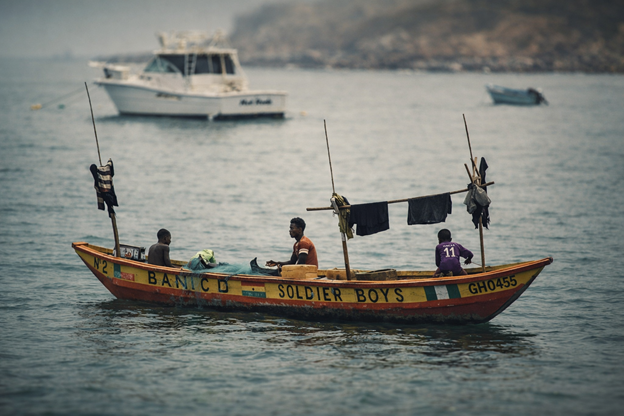
Olakunle Bolawa’s Soldier Boys, presented during the Society for Nigerian Artists Exhibition at the Kenneth Dike State Library, Awka 28–30 November 2025, unfolds as a restrained yet incisive meditation on labour, kinship, and collective survival along the West African coast. Working within the discipline of fine art photography, Bolawa moves beyond documentary description to construct images that function as studies in shared form, repetition, and endurance.
At first encounter, the photographs appear direct: fishermen at sea, boats edging toward shore, nets drawn from turbulent water. Yet Bolawa’s sustained attention to structure quickly disrupts any purely journalistic reading. His images insist on duration and return, asking the viewer to consider how meaning is generated through repeated gestures and collective effort rather than singular events.
The titular work, Soldier Boys (all works cited, 2022), centres on a wooden fishing boat adrift in open water, its name painted plainly along the hull. The title reframes the figures it names. These are not soldiers of aggression or conquest, but custodians of continuity—young men navigating environmental uncertainty and economic precarity. Clothing strung across makeshift supports cuts horizontally through the frame, introducing a fragile architecture that counters the immensity of the sea. These suspended garments operate almost as sculptural elements, marking presence, labour, and vulnerability in equal measure.
In subsequent photographs, Bolawa returns the viewer to the shoreline. Fishermen stand knee-deep in surf, hauling a heavy net in tightly coordinated motion. The net becomes the series’ most insistent formal and conceptual device: a drawing in space that binds bodies into a single distributed form.
Individual identity recedes as hands, torsos, ropes, and water interlock. Bolawa’s framing privileges horizontality, the line of the shore, the stretched net, the alignment of bodies, suggesting order without rigidity, structure shaped by necessity rather than design.
What distinguishes Soldier Boys is its refusal of spectacle. Bolawa neither romanticises nor dramatizes hardship. Instead, his photographs emphasise continuity: the time required to pull a net ashore, the repeated negotiation with tides whose generosity is never assured. The sea functions not as metaphor alone, but as an active collaborator, exerting pressure on every action and every frame. Its surface alternates between calm and resistance, mirroring the unstable conditions under which these communities persist.
Within the context of contemporary Nigerian photography, Soldier Boys positions itself at an intersection of social realism and formal restraint. Bolawa avoids isolating heroism or individual struggle, insisting instead on collective presence. Kinship here is not sentimental but operational, produced through shared labour, synchronised movement, and mutual reliance.
Taken together, the photographs read as a study in collective form. Like the nets they depict, their strength emerges through interdependence and tension rather than singular emphasis. Soldier Boys affirms that survival, like artistic meaning, is rarely solitary, and that community is continually remade through the rhythms of work, water, and return.