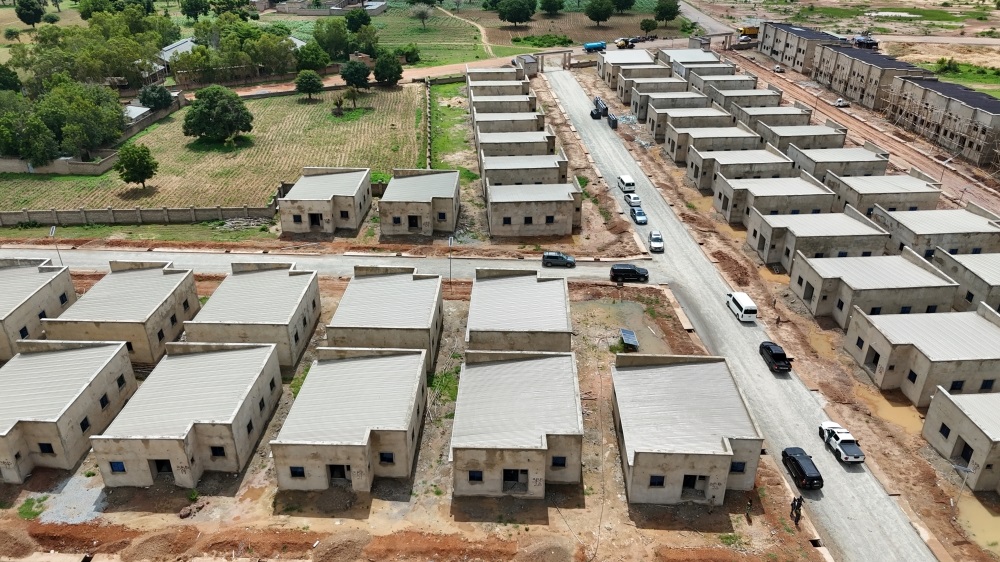
Nigeria’s worsening housing crisis is being compounded by a maze of land bureaucracy that experts say is frustrating investors, delaying housing delivery and pushing home ownership beyond the reach of millions of citizens.
Stakeholders in the housing sector reveal that delays in obtaining Certificates of Occupancy (C-of-O), Governor’s Consent, land registration approvals and multiple charges imposed by state governments are discouraging real estate investments and slowing down construction projects nationwide.
They warned that unless urgent reforms are carried out in land administration, Nigeria’s ambitious housing delivery targets may remain unattainable despite growing demand and government promises under the Renewed Hope Housing Agenda.
The concerns come amid recent disclosures by the Federal Ministry of Housing and Urban Development that over 90 percent of land in Nigeria remains unregistered, a development the ministry said has trapped more than $300 billion in “dead capital” that cannot be used to access finance or drive economic growth.
Immediate past president of the Nigerian Institute of Quantity Surveyors (NIQS), Kene C. Nzekwe, in a telephone conversation with our reporter from Kaduna, described Nigeria’s land administration system as outdated, corruption-prone and heavily tilted against citizens and investors.
According to him, bureaucratic inefficiencies and archaic procedures embedded in the Land Use Act have continued to weaken investor confidence in the housing sector.
“The outdated land administration system has continued to undermine investor confidence in the housing sector,” he said.
“The land administration crafted to be in the hands of the government has increased bureaucratic procedures that are marred by corruption. This has continued to erode investment and slow private sector involvement in housing development.”
Nzekwe argued that while the Federal Capital Territory (FCT), has made progress through its digitised land administration platform, AEGIS, many states still operate largely analogue systems vulnerable to manipulation, document loss and delays.
He blamed the National Assembly for failing to amend the Land Use Act to reflect present economic realities.
“What we need is for the National Assembly to update the Act. Land should be rested more in the hands of the people and not government. That will open up the sector, reduce corruption and curb long bureaucratic procedures,” he stated.
While arguing that the uncertainty surrounding land ownership documentation has forced several local and foreign investors to either suspend projects or divert investments to neighbouring African countries with faster and more transparent land administration systems, the former President of NIQS called for a comprehensive amendments of the Land Use Act, full digitisation of land registries, harmonisation of fees and timelines, and decentralisation of approval processes to reduce human interference.
Also speaking, Abuja-based architect and public affairs commentator, Chike Chamberlain Ibeanu, at the weekend told NATIONAL ECONOMY that land bureaucracy has become the “single biggest structural barrier” to affordable housing in Nigeria.
According to him, delays associated with land documentation are inflating housing costs and frustrating developers who depend on approvals to secure financing.
“It is like a traffic jam blocking the road to affordable housing,” he said.
“Before anyone can build a house, they need documents like a Certificate of Occupancy. In Nigeria, this can take months or even years. Because of this, developers cannot commence projects, banks cannot finance projects and costs continue to rise during the waiting period.”
He added that inadequate staffing, lack of digitisation and dependence on middlemen in land registries have worsened inefficiency and opacity in the system.
“It is not really bricks and mortar that is Nigeria’s biggest housing problem; it is land paperwork,” he stressed.
The federal government itself has acknowledged the scale of the crisis.
The immediate past minister of housing and urban development, Ahmed Musa Dangiwa, even while in office admitted that Nigeria performed poorly in the World Bank Doing Business ranking on property registration because of excessive procedures, long delays and high costs associated with land transactions.
Dangiwa said the cumbersome and expensive registration system has made it difficult for landowners to leverage assets for economic purposes, noting that less than 10 per cent of land in Nigeria has been formally registered in over 140 years.
The former housing minister identified complex manual workflows, fragmented paper records, corruption risks and tenure insecurity as major obstacles undermining effective land governance across states.
To address the challenge the federal government recently launched the Nigeria Land Titling, Registration and Documentation Programme, also known as Land4Growth, aimed at modernising land administration and unlocking dead capital tied to unregistered property, but stakeholders are still worried about the effectiveness of the process.
Dangiwa said the programme seeks to digitise registries, harmonise land records and improve titling systems nationwide, while urging states to dedicate between one and three percent of their annual budgets to land administration reforms.
On the other hand, a developer from Lagos who did not want to be addressed by name lamented that to obtain Governor’s Consent alone in some states can take several months or years, while additional demands for charting fees, consent fees, stamp duties, registration charges and development levies significantly increase the cost of housing projects.
He said despite these initiatives, Nigerians and investors continue to suffer the burden of multiple taxation and overlapping charges imposed by federal and state agencies before land transactions can be completed.
The analyst also warned that these bottlenecks are partly responsible for Nigeria’s growing housing deficit estimated at over 28 million units.
He added that the delays that comes with these bureaucratic procedures in the built environment especially in land administration is responsible for increasing the risk profile of housing projects, making financial institutions reluctant to provide mortgage financing.
Experts say unless Nigeria simplifies land administration and restores investor confidence, the country’s housing sector may continue to struggle under the weight of bureaucracy, corruption and policy inertia.

Sunday, October 18, 2026
Hopes Dim For Nigeria’s $300bn Housing Investment Potential