
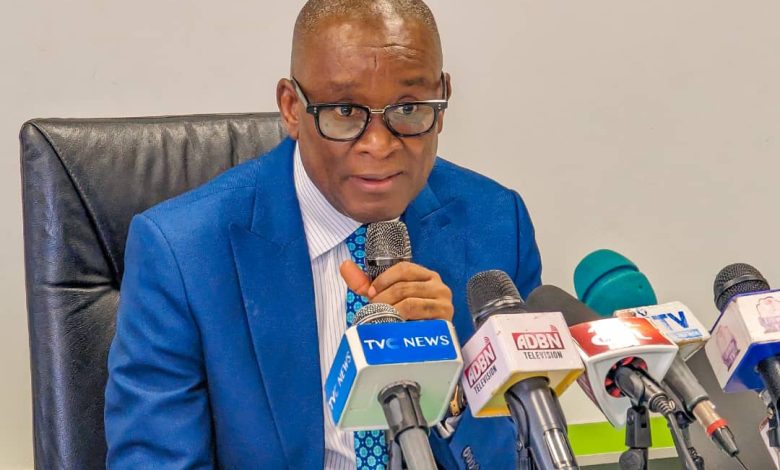
Nigeria cannot industrialise when manufacturers borrow at interest rates above 30 per cent, the Minister of State for Industry, Trade and Investment, John Enoh, has said.
Enoh spoke on Thursday at the second technical session of the Industrial Revolution Work Group (IRWG), where he compared Nigeria’s financing costs with those of manufacturers in neighbouring countries.
He said Nigerian manufacturers borrow at rates above 30 per cent, while their counterparts in Benin Republic and Cameroon access loans at about eight per cent.
“That arithmetic is not a market outcome; it is a policy failure with a compound interest schedule, and no exhortation of mine will repeal it. Instruments will,” the minister said.
Enoh said the finance and incentives table of the IRWG must develop instruments capable of providing manufacturers with affordable financing at sustainable tenors and rates.
He also identified energy and infrastructure as major constraints to industrialisation, arguing that Nigeria could not build a competitive industrial sector by relying on generators.
The minister called for the replication of the Idu pilot through initiatives that connect gas to industrial clusters and provide factories with predictable electricity prices.
On regulatory reform, Enoh said the government should identify overlapping agencies, licences that could be merged and levies that could be abolished to reduce the burden on manufacturers.
“Our factories do not lack regulators; they lack relief. Where two agencies perform one function, recommend which one stands down. Name the licences to be merged, the levies to be abolished, and the dates,” he said.
On locally made products, the minister said patriotism alone would not make Nigerian goods competitive if consumers could not afford them.
He called for stronger enforcement of standards, punishment for counterfeit products and greater use of locally made goods in federal procurement.
Enoh also identified skills and innovation as critical to industrial development, saying modern factories would increasingly depend on mechatronics, industrial software and advanced production technologies.
To address the identified constraints, he directed the five tables of the work group to produce an actionable matrix containing specific actions, institutions, deadlines and measurable indicators.
He said the government would also induct new private-sector members into the industrialisation initiative, including RussellSmith Nigeria and FATE institutions.
“We will hear from RussellSmith Nigeria, whose work will help our MSMEs become what indigenous advanced manufacturing already looks like on Nigerian soil,” Enoh said.
“And we will welcome the FATE institutions, whose work is credit-ready.”
The minister said the second ministerial roundtable would bring together the Minister of Finance, the President of the Manufacturers Association of Nigeria (MAN), bank leaders, development finance institutions and institutional investors to confront the challenges facing industrialisation.
According to him, the meeting will focus on adopting a national industrial compact containing specific financing instruments, institutions and 30-, 60- and 90-day timelines.