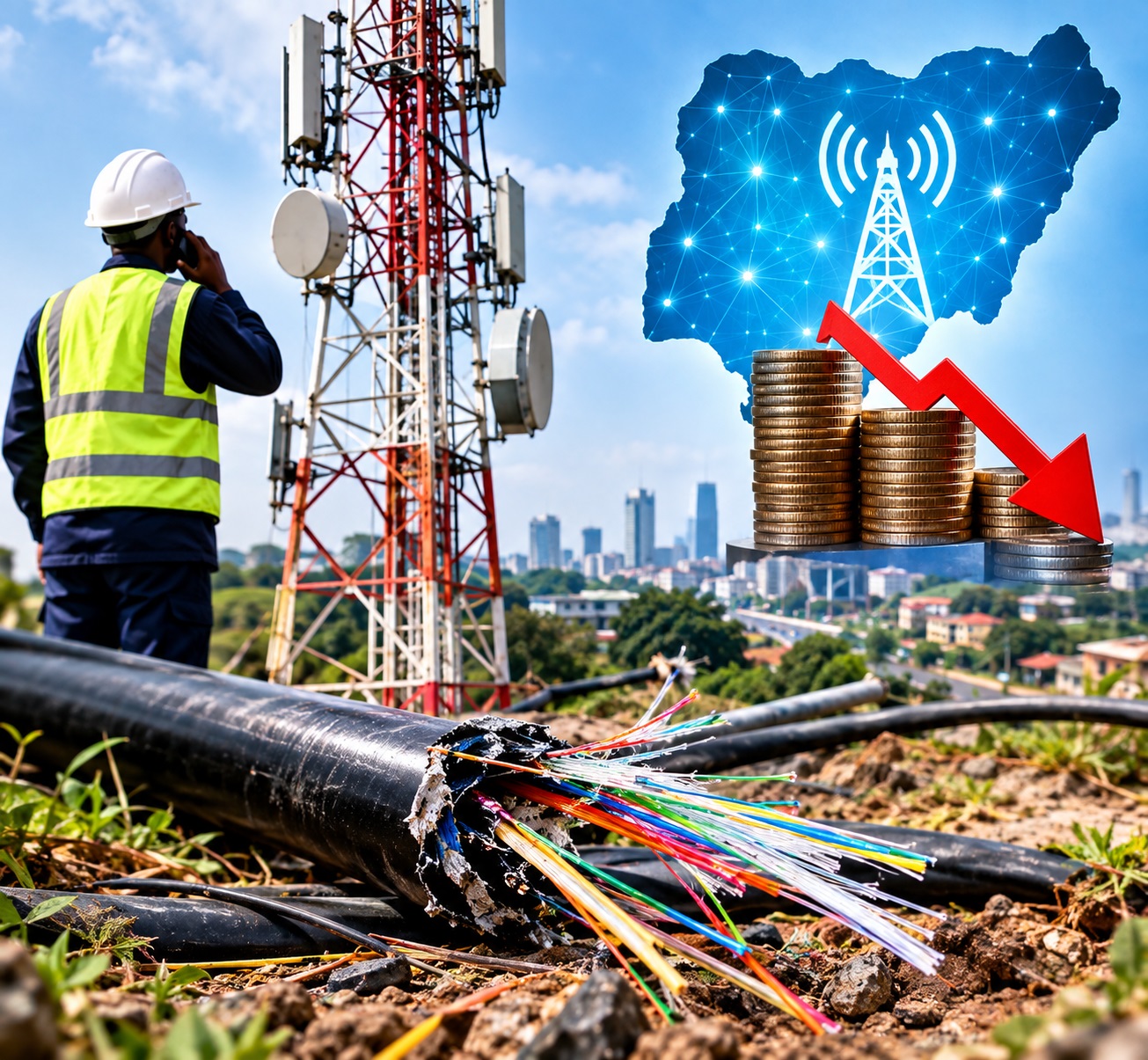
More than ₦2.1 trillion being committed by Nigerian telecommunications operators to expand and upgrade infrastructure is facing a growing threat from fibre cuts, vandalism and road construction, with thousands of disruptions already recorded this year.
The Nigerian Communications Commission (NCC) said more than 5,000 fibre-optic cable cuts occurred across the country in the first six months of 2026, with road construction, excavation and related activities among the leading causes. The damage is adding to the cost of running networks at a time when operators are investing heavily to expand broadband capacity.
The disruptions are increasingly spilling beyond telecom companies. Banks, fintech firms, payment platforms, point-of-sale operators and businesses that rely on cloud services can lose access to critical systems when fibre routes are severed. Failed electronic payments, interrupted customer service and lost working hours are among the consequences.
Nigeria recorded 245 major network outages in May alone, according to industry reports, underscoring the fragility of infrastructure that has become essential to the economy. In the first quarter, operators reportedly experienced 577 network outages, with fibre cuts accounting for a significant share.
Gbenga Adebayo, chairman of the Association of Licensed Telecommunications Operators of Nigeria (ALTON), has warned that repeated fibre damage by federal and state road construction contractors is causing “enormous economic losses” while disrupting banking, education, security and other services.
The financial impact extends beyond replacing a damaged cable. Operators must reroute traffic, deploy repair crews and absorb emergency maintenance costs, while businesses connected to affected networks may have to switch to alternative connectivity or suspend transactions until service is restored.
Dimeji Edun, a technology and digital economy expert, said road construction accounts for about 60 per cent of network outages caused by fibre cuts, highlighting what he described as poor coordination between infrastructure developers and telecommunications companies.
Nigeria has about 35,000 kilometres of fibre infrastructure in the ground, Edun said, while only about 16 per cent of the population is directly connected to it. That leaves the country needing significantly more fibre to extend broadband access even as existing networks are repeatedly damaged before their full economic value can be realised.
The problem is compounded by vandalism, cable theft and access denial. NCC figures cited by industry stakeholders show that Nigeria recorded more than 27,685 fibre cuts, over 27,000 cases of access denial and 4,210 incidents of cable theft in 2025.
The scale of the losses has strengthened calls for telecom infrastructure to be designated as critical national infrastructure, which would provide greater protection for assets that increasingly underpin financial transactions, commerce, government services and other economic activity.
For financial-technology companies and payment operators, the exposure is particularly high because their businesses depend on continuous connectivity. A disruption can affect point-of-sale terminals, mobile applications, electronic payments and customer authentication, creating costs that are ultimately distributed across operators, merchants and consumers.
Telecom companies are also contending with the high cost of deploying new infrastructure. Ajibola Olude, executive secretary of the Association of Telecommunications Companies of Nigeria (ATCON), identified right-of-way charges, energy costs and taxes as major constraints on broadband expansion.
Olude said it is cheaper to transport internet bandwidth from Lagos to Canada than to many parts of Northern Nigeria, citing inconsistent state policies and hidden charges as factors slowing network expansion and widening the digital divide.
Right-of-way charges are particularly significant because fibre networks require extensive physical deployment along roads and other public corridors. Multiple charges, permit requirements and delays in securing approvals increase the cost and time required to build networks.
NCC executive vice chairman Aminu Maida also identified right-of-way bottlenecks, multiple permits, vandalism, poor deployment standards and weak coordination among stakeholders as obstacles to nationwide fibre expansion. The Commission said 13 states had waived right-of-way charges, while 16 others had adopted the National Economic Council-recommended rate of ₦145 per linear metre.
The cost of protecting existing infrastructure is adding another burden. Industry stakeholders say operators spend more than 20 per cent of their budgets on spare parts because vandalism and fibre cuts repeatedly force emergency repairs. Technical teams are also diverting equipment intended for new sites to restore damaged infrastructure.
That creates a trade-off for an industry already under pressure to expand coverage: money and equipment that could be used to build new capacity are instead being deployed to repair networks that have already been installed.
Tony Emoekpere, president of ATCON, on his part, called for greater infrastructure sharing, improved deployment standards and stronger industry collaboration to reduce costs and accelerate broadband expansion.
According to him, the issue is becoming more important as Nigeria seeks to move beyond a predominantly mobile-led internet market toward greater fixed broadband access. He said fibre-to-the-home and fibre-to-the-building services require substantial investment in last-mile networks, making the protection of existing routes increasingly important.
Industry stakeholders are advocating closer coordination between telecom operators, federal and state governments, road construction companies, electricity distribution companies, security agencies and local communities.
One proposed solution is a “dig-once” policy, under which ducts for telecommunications infrastructure would be incorporated into roads and other major infrastructure projects before construction begins. This would reduce repeated excavation and lower the risk of damaging existing fibre.
Shared ducts and standardised infrastructure corridors could also allow multiple operators to use protected routes rather than repeatedly excavating roads to deploy separate networks.
For Nigeria, the stakes extend beyond the telecommunications industry. Fibre has become a basic economic utility, carrying the data that supports banking, electronic payments, commerce, public administration, education and business operations.
As operators commit more capital to expanding digital infrastructure, the recurring damage raises a fundamental question for the sector: whether Nigeria can continue spending billions of naira on new fibre while failing to adequately protect the networks already in the ground.
Without better coordination between infrastructure developers and telecom operators, stronger protection against vandalism and theft, harmonised right-of-way policies and improved underground utility mapping, the country risks creating a cycle in which investment in digital infrastructure is followed by repeated spending to repair infrastructure that could have been protected.

Monday, October 26, 2026
Fibre Cuts Put N2.1trn Telecom Investment At Risk