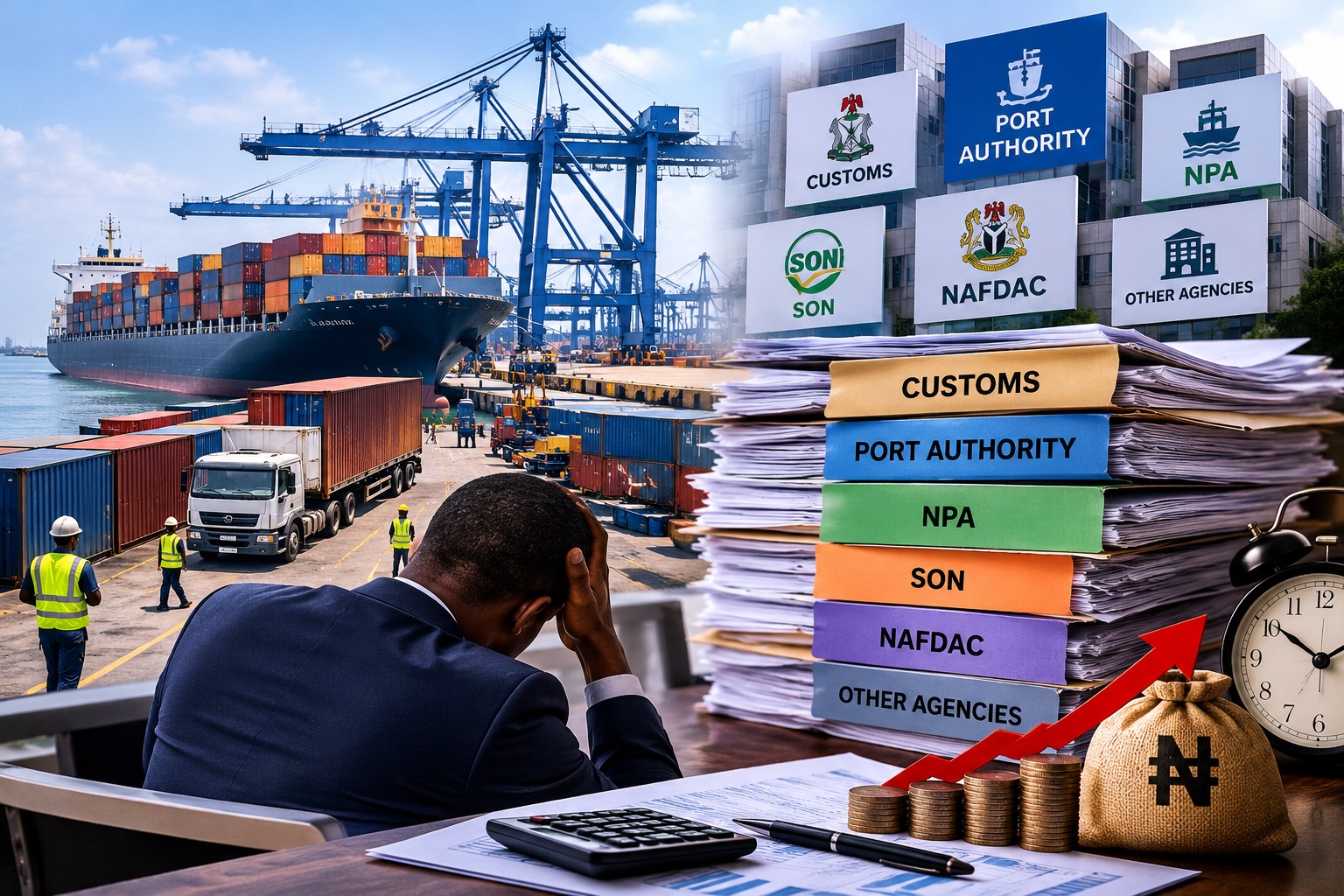
Importers, shippers and clearing agents have described Nigerian seaports as among the most expensive in West and Central Africa, blaming the proliferation of government agencies at the ports for rising cargo clearance costs, delays and other inefficiencies.
The stakeholders said successive administrations had attempted to reduce the number of government agencies operating physically within the ports, only for many of the agencies to gradually return.
In October 2011, former Minister of Finance and Coordinating Minister of the Economy, Dr Ngozi Okonjo-Iweala, reduced the number of permanent government agencies operating at Nigerian seaports from 14 to six, later adjusted to seven, in a bid to speed up cargo clearance and reduce congestion.
The reform was designed to cut cargo clearance times, lower costs and curb corruption and delays. Eight agencies were removed from having permanent physical offices or presence inside port terminals.
The agencies approved to maintain a physical presence included the Nigerian Ports Authority (NPA), Nigeria Customs Service (NCS), Nigerian Maritime Administration and Safety Agency (NIMASA), Port Health Services, Nigeria Immigration Service (NIS), Port Police and the Department of State Services (DSS).
The agencies asked to leave included the National Agency for Food and Drug Administration and Control (NAFDAC), Standards Organisation of Nigeria (SON) and National Drug Law Enforcement Agency (NDLEA), among others.
However, in June 2017, the then Managing Director of NPA, Hadiza Bala Usman, also announced the eviction of agencies that had returned to the ports.
Bala-Usman said only seven agencies were permitted to maintain physical operations inside the ports to streamline processes and support 24-hour cargo clearance.
Despite the successive reforms, stakeholders said several of the agencies had returned to the ports, contributing to higher costs and delays in cargo evacuation.
Speaking on the issue, the director-general of the Nigerian Ports Economic Regulatory Agency (NPERA), Dr Pius Akutah, said technology would eventually reduce the need for government agencies to maintain physical offices within the port environment.
Akutah said agencies should be allowed to carry out their statutory mandates, provided their activities did not impede cargo clearance.
“So it will get to a point where, even without phasing out certain aspects of the work that agencies do within the port sector, agencies themselves will see no need to be within the space. But they will be within the space with the use of technology. And in the comfort of their offices, they will carry out their mandate.
“We are not stopping any agency from carrying out its mandate because every agency has its mandate. We can’t say, ‘No, you cannot carry out your mandate.’ But you do it responsibly, in a way that it does not affect clearance processes.
“And that is why recently the issue of the Maritime Police has been generating a lot of controversy. And the role of the Shippers’ Council has always been very clear. It is to facilitate the release of those containers that are stopped by Maritime Police, which is constituting issues with the clearance processes.
“So it is our duty as port economic regulator to ensure that if a container is stopped by the police, they should release it. And we have played that role for the sake of supporting the shippers to ease their challenges.
“We have the cause to engage them again to say, look, we don’t even want to be involved in any process of clearing any stoppage of containers on the way, which, as far as we are concerned, is counterproductive to the efforts we are making towards the clearance processes.
“So these processes will be streamlined in a regulation on what needs to be done. And the agencies will know their roles, their individual roles, on what they need to do. As long as it does not impact on the clearance process negatively, you can carry out your mandate.
“But once your mandate becomes a wedge in the progress of these free clearance processes, then you will need to review it with us to see how best you can carry out your mandate without affecting these processes.
“Because at the end of the day, Nigerians are waiting to see how potent this law is and how effective it will be. If at the end of the implementation process nothing has changed in the sector, then it means that we have failed.
“And we don’t want to fail. So we want to see the changes that will come. And you know that once these processes are seamless, it will reduce costs on its own.
“So the component of cost is very crucial to us. If we are building a trillion-dollar economy, it is not only in terms of the amount of money that government will make, but it is the overall totality of the GDP of the economy that will promote that $1 trillion.
“It is not just about what revenue government is making, but generally how much business is booming in the country.
“And that’s what we are about to do. So never mind. The agency is working on those areas. And within a limited time, we’ll begin to see the results,” he said.
Also speaking, the acting president of the Association of Nigerian Licensed Customs Agents (ANLCA), Dr Kayode Farinto, said the increasing volume of trade and the growing risk of non-compliant imports made it difficult to simply remove regulatory agencies from the ports.
“So, the issue now is, in view of the fact that the vices in the party are increasing, we have some non-conformist importers who have the habit of importing consignments to make gains, even at the risk of national interest.
“It is very difficult for us to say which agency should vacate the port. For example, if anybody brings in a radioactive material now, it is the responsibility of NESREA.
“Even though we say NESREA is not adding value, you know that psychotropic substances are increasing on a daily basis. That is the responsibility of NDLEA while fake drugs is the responsibility of NAFDAC.
“Also, sub-standard products are the responsibility of SON. So, which one do you want to say should be removed from the port?
“The issue of proliferation of government agencies, we have gone beyond that because Nigeria is getting larger, our volume of trade is increasing.”
Farinto said rather than remove regulatory agencies from the ports, government should ensure that they remained focused on their statutory responsibilities.
He said revenue generation by regulatory agencies could undermine their core mandates and add to the cost of doing business.
“Since the level of non-conformity is increasing, the only thing we can say is that any agency that has a regulatory function should be confined to its statutory responsibility.
“Number one, government should stop using them for generating revenue. I’m coming from another angle.
“I’ll give you an example now. Some will say go and get SONCAP. When you get SONCAP and you bring in the consignment, some will say if you don’t pay administrative charges on the container, the container that you have SONCAP for and you carry it from the port will be accosted because of 30 per cent administrative charges.
“Are we now regulating products or are we looking for internally generated revenue? So, these are the things that are very, very important.
“So, talking about the proliferation of government agencies, I think we have gone beyond that. But agencies should be saddled and confined with their statutory responsibilities. That is the only solution that can stop diminishing the port.
“Just stay and stop being used as a revenue-generating agency for government. So, do your job. Do your statutory job. If you have any sort of standard goods that do not have product certificates, confiscate them, destroy them.
“For example, if you bring any product now that you have NAFDAC registration permit, let me use that word, permit, you have paid almost N2 million for the permit. But because you have not gone for the first and second stamping, when NAFDAC will collect maybe N70,000 from you, they will subject you to a lot of penalty. And that is an internally generated revenue.
“This is not your statutory responsibility. You will leave your core responsibility; you are going to generate revenue. It is going to be at the expense of your statutory responsibility. So, eventually, you leave the elephant, you are chasing the cat.
“That is why we have some standard products, unadulterated products, that have actually been imported into our markets. So, I don’t want to come from that angle. Confine your job to your statutory responsibility as stipulated by your Act.”
On his part, the Tin Can Island chairman of the Africa Association of Professional Freight Forwarders and Logistics of Nigeria (APFFLON), Mr Clinton Okoro, said successive governments had failed to sustain efforts to streamline agencies operating at the ports.
Okoro said agencies that were removed from the ports under the earlier reform had gradually returned, creating multiple layers of intervention for importers and clearing agents.
“I would say that probably the government is not really serious with some of the decisions that they make. Though it is not the APC government, if you remember, it was when Madam Ngozi Okonjo-Iweala, under Jonathan, made that pronouncement.
“When she made that pronouncement, there was this government backing her up, backing that statement up. That was why so many of them left, like SON, NAFDAC and so many of them.
“But later, gradually, before you know it, all of them are back to the port. NAFDAC is back. SON is back. Everybody is there. NESREA and Quarantine and all of them, they are all there.
“This is not something that we need to even discuss because it is something that is very, very open. Everybody knows what they are doing here. It is an organised crime. That is what is happening in the port, whether they like it or not.
“I will say it any day, any time. With those agencies, there is nothing that you clear from the seaport that they will not want to pick their nose into. The DSS will come, even to goods that are not related to or under their jurisdiction. They will still want to come.
“Everybody believes that the port is a place where you come and make your money. It is a national cake. Come and cut your own and go. So that is what they are doing, to be frank. The NDLEA are there, Quarantine are there.
“Even though you are not carrying anything that relates to Quarantine products, such as plants and all that, they will still ask you to settle them. So all those costs, when you put them together, are still the cost of clearing, and it is making it go high. It is what we face every day.
“And if there is any little issue on your job, they will capitalise on that.
“What of Maritime Police? Maritime Police is causing a lot of headache. They are causing a lot of issues in the clearance process, where they just randomly block a whole ship.
“So every day you see us complaining, running from one pillar to post and all that.
“All those things are something that we need to thank God that you people are there, so that when you hear our voice like this, you can help us to push it out so that the government can act.
“Something that is coming out of the port is smuggled, but the government is looking at it and they are leaving it. They just look away.
“So all those things put together, whether you like it or not, must add to the cost of clearing. And whether we like it or not, any businessman is a business person. When they buy whatever they buy, whatever cost they clear it, they will add it up and they will go to the market and sell,” he ended.