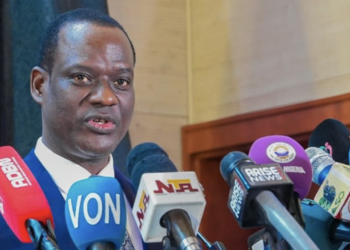

Nigeria needs an annual compound growth rate of 28.02 per cent to achieve a $1 trillion economy by 2030, the President of the Chartered Institute of Directors Nigeria (CIoD), Mr Adetunji Oyebanji, has said.
Oyebanji disclosed this in Lagos while delivering the keynote address at the 42nd Omolayole Management Lecture.
He said the 28.02 per cent compound annual growth rate was required to raise Nigeria’s estimated 2025 nominal Gross Domestic Product (GDP) of $290.79 billion to $1 trillion by 2030.
According to him, the required growth rate was aggressive and had no historical precedent for an economy of Nigeria’s current size.
“The ambition cannot be achieved through incremental improvement or business-as-usual policies.
“There is a need for sustained acceleration in economic growth, structural transformation and investment,” he said.
Oyebanji identified power deficit, infrastructure gaps, oil sector inefficiencies and foreign exchange volatility as some of the structural constraints limiting Nigeria’s economic expansion.
He also listed the low tax-to-GDP ratio, insecurity, policy inconsistency and human capital deficits among factors constraining economic growth.
The CIoD president said Nigeria needed to move beyond reliance on its economic resources by building effective institutions and ensuring policy consistency.
He added that the country must create an environment conducive to private-sector investment and industrial expansion.
Oyebanji noted that recent reforms in monetary policy, tax administration and the petroleum sector were contributing to improved economic conditions, investment certainty and fiscal sustainability.
He said reforms by the Central Bank of Nigeria ( CBN), had contributed to moderation in inflation, improved foreign exchange market stability and stronger investor confidence.
He added that tax administration reforms could improve domestic revenue mobilisation and reduce dependence on oil revenue.
According to him, petroleum sector reforms could enhance transparency, investment certainty and production potential.
He also identified infrastructure, solid minerals, services and the creative industry as critical sectors for economic expansion.
Oyebanji outlined 10 strategic pillars required to drive Nigeria’s economic transformation, including macroeconomic stability, institutional strengthening and policy consistency.
Others are regulatory certainty, infrastructure development, domestic revenue mobilisation, private-sector and investment promotion, industrialisation and diversification.
He also listed human capital development, technology and digital transformation, governance, transparency and the rule of law.
The CIoD president said Nigeria must accelerate investment across productive sectors, strengthen infrastructure, maintain fiscal and monetary discipline and expand exports.
He also called for improved industrial competitiveness, deeper development of the digital economy and stronger domestic revenue mobilisation.