The economic health of every nation is measured through key macroeconomic indicators, including inflation, unemployment, Gross Domestic Product (GDP), government revenue and expenditure, interest rates, public debt and exchange rates. However, these indicators must be examined beyond statistical performance to determine their actual impact on citizens.
Nigeria presents an interesting economic paradox: while government officials celebrate improving macroeconomic indicators, millions of Nigerians continue to struggle with declining purchasing power, rising living costs and shrinking disposable income.
According to the National Bureau of Statistics (NBS), Nigeria’s headline inflation declined to 14.63 per cent in September 2026, compared to 15.39 per cent in August. Food inflation stood at 19.59 per cent, while core inflation moderated to 12.95 per cent. Although these figures suggest improving price stability, they do not necessarily indicate improved household welfare.
A declining inflation rate does not automatically mean that prices are falling. Rather, it indicates that prices are increasing more slowly. Consequently, Nigerians continue to experience the cumulative effects of previous price increases on food, transportation, energy, healthcare and education.
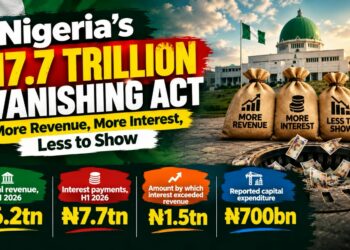
Government revenue presents another interesting perspective. The substantial increase in allocations to federal, state and local governments should ordinarily translate into improved infrastructure, healthcare, education and public services. However, the fundamental question remains:
Are Nigerians experiencing development proportional to the increased revenue available to their governments?
Revenue mobilisation should not be celebrated merely by the amount collected or distributed, but by measurable improvements in citizens’ living standards.
Similarly, Nigeria’s unemployment statistics require careful interpretation. Under the NBS methodology, individuals who work for at least one hour for pay or profit within the reference period may be classified as employed. While this follows international statistical standards, it does not adequately communicate the challenges of underemployment, low wages and inadequate earnings.
Employment without sufficient income cannot guarantee economic security or meaningful purchasing power.
Nigeria’s GDP growth also deserves attention. The economy expanded by approximately 4.43 per cent in the second quarter of 2026, reflecting positive economic momentum. Nevertheless, economic growth must become more inclusive through productive investment, industrialisation, agricultural development and sustainable employment opportunities.
Growth driven by expanding services and other sectors is valuable, but its developmental impact depends on productivity, employment generation and the distribution of economic benefits.
Since the removal of petrol subsidies in 2023 and subsequent exchange-rate adjustments, Nigerian households have experienced significant increases in transportation, food and energy costs. The depreciation of the naira from approximately ₦776 per dollar to levels around ₦1,300–₦1,400 has further affected import costs and household expenditure.
External geopolitical tensions, particularly developments in the Middle East, also expose Nigeria’s vulnerability to global energy-price shocks.
Recent government statements suggesting that Nigeria’s economy has undergone significant transformation may be justified by improvements in fiscal revenue, foreign exchange management and other macroeconomic indicators. However, economic transformation must ultimately be assessed through its impact on ordinary citizens.
The September 2026 food inflation rate of 19.59 per cent remains particularly concerning. Many low-income Nigerian households devote a substantial proportion of their earnings to food, leaving limited resources for housing, transportation, healthcare, education and savings.
For illustration, a household spending ₦60 out of every ₦100 earned on food has only ₦40 remaining for other essential needs. Such expenditure patterns weaken financial resilience and restrict opportunities for wealth creation.
This raises an important question: **Can an economy be considered successful when its statistical indicators improve but citizens’ disposable incomes remain under severe pressure?**
Nigeria must therefore adopt a more citizen-centred approach to economic management.
First, government must strengthen domestic agricultural production through irrigation, mechanisation, improved rural infrastructure, affordable financing and year-round farming. Sustainable food security requires increased local productivity rather than excessive dependence on imports.
Second, expanding access to Compressed Natural Gas (CNG), renewable energy and reliable electricity can reduce transportation and production costs while limiting exposure to global petroleum-price volatility.
Third, monetary policy must balance inflation control with economic growth. Although higher interest rates can help moderate inflation, prolonged restrictive monetary conditions may constrain business expansion, investment and employment generation. Supply-side interventions must complement monetary tightening.
Fourth, increased government revenue must produce visible improvements in public infrastructure, healthcare, education and social protection. Fiscal performance should be evaluated through measurable developmental outcomes.
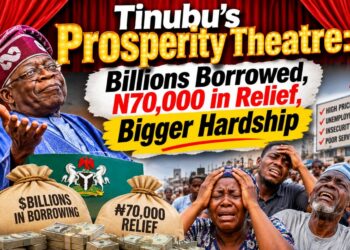
President Bola Ahmed Tinubu’s administration has introduced significant economic reforms aimed at addressing structural weaknesses. While these reforms may strengthen long-term macroeconomic stability, their immediate consequences have imposed considerable hardship on Nigerian households.
Ultimately, **economic stability is not the same as economic prosperity**. Stable exchange rates, declining inflation and rising government revenue are important achievements, but they remain incomplete without corresponding improvements in purchasing power, real wages, employment opportunities and household welfare.
Nigeria’s economic success must not be measured only by what government earns or what the economy produces, but by what ordinary Nigerians can afford, save and achieve.
The true lens of economic development must always be the welfare of the people.