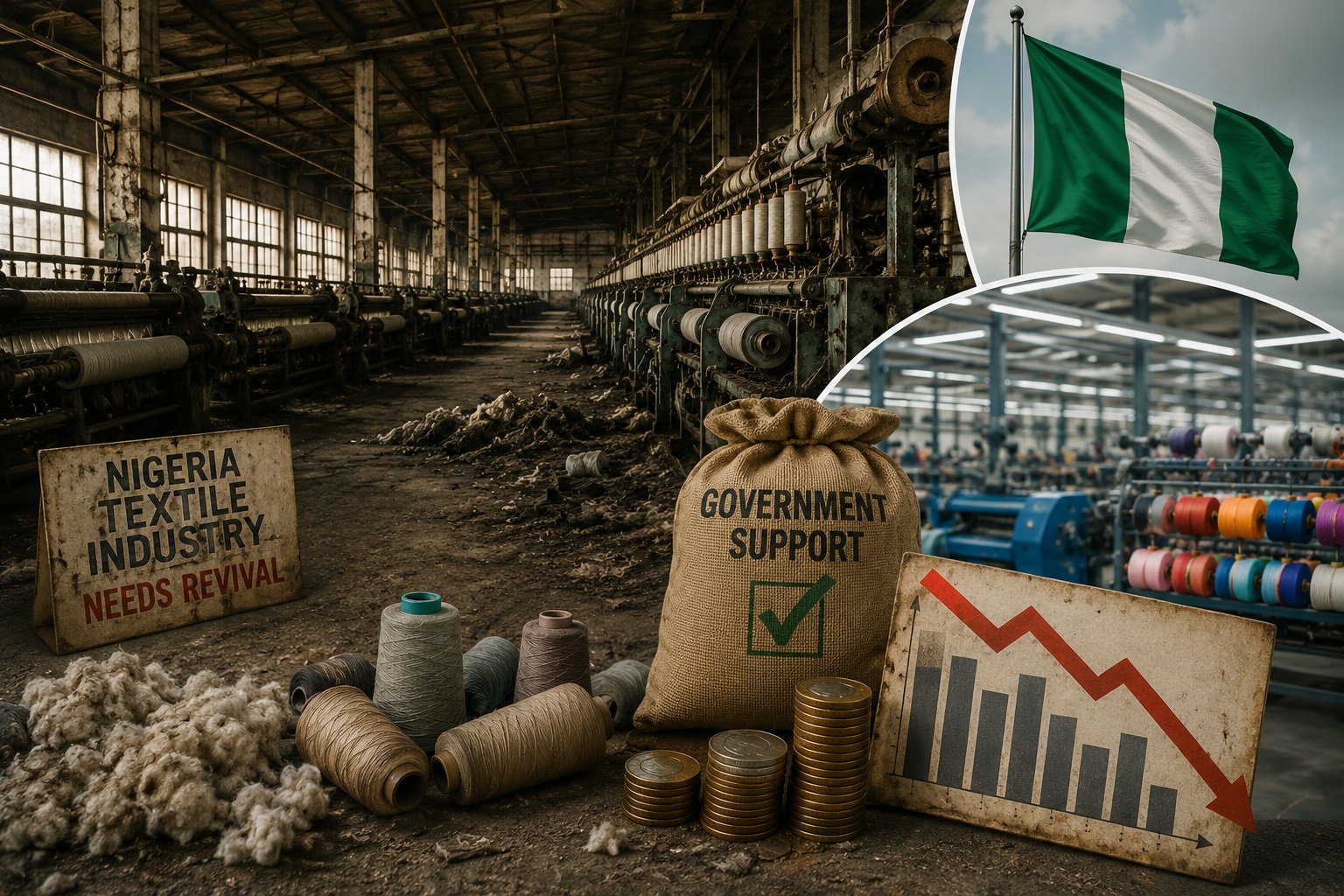
Over N100 billion in intervention funds, multiple import bans, and years of policy roadmaps have failed to revive Nigeria’s textile industry.
Today, the industry still faces significant challenges, with fewer than 20 out of 180 textile mills currently operational.
Manufacturers cited high energy costs, the prevalence of cheaply imported fabrics, and the burden of affordable loan repayments at 30 per cent interest as major hurdles.
The director-general of the Nigerian Textile Manufacturers Association (NTMA), Hamma Kwajaffa, emphasised the urgent need for a comprehensive approach to revitalising the sector.
While financial assistance, such as bailouts, plays a role, Kwajaffa stressed that more is required beyond funding.
According to him, competitiveness against other countries is crucial, and without a strategic framework and benchmarking against successful manufacturing environments, Nigerian textiles will continue to face challenges.
He stated that infrastructure deficiencies remain critical, and addressing them will require a multi-faceted strategy rather than a singular solution.
Kwajaffa pointed out the decreasing visibility of Nigerian-produced goods in both domestic and global markets, particularly within the cotton sector, explaining that “many local farmers face discouragement due to fluctuating cotton prices driven by international markets, making it difficult to compete with agricultural practices in countries like the United States, where advanced mechanisation prevails.”
He added that “the shortage of raw materials poses a significant barrier. Unlike countries like India, which have numerous operational refineries, Nigeria’s limited refining capacity hampers the availability of polyester, a vital input for textiles.
“The influx of imported fashion products further complicates the landscape, as local designs are often replicated and sold cheaply overseas, diminishing the ability of homegrown manufacturers to compete.”
To enhance the textile sector’s competitiveness, Kwajaffa suggested “strategic reforms aimed at strengthening the regulatory framework and addressing current challenges. By focusing on these areas, Nigeria can breathe new life into its textile industry.”
The director-geneal of the Lagos Chamber of Commerce & Industry (LCCI), Dr. Chinyere Almona also emphasised the need to tackle structural issues, saying that “although government intervention funds, like the 2009 CBN Cotton, Textile & Garment (CTG) Revival Fund, provided financial relief, they did not resolve deeper issues such as unreliable power supply, limited infrastructure, outdated machinery, and weak supply chains.”
She pointed out that “high inflation has further diminished the purchasing power of intervention funds, complicating firms’ efforts to finance modernisation and investment. Moreover, fluctuations in the exchange rate have escalated production costs since most machinery and materials are imported, limiting the effectiveness of past interventions.
“The ageing equipment in many surviving mills compromises competitiveness, as older machinery is less efficient, requiring more maintenance and producing lower-quality output compared to modern facilities abroad.”
She also said, “Trade liberalisation has created an opportunity for Nigerian manufacturers to improve, but inconsistent policies over the past decade have exposed them to intense competition from cheaper imported textiles without sufficient enhancement of local productivity.
“Additionally, frequent changes in tariffs and foreign exchange regulations have introduced uncertainty, discouraging long-term investment in the textile sector.”
Almona also highlighted that the high energy costs, particularly due to reliance on diesel or LPFO-powered generators, further exacerbate production expenses.
She insisted that revitalising Nigeria’s textile industry requires a concerted effort to address infrastructure, regulatory frameworks, and competitiveness.
“By pursuing these strategic initiatives, Nigeria can unlock its potential in the textile sector and foster sustainable growth,” she said.
Also, the director/CEO of Centre for the Promotion of Private Enterprise (CPPE), Dr Muda Yusuf, said the decline of Nigeria’s textile industry is primarily the consequence of longstanding structural constraints, saying that these include high energy costs, expensive credit, poor infrastructure, logistics bottlenecks, obsolete technology, smuggling, weak access to long-term finance and policy inconsistency.
According to him, textile manufacturing is one of the most energy-intensive industries globally. Operating within a high-cost production environment has severely undermined the competitiveness of local manufacturers.
He stated that reviving the textile industry requires a comprehensive value-chain approach, saying that priority should be given to restoring domestic cotton production, which historically supplied the industry’s raw materials.
“Insecurity in farming communities, weak productivity, inadequate extension services and poor incentives have severely undermined cotton cultivation.
“Textile manufacturers also require access to affordable long-term finance, modern technology, reliable energy and a more competitive operating environment,”he emphasised.

Sunday, October 25, 2026
High Costs, Cheap Imports Keep Nigeria’s Textile Industry In Crisis