By Cees Harmon
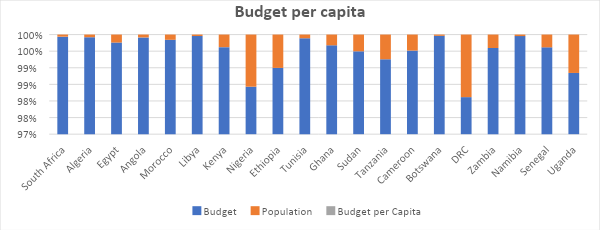
Among the 20 African countries with the largest annual budget, Nigeria has over the years been running the second-lowest budget per capita, better only than the Democratic Republic of Congo. Budget per capita, an index derived by National Economy, is an indicator of how much government expenditure impacts each individual in a country’s population. It is calculated by dividing a country’s budget by its population in a given fiscal year.
This finding is semi-contrary to popular perception that the Federal Government of Nigeria has been running adequate budget for developmental progress over the years, but misappropriated by corrupt politicians. Nigeria’s budgetary allocations have hardly been enough to push for the sort of infrastructural development that would get the country out of the developmental woods.
Using 2017 as a sample year, Nigeria, with a current population of 206 million, according to Worldometers, ran the ninth-largest budget among big-budget African countries. According to Wikipedia, the equivalent of Nigeria’s budget in 2017 was estimated to be $12.9 billion United States dollars. This was a far cry from the likes of South Africa that ran a budget of $92 billion in the same year. Algeria ran a $54 billion budget in the same year; Egypt $43 billion, Angola, $37 billion, Morocco, $23 billion, while Libya and Kenya ran 16 and 14 billion U.S. dollars respectively. This was followed by Nigeria with almost $13 billion.

When divided by the countries’ populations, which is their budget per capita, Nigeria came second only to the Democratic Republic of Congo among the 20 African countries with the largest budget, with $63 U.S. per person. Botswana, Libya, Namibia and South Africa topped Africa’s budget per capita with $2,655, $2254, $2,134 and $1,574 respectively, as seen in the chart below.

With a constancy of more than 70 percent of Nigeria’s budget being devoted to recurrent expenditure, and hardly meeting budget target up to 70 percent over the past decade, it can be inferred that at best, (i.e. assuming there is no budget deficit) only less than $20 dollars could be left per person for infrastructural development. But considering Nigeria’s perennial budget deficit at 50 percent in some years, what is left for capital projects is understandably too paltry for any meaningful infrastructural development.
The statistics may explain why the roads are bad, electricity generation is poor, and a host of other developmental deficiencies on the part of the government.
Since infrastructural development is a sine qua non to economic development, it may make sense that the federal government goes borrowing tied to projects.
This finding lends credence to the request by the Buhari-led executive to initiate the currently debated $30 billion project-tied loan with the objective of unleashing some of the country’s economic potentials.
Two decades of dependency on oil money to open up the economy have proved futile. This is coupled with the public loss of confidence in government to deliver, as well as allegations and counter-allegations of fiscal indiscipline.
The way forward to infrastructural, hence economic development may just be massive project-tied loans.