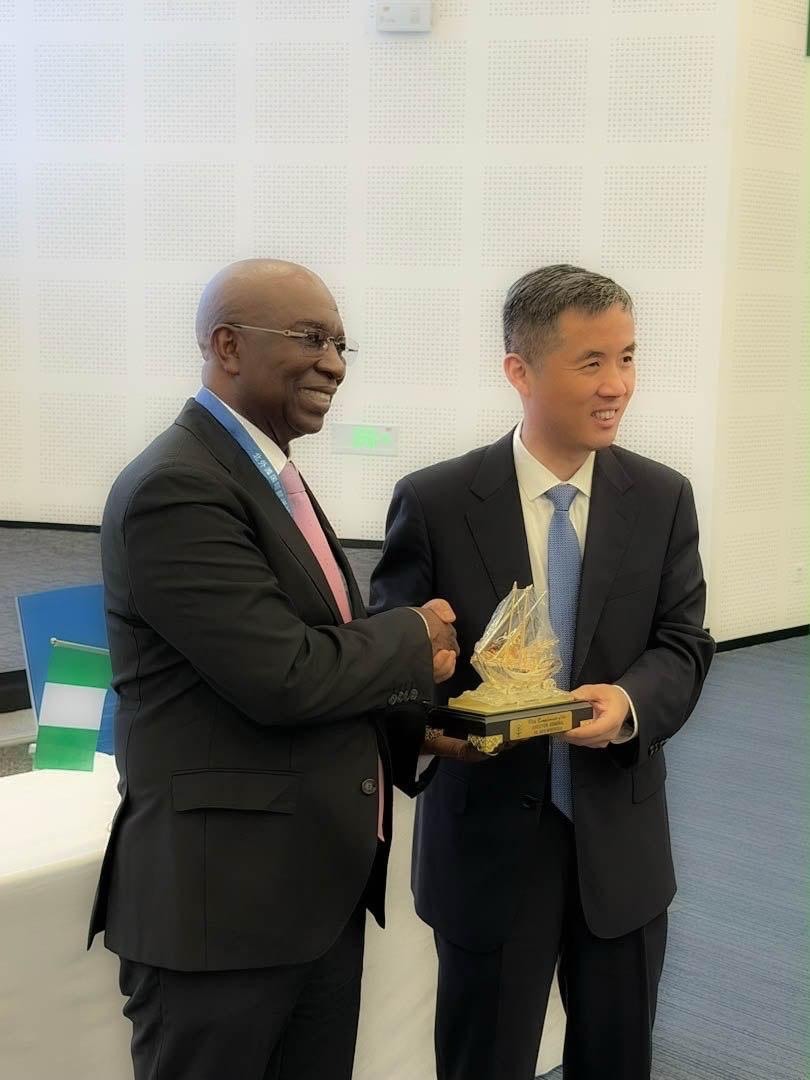
The Nigerian Maritime Administration and Safety Agency (NIMASA) and the China Maritime Safety Administration (China MSA) have signed a Memorandum of Understanding (MoU) to strengthen bilateral cooperation and promote the development of the maritime industry in both countries.
The agreement was signed in Shanghai, China, at a ceremony held at the Shanghai Seafarers Assessment Model Centre, establishing a framework for collaboration in maritime safety and navigation, marine environmental protection, seafarer training, certification and rights protection.
Other areas covered by the agreement include marine casualty and incident investigation, maritime transportation facilitation and maritime security.
Speaking at the ceremony, Director-General of NIMASA, Dr Dayo Mobereola, described the agreement as a historic milestone in the relationship between Nigeria and China, stressing the need to translate the partnership into practical programmes and measurable benefits for both countries.
Mobereola said the agreement represented a commitment to strengthening maritime cooperation, sharing expertise and creating tangible opportunities for the maritime industries of both nations.
He added that President Bola Tinubu remained committed to deepening Nigeria’s longstanding relationship with China, particularly in the maritime sector, in line with the Federal Government’s Renewed Hope Agenda and the objectives of the Ministry of Marine and Blue Economy, led by Adegboyega Oyetola.
Also speaking, Director-General of China MSA, Xu Wei, reaffirmed China’s commitment to strengthening maritime relations with Nigeria, noting the country’s interest in Nigeria’s maritime development and progress in the sector.
He pledged China’s continued support for bilateral collaboration and sustainable growth in the maritime industries of both countries.
The agreement is expected to promote technical cooperation, knowledge-sharing, capacity development and the exchange of best practices, while strengthening institutional ties between the two maritime administrations.
The partnership is also expected to enhance Nigeria’s maritime capacity, improve safety standards and support the growth of the country’s maritime industry