Manufacturers and small businesses across Nigeria are facing renewed financing challenges as slowing credit growth, elevated interest rates and tighter lending conditions continue to restrict access to funds needed for expansion and productivity.
The development comes despite expectations that borrowing conditions would ease following the commencement of the Central Bank of Nigeria’s (CBN) monetary easing cycle late last year and the recapitalisation of banks, which initially boosted lending to businesses and households.
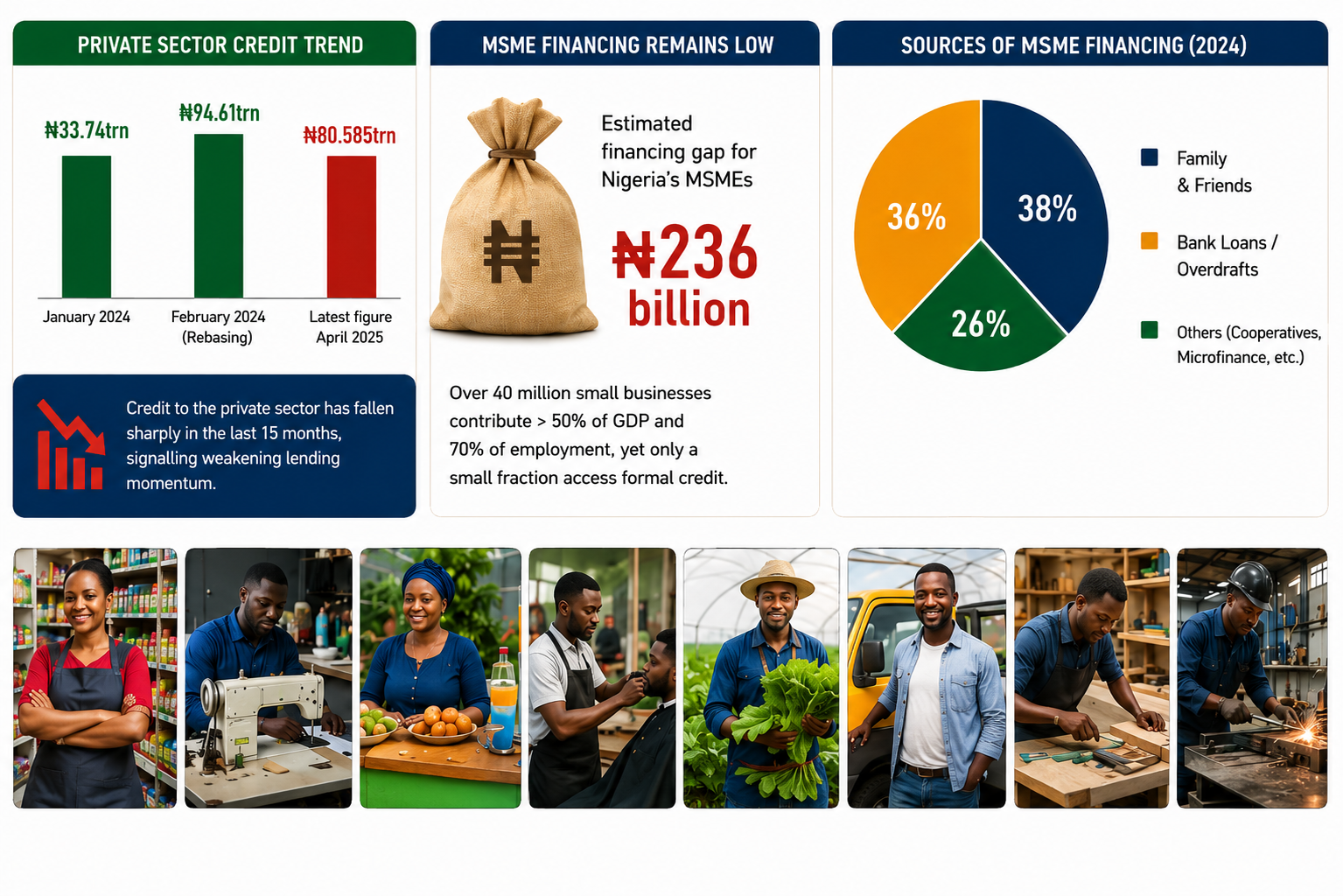
Private sector credit had climbed to a record N94.610 trillion in February 2026 from N93.743 trillion in January, reflecting stronger lending activity by financial institutions.
However, recent data from the apex bank indicate that credit to the private sector has since declined sharply to N80.585 trillion, signalling weakening lending momentum and growing caution among lenders.
The slowdown follows renewed global economic uncertainties, including geopolitical tensions and rising oil prices, which have heightened inflation concerns and prompted the Monetary Policy Committee (MPC) to retain the benchmark interest rate at 26.5 per cent at its latest meeting.
Economic analysts warn that the combination of high borrowing costs and slowing credit expansion could further strain Nigeria’s productive sector, particularly manufacturers and Micro, Small and Medium Enterprises (MSMEs), which are already grappling with rising operating expenses and subdued consumer demand.
The Centre for the Promotion of Private Enterprise (CPPE) cautioned that additional monetary tightening could undermine investment and economic recovery.
“The Nigerian economy remains fragile and structurally constrained. Further tightening of monetary conditions could significantly weaken credit expansion, dampen investment appetite and undermine the fragile recovery momentum within the real sector,” the organisation stated.
According to the CPPE, persistently high interest rates could also worsen loan defaults and increase debt-service burdens for businesses and government.
“Further tightening under prevailing conditions therefore risks imposing disproportionate costs on the productive sector without necessarily delivering commensurate gains in inflation moderation,” it added.
The credit squeeze is particularly troubling for Nigeria’s MSME sector, which faces an estimated financing gap of about $236 billion. Although the country has more than 40 million small businesses contributing over half of national GDP and nearly 70 per cent of employment, only a small fraction have access to formal bank credit.
A report by Stears on MSME lending in Nigeria, Ghana and Kenya found that despite their significant economic contribution, most small businesses remain excluded from structured financing opportunities.
Similarly, Moniepoint’s 2025 Informal Economy Report revealed increasing reluctance among entrepreneurs to seek loans due to rising borrowing costs and stricter lending requirements.
The report showed that 51 per cent of respondents had never taken a loan and had no intention of doing so, up from 30 per cent a year earlier.
Chief executive officer of CPPE, Dr. Muda Yusuf, attributed the challenge partly to poor financial record-keeping among small businesses.
“Many commercial banks don’t even want to deal with them because they consider them risky,” Yusuf said.
He explained that the absence of audited accounts and reliable financial statements often makes it difficult for lenders to assess repayment capacity and business sustainability.
The prolonged high-interest-rate environment has compounded the problem. Since 2024, the CBN under Governor Olayemi Cardoso has raised the Monetary Policy Rate from 18.75 per cent to 26.5 per cent in efforts to curb inflation and stabilise the economy, pushing lending rates for many SMEs above 30 per cent annually.
A 2024 MSME Survey by PwC Nigeria identified high interest rates as the leading obstacle to accessing credit, with 27 per cent of respondents citing it as their biggest challenge.
Financial experts say banks are increasingly adopting a risk-averse posture, directing credit primarily to businesses with strong governance structures, transparent financial records and proven repayment histories.
As a result, many small businesses have turned to informal funding sources such as family members, cooperative societies and microfinance institutions. PwC data showed that family and friends account for 38 per cent of MSME financing, while only 26 per cent obtain funding through bank loans or overdrafts.
Yusuf noted that reliance on informal financing often exposes entrepreneurs to even higher borrowing costs.
“Some of them pay as high as five per cent per month flat. Some pay up to seven per cent per month flat,” he said.
For many operators, such costs have made business expansion increasingly difficult. An SME operator in Agege, Musiliu Akinloye, advocated greater adoption of asset-based financing models.
“Banks should not just give cash; instead, they should finance the purchase of business assets directly and allow borrowers to pay over time,” he said.
Stakeholders have therefore called for measures to improve access to affordable credit, including enhanced financial literacy, concessionary funding schemes, credit guarantees and alternative credit assessment models.
National President of the Association of Small Business Owners of Nigeria (ASBON), Dr. Femi Egbesola, urged entrepreneurs to maintain proper financial records, separate personal and business finances and build credible credit histories through digital platforms.
Former chairman of the National Association of Small Scale Industrialists (NASSI), S.T. Kuti George, also advised SMEs to formalise their operations through registration with the Corporate Affairs Commission (CAC), tax compliance and stronger corporate governance practices.
Analysts warn that unless access to affordable financing improves, manufacturers and SMEs may continue to struggle with rising operational costs, slowing investments and weak consumer demand, with broader consequences for economic growth and job creation.
Also, the Manufacturers Association of Nigeria (MAN) has voiced concerns regarding persistently high lending rates, calling them a significant barrier to production and competitiveness in the sector.
The director-general of MAN, Segun Ajayi-Kadir, expressed hopes that commercial banks will develop tailored financial products to aid manufacturers in enhancing productivity.
He advocated for the CBN to encourage banks to allocate more funding towards the manufacturing sector and for government initiatives to create favourable conditions for extending long-term loans to manufacturers at single-digit interest rates.
Ajayi-Kadir believed that improved access to finance, coupled with reduced borrowing costs, would lead to increased production and enhanced competitiveness.
The president of the Lagos Chamber of Commerce & Industry (LCCI), Engr. Leye Kupoluyi, underscored the importance of maintaining a balanced Cash Reserve Ratio (CRR) for Deposit Money Banks and Merchant Banks. Currently set at 45 per cent and 16 per cent respectively, this ratio limits banks’ ability to lend to productive sectors.
Kupoluyi said as a result, banks may continue to prioritise larger, low-risk borrowers, while SMEs could keep facing challenges in accessing credit, saying that “the high effective cost of funds may persist as a considerable portion of deposits are non-earning.
“The 75 per cent CRR on non-TSA public-sector deposits further discourages banks from relying heavily on government funds, adding to the cost of maintaining such deposits,” he said.
He further noted that a more balanced policy environment could stimulate credit expansion, support private-sector growth, and promote economic activity in the near future. According to him, b-y addressing these financial barriers, the manufacturing sector can be poised for recovery and sustainable growth.

Sunday, October 18, 2026
N80trn Credit Retreat Deepens SMEs,Manufacturers’ Funding Crisis