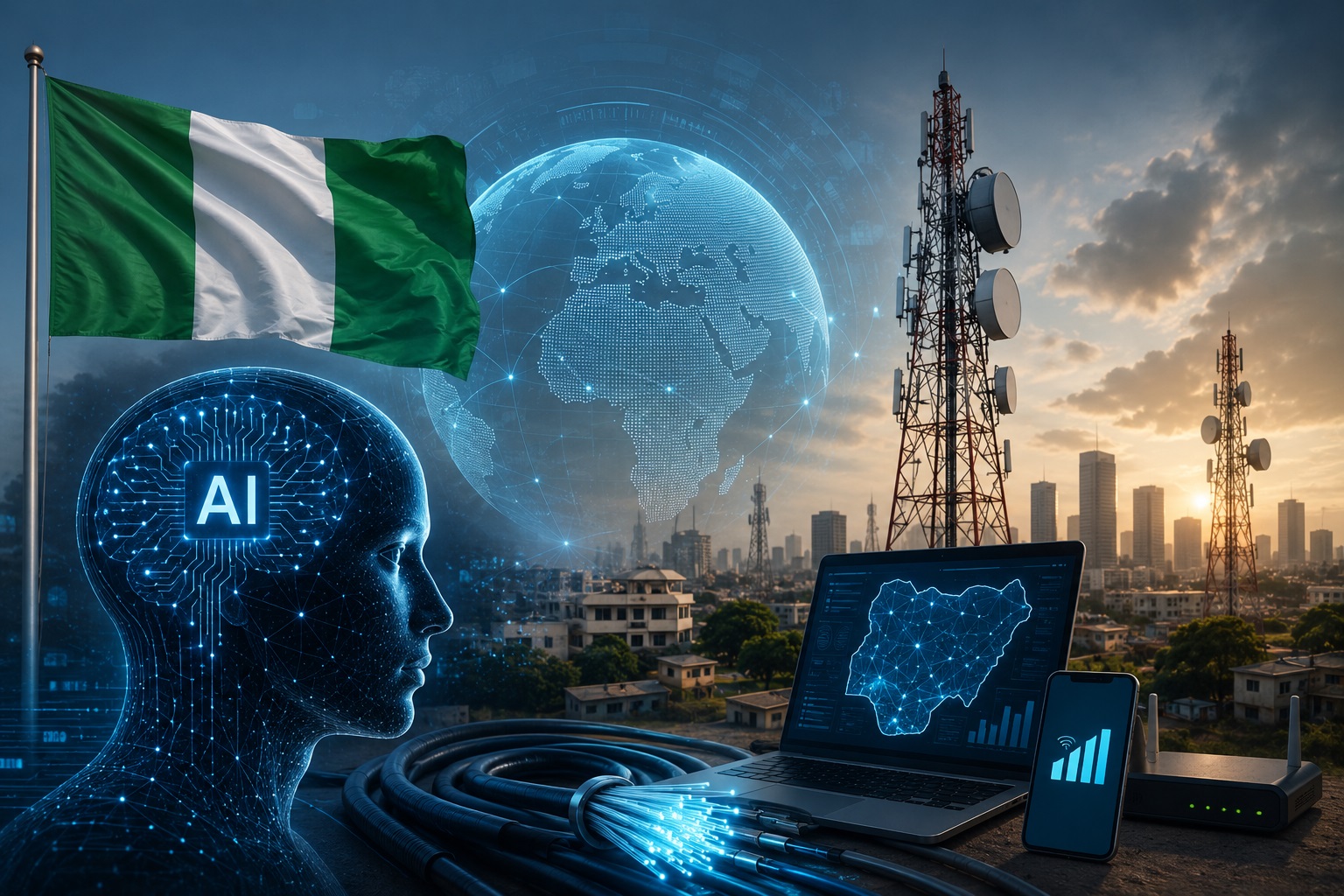
Artificial Intelligence (AI) is fast becoming the defining technology of the global economy, reshaping industries from finance and healthcare to education, manufacturing and agriculture. Yet, while countries are investing billions of dollars in fibre infrastructure, high-capacity data centres and next-generation telecommunications networks to power AI, Nigeria risks being left behind.
Industry players have warned that unless the country urgently upgrades its telecommunications infrastructure and develops AI-ready digital facilities, it could remain a consumer rather than a creator of AI technologies, forfeiting the economic opportunities that accompany the next wave of digital transformation.
The warning comes as Nigeria intensifies efforts to position itself as Africa’s digital powerhouse. Artificial intelligence has featured prominently in government policy discussions, while businesses are increasingly deploying AI to automate operations, improve customer experience and enhance productivity. However, experts argue that AI cannot flourish on weak broadband infrastructure, unreliable connectivity and inadequate computing capacity.
At the recent West Africa Telecoms Infrastructure Summit and Exhibition (WATISE) 4.0 held in Lagos, industry leaders unanimously agreed that telecommunications infrastructure has become the foundation upon which every successful AI ecosystem is built.
They allude to the fact that AI applications require ultra-fast broadband, low-latency fibre networks, resilient internet exchanges and local cloud infrastructure capable of processing enormous volumes of data.
Chairman of the Association of Licensed Telecoms Operators of Nigeria (ALTON), Engr. Gbenga Adebayo said the country’s AI ambitions cannot succeed without significant investment in telecommunications infrastructure.
“The AI revolution is fundamentally dependent on communications infrastructure. Artificial intelligence requires enormous amounts of data. The more we talk about AI, the more we must recognise that data consumption will continue to grow,” Adebayo said.
His concerns are reinforced by Nigeria’s rapidly expanding internet usage. Data from the Nigerian Communications Commission (NCC) showed Nigerians consumed a record 4.06 million terabytes, equivalent to more than four billion gigabytes of internet data during the first quarter of 2026 alone. While the figure demonstrates growing digital adoption, it also highlights mounting pressure on existing telecommunications infrastructure.
Experts believe Nigeria faces an even bigger challenge, which is the absence of AI-ready data centres. Unlike conventional enterprise facilities, AI workloads require specialised infrastructure, including graphics processing units (GPUs), advanced cooling systems, high-density computing racks and an uninterrupted power supply. These facilities demand billions of naira in long-term investments.
Similarly, at an earlier stakeholder event, Chief Executive Officer of Digital Realty Nigeria, Ikechukwu Nnamani, remarked that Nigeria currently lacks such infrastructure.
“There is no data centre in Nigeria today that is AI-ready. Local AI companies are creating solutions, but they are hosting abroad because the infrastructure here cannot support the kind of computing AI requires,” Nnamani warned.
He noted that the challenge extends beyond technology to national competitiveness.
“One of Teraco’s data centres in South Africa is bigger than all data centres in Nigeria combined, he said. He revealed that powering a 100-megawatt AI facility alone would require an investment of at least 100 million dollars if operators must generate their own electricity.
Technology policy adviser Jide Awe believes another overlooked obstacle is Nigeria’s dependence on foreign internet routing. According to him, large volumes of internet traffic generated within Nigeria still travel through overseas exchange points before returning to domestic users, increasing costs, slowing digital services and exposing critical information to foreign jurisdictions.
“Nigeria must redesign its internet ecosystem around local routing. Dependence on overseas exchange points quietly drains the economy, increases costs and exposes the country to unnecessary security and regulatory risks,” Awe said.
The experts noted that keeping more internet traffic within Nigeria would significantly improve latency, strengthen data sovereignty, lower operating costs for AI businesses and encourage greater investment in local cloud services. Combined with AI-ready data centres, such reforms could create an ecosystem capable of supporting indigenous AI innovation instead of relying almost entirely on foreign platforms.
However, infrastructure challenges have remained a quagmire. Although telecom operators invested more than ₦2.1 trillion in network expansion and modernisation in 2025, service disruptions remain widespread. While, the NCC’s uptime portal recorded 245 major network outages in May 2026 alone, affecting operators including MTN, Airtel, T2 Mobile, FibreOne, Layer3, ipNX and others. Such outages highlight the fragility of the infrastructure upon which Nigeria hopes to build an AI economy.
The consequences extend far beyond the technology sector. Artificial intelligence increasingly underpins digital banking, precision agriculture, smart manufacturing, autonomous logistics, healthcare diagnostics and public services. Weak telecommunications infrastructure therefore limits not only AI development but also broader economic productivity, innovation and job creation.
Experts say addressing the challenge will require coordinated investment in nationwide fibre networks, reliable electricity, AI-ready data centres, local cloud infrastructure, internet exchange points and stronger public-private partnerships. They also advocate policies that encourage domestic data hosting and reduce dependence on foreign digital infrastructure.
The stakes are high with countries investing aggressively in AI infrastructure and positioning themselves as producers of the next generation of digital technologies, while those that fail to build the necessary foundations risk becoming perpetual importers of foreign innovation.
Hence, for Nigeria, the choice is increasingly clear. For the nation to compete in the global artificial intelligence {AI} economy, it would depend on the strength of its telecommunication infrastructure capacities. And without resilient telecom networks, AI-ready data centres, as well as a stronger local internet ecosystem, the country’s ambition to become Africa’s digital leader could remain aspirational rather than transformational.

Monday, October 5, 2026
Nigeria Risks Missing AI Trillion-Dollar Economy Without Telecom Upgrades