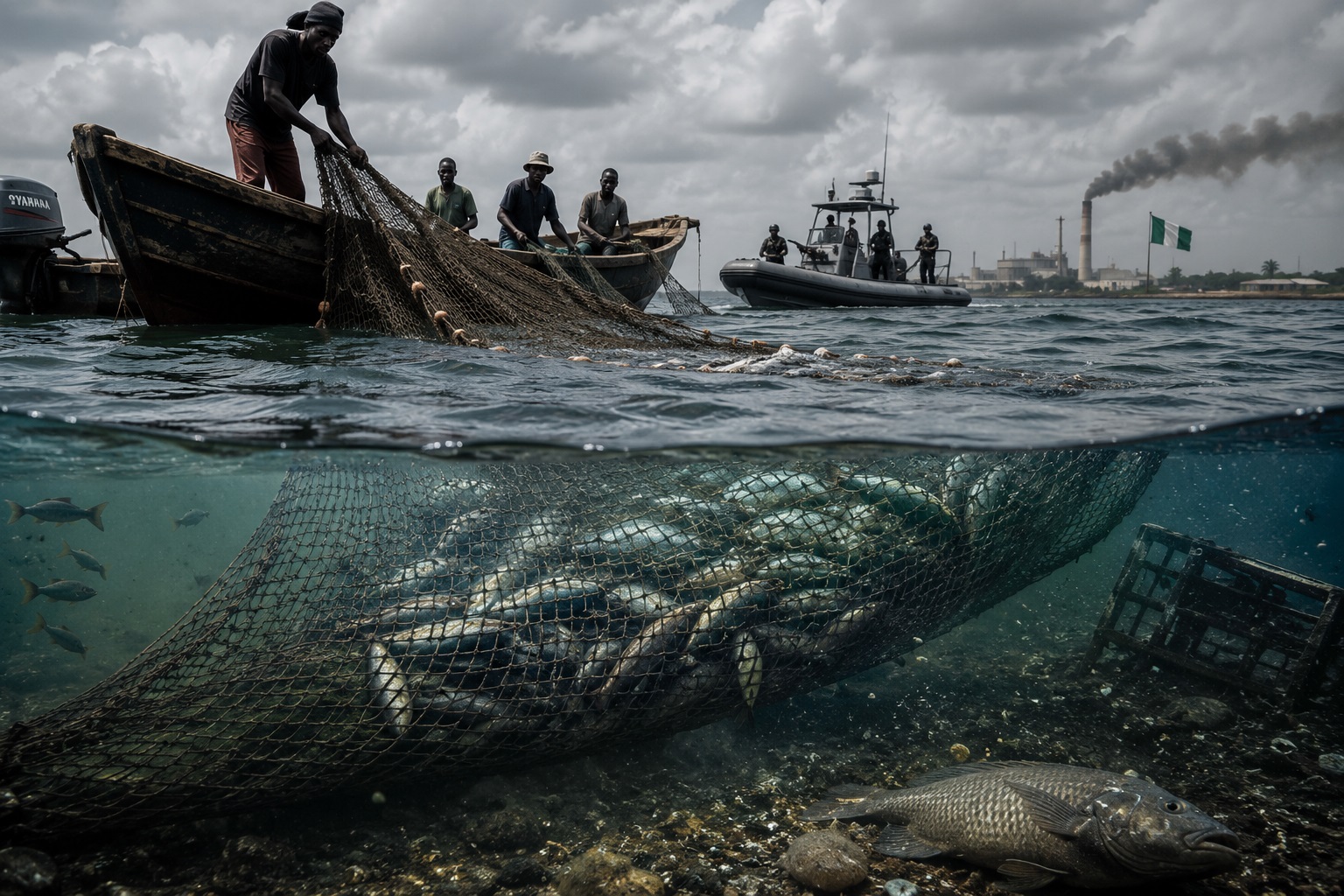
Nigeria’s marine economy is under mounting pressure as illegal, unreported and unregulated (IUU) fishing continues to drain between $70 million and $100 million annually from the country’s coastal waters, with foreign industrial trawlers repeatedly identified as major offenders operating within restricted fishing zones.
The losses, according to industry data, are compounded by the growing strain on Nigeria’s fisheries sector, which supports over 10 million livelihoods across fishing, processing, marketing and distribution chains.
Experts warn that the continued depletion of fish stocks is not only eroding income for coastal communities but also weakening national food security.
Nigeria’s fish consumption is estimated at about 3.6 million metric tonnes annually, yet domestic production supplies only around 1.2 million metric tonnes.
The resulting shortfall of roughly 2.4 million metric tonnes is largely filled through imports, a gap analysts say is being worsened by illegal fishing activities that further reduce local catch potential.
Marine experts caution that IUU fishing accelerates stock depletion by targeting both juvenile and mature fish populations, often using unregulated gear and operating in protected or exclusive artisanal fishing zones.
Over time, this practice disrupts breeding cycles, reduces regeneration capacity and weakens the long-term sustainability of Nigeria’s marine ecosystems.
Global estimates suggest that illegal fishing costs the world economy over $23 billion annually, with West African waters among the most vulnerable due to limited monitoring capacity, vast maritime boundaries and persistent enforcement challenges.
In response, the federal government has stepped up efforts to strengthen ocean governance through the Ministry of Marine and Blue Economy.
Last week, Nigeria announced its readiness to leverage the €59 million West Africa Sustainable Ocean Programme (WASOP) to enhance surveillance, enforcement and regional cooperation against illegal fishing.
The Minister of Marine and Blue Economy, Dr. Adegboyega Oyetola, said the initiative presents a strategic opportunity to improve maritime security and protect marine resources across the sub-region.
He described IUU fishing as a direct threat to food sovereignty, national security and coastal livelihoods, warning that unchecked exploitation of marine resources could have long-term economic consequences.
“Illegal, unreported and unregulated fishing is a direct threat to national security, food sovereignty and the survival of our coastal communities,” Oyetola said. “We cannot afford to stand by and watch our marine ecosystems depleted and economic livelihoods eroded.”
He called for stronger international cooperation, enhanced monitoring systems and decisive enforcement measures to dismantle illegal fishing networks operating within Nigerian waters and across West Africa.
Despite government interventions, stakeholders argue that enforcement remains the weakest link in the fight against IUU fishing.
The president of the Nigerian Trawler Owners Association (NITOA), Mrs. Benedette Okonkwo, acknowledged ongoing government efforts but stressed that policy declarations must be matched with visible action, particularly in prosecution and deterrence.
According to her, while arrests of illegal vessels are often announced, follow-through prosecution is inconsistent, weakening the deterrent effect of enforcement operations.
“I am not saying government should not fight IUU fishing. It is important for protecting our waters and ensuring sustainability,” she said. “But when vessels are caught, are they prosecuted? We cannot keep saying vessels are harvesting our resources without visible consequences.”
Okonkwo warned that arrest statistics without convictions risk encouraging repeat violations, stressing that enforcement agencies must demonstrate accountability if Nigeria is to safeguard its marine resources effectively.
She also distanced members of NITOA from illegal activities, insisting that domestic operators comply with existing regulations while most infractions are linked to foreign industrial trawlers operating within Nigerian waters.
“Because they are foreign vessels, our waters cannot be that porous. Agencies responsible for maritime monitoring must ensure compliance and prosecute offenders rather than merely report incidents,” she said.
She further noted that illegal fishing has serious implications for stock sustainability, local employment and revenue generation, warning that continued exploitation could permanently damage Nigeria’s coastal economy.
“If people come in and take our fish illegally, it affects stock levels and sustainability. It also affects the economy because it denies indigenous operators the opportunity to benefit from natural regeneration,” she added.
Beyond economic losses, Okonkwo highlighted concerns over fisheries data integrity, explaining that unreported catches distort national statistics and make it difficult for policymakers to properly assess marine resources and plan sustainable quotas.
“In terms of data, we cannot even say what is being caught. So we lack proper information about our marine resources. That is a serious problem,” she said.
A fisheries expert at Dennis Osadebay University, Asaba, Delta State, Adagha Oghenefejiro, explained that IUU fishing takes multiple forms, each undermining fisheries management systems and marine ecosystems.
He noted that illegal fishing includes operations without licences, fishing in restricted zones, exceeding catch limits, harvesting protected species and using banned equipment, all of which contribute directly to stock depletion and habitat destruction.
“Unreported fishing occurs when catches are underreported or misreported to authorities, undermining accurate stock assessment and quota allocation,” he explained. “Misreported data distorts fisheries statistics and weakens management decisions, potentially accelerating overfishing.”
Adagha also warned that unregulated fishing, particularly in international waters with weak governance, allows exploitation without accountability due to limited monitoring capacity across vast maritime zones.
Sunday, October 18, 2026
Illegal Fishing Costs Nigeria $100m Annually, Threatens 10m Jobs