
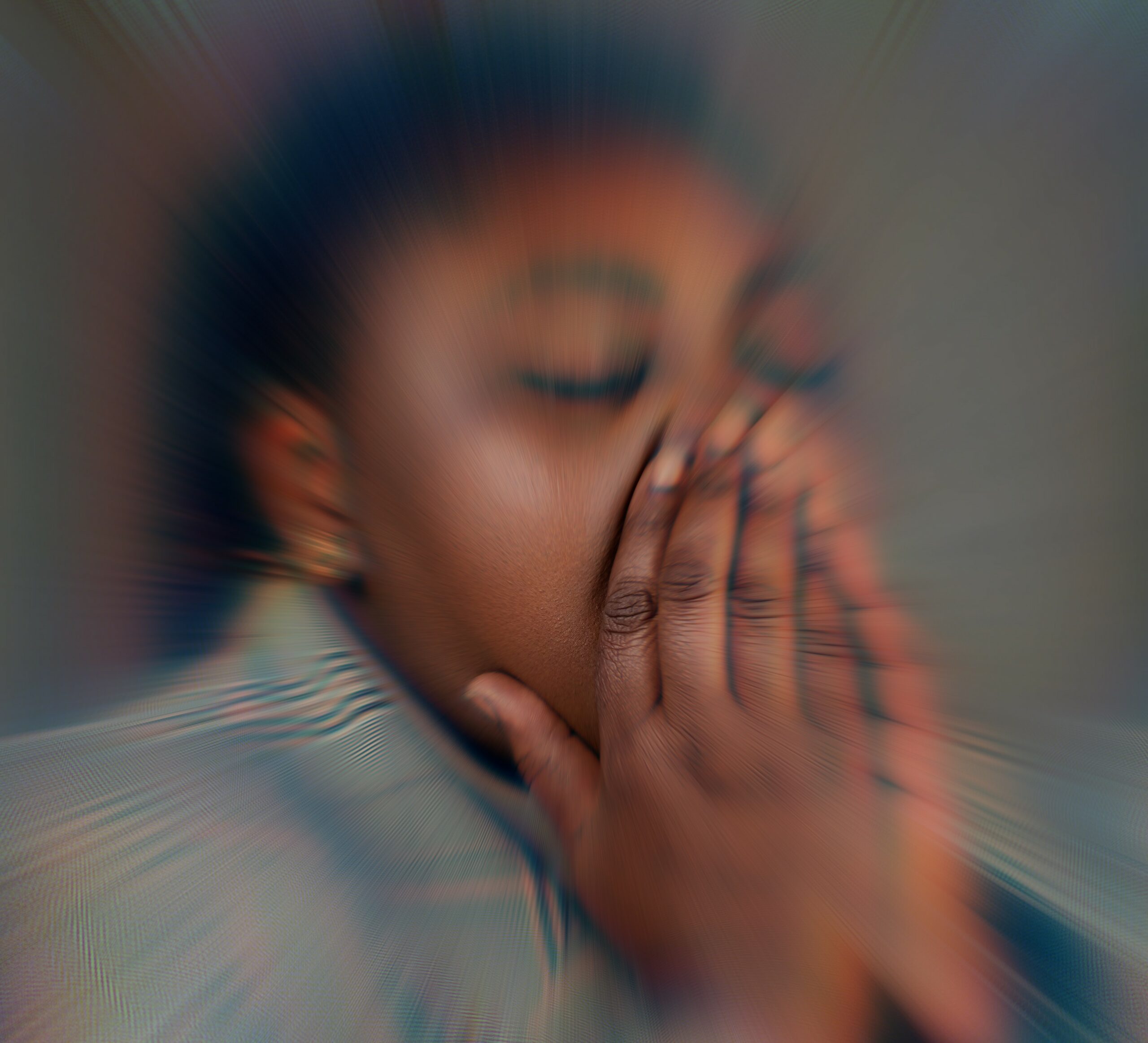
Between Visibility and Concealment. If you wonder what it means to capture a moment when the experience itself never seems to stand still but keeps moving, it’s In Between Moments, Oluwadamilola Oladapo explores the fragile space between presence and absence, clarity and uncertainty. Rather than treating portraiture as a record of someone’s appearance, this photograph asks us to think about how emotion and memory shape what we see and how we see.
This image shows us a closely cropped figure with eyes closed and the other hand resting against the face. This pose feels private but reflective; it might suggest tiredness, withdrawal or a moment of quiet thought, but the photograph does not settle into stillness. Visible lines spread across the face, giving the impression that the image kept shifting even as we look at it. What could have been a simple, intimate portrait becomes something less certain and more searching with endless possibilities.
Distortion as a Language of Experience
The face is at the centre of the photograph, yet we cannot read it completely. The closed eyes prevent the direct connection often associated with portraiture, while the blurred edges and overlapping shape make the subject feel both close and distant. We can see the person clearly enough to recognise a human presence, but not clearly enough to know what they might be feeling or trying to say.
That distance, or should we say the lack of distinct judgment of the portrait, is part of the image’s appeal. This portrait tells us that a portrait can bring us close to another person without giving us access to their inner life. Here, the hand resting against the face adds to the sense of intimacy and silence, but it also leaves the gesture open to multiple interpretations. It might express exhaustion, self-protection or introspection. The photograph does not tell us which reading is correct, allowing each viewer to bring their own experiences and interpretations to the image.
Between Experimentation and Resolution
The motion blur is more than just a visual effect; it shapes the way we understand the photograph. The streaks seem to pull the subject’s features outwards, as though the moment is stretching beyond the frame. This challenges the familiar idea of photography.
Our memories rarely work like perfect photographs. Feelings can change what and how we remember it. And time can soften or change the details of an experience. The shifting outline in Between Moments suggests something similar: a moment can be recorded, but it cannot be preserved exactly as it was felt.
The cool teal and grey tones create a subdued atmosphere for the photograph, while the warmer reddish-brown tones of the skin keep the image grounded in the human figure. This contrast helps the photograph balance abstract with intimacy. Even as the image becomes visually unstable, the person remains at its centre.
A Moment That Refuses to Settle
The same distortion that gives the photograph its character can also make it difficult to read. At times, the blur and repeated contours compete with the subject, drawing attention to the technique rather than the quiet gesture of the closed eyes and resting hand. For some viewers, the effect may feel stronger than the emotion it is meant to convey.
That tension is not necessarily a flaw. It raises an interesting question for Oladapo’s developing practice: how far can an image be disrupted before the technique begins to overwhelm the person within it? Experimenting with different levels of focus, movement, exposure, and space could open up additional ways to balance clarity with uncertainty.
The photograph is most compelling when its visual experimentation stays connected to the human presence at its centre. Its strength lies not simply in making a familiar portrait look unusual, but in using that unfamiliarity to encourage us to look more carefully at things we think we can see but are not visible.
Between Moments sits at the intersection of traditional portraiture and experimental fine art photography. It does not offer a complete account of the person depicted, nor does it attempt to explain the meaning of the gesture. Instead, it leaves us with an image that feels intimate yet elusive, recognisable yet unsettled.
For Oladapo, the photograph shows how fine art photography can explore not only what the camera records, but also how seeing is influenced by emotion, memory and time. Its most interesting quality is the sense that the moment is already slipping away as it is being captured. The image invites us to accept that some experiences cannot be held still or fully explained, and that their uncertainty can be meaningful in itself.