In her latest body of work, visual artist Funmilayo Kayode offers a powerful exploration of female resilience, presenting ‘The Strength of Woman’ as part of the ‘Our Shared Prosperity’ exhibition during the Calabar Carnival 2024.
The month-long exhibition, which ran from December 1 to 31, 2024, at the Calabar Art Exhibition, reframes womanhood not just as a gender, but as a living force; deeply ceremonial, spiritual, economic, and anchored in cultural memory. Throughout the series, Kayode elevates the woman into both subject and symbol. These are not passive individuals merely sitting before a camera; they are depicted as custodians of history, labour, beauty, and communal continuity.
The most compelling frames borrow heavily from nature. By utilizing earth-toned garments, clay vessels, woven objects, shells, and natural light within forested backdrops, Kayode builds a raw visual vocabulary of origin and endurance. Crucially, materials like clay, fibre, calabash, raffia, and shell transcend mere decoration. They seamlessly extend from the subjects’ bodies, whispering stories of fertility, inheritance, craft, nourishment, and ancestral wisdom.
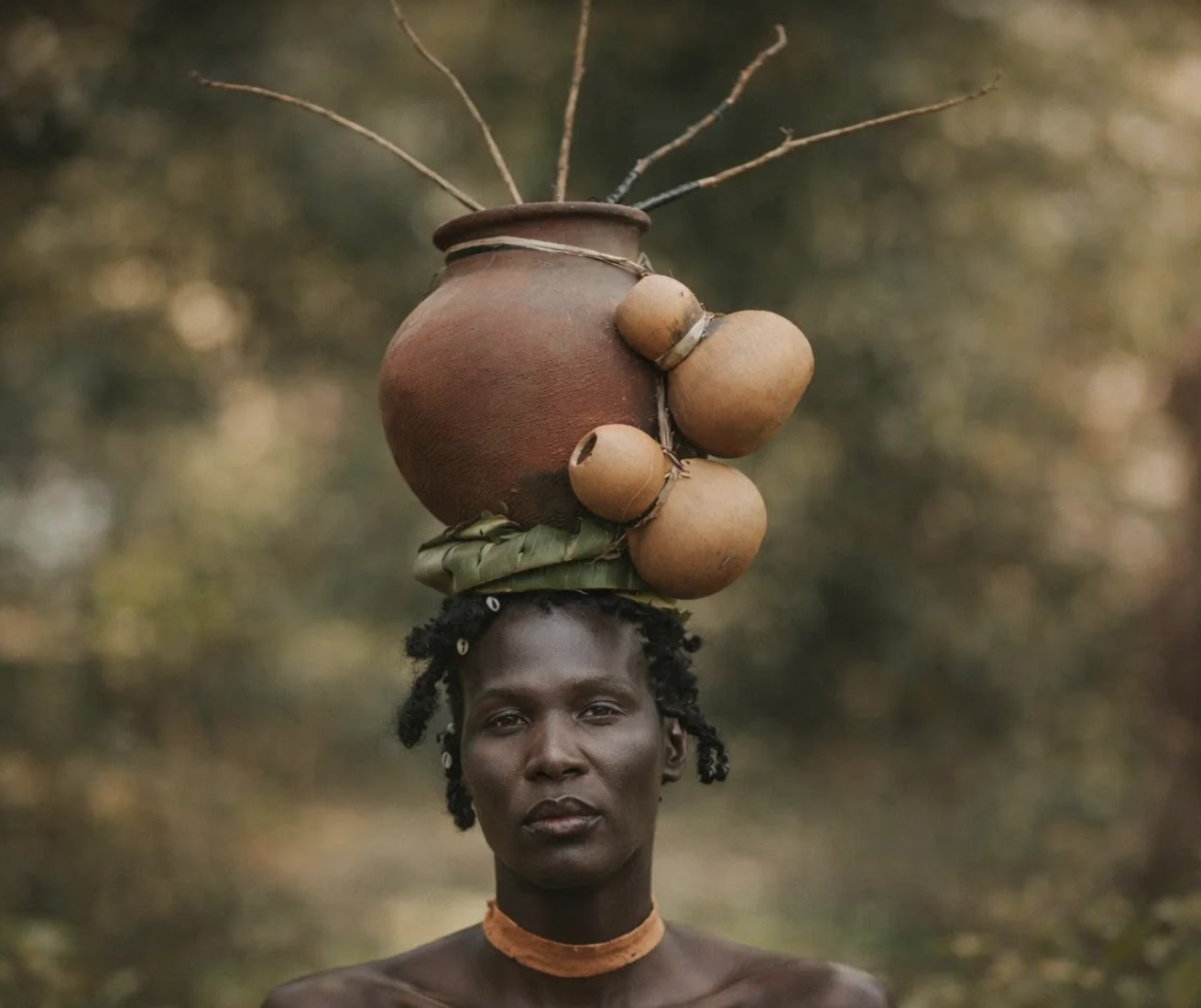
The opening portrait carries a particularly striking weight. A woman locks eyes with the camera with calm intensity, effortlessly balancing a large clay pot and a cluster of gourds on her head. The image is quiet, yet it speaks volumes. Her direct gaze gives the photograph its undeniable authority, while the balanced vessels feel sculptural, transforming her posture into an architectural form. Here, strength is not a loud physical struggle, but a masterclass in control, balance, and composure. A blurred natural background allows her figure to emerge iconically, straddling both the modern moment and an ancient visual tradition.
In another frame, a seated figure wrapped in an expansive orange garment commands a regal presence. The fabric spills outward like earth or fire, while suspended woven baskets and clay objects around her evoke scenes of domestic labour, ritual, and creative making.
The composition thrives because it refuses to reduce “prosperity” to mere material wealth. Instead, Kayode connects prosperity directly to the hands, the land, the household, and the community structures that women quietly sustain. Dignified and self-possessed, the subject occupies the landscape as both its guardian and its source.
The third photograph shifts the narrative into a quieter, more intimate space. A young woman handles a string of shells resting on a dark plate, her attention completely turned inward. This deliberate shift moves the series from the monumental to the contemplative. The shells evoke ideas of value, memory, adornment, and historical exchange, turning a simple gesture into something ceremonial. Enhanced by the rhythmic contrast of a black and orange garment, her lowered gaze lends the work an emotional depth that reminds the viewer that strength is not always public or performative. Sometimes, it lives in care, reflection, and the quiet preservation of inherited traditions.
Within the broader festival theme of “Our Shared Prosperity,” Kayode’s work delivers a profound commentary. The series argues that true prosperity cannot be measured by economic expansion alone, but by cultural continuity. It challenges the audience to recognize the unseen systems of labour, aesthetics, knowledge, and spiritual resilience that women carry across generations, positioning the female figure at the very center of communal survival.
Curatorially, the series hits its stride when it embraces its staged fine-art photography roots. The three outdoor portraits feel entirely cohesive, meticulously styled, and visually mature, sharing a unified palette and atmospheric tension.
While an installation image of a painted female portrait is included, offering decent evidence of how the theme expanded into the physical gallery space, it feels visually detached from the core photographic narrative.
Similarly, the final portrait of a woman in white against a woven backdrop introduces a direct, bright studio aesthetic. Though it supports the overarching theme of cultural identity, it lacks the moody, cinematic refinement of the first three images and slightly disrupts the curatorial flow.
Ultimately, *The Strength of Woman* succeeds because it treats the female body as a canvas of profound meaning rather than a mere spectacle. Kayode’s contribution to the Calabar Carnival programme beautifully mirrors the spirit of the festival, proving that shared prosperity ultimately begins with those who carry, shape, and preserve the life of the community.