
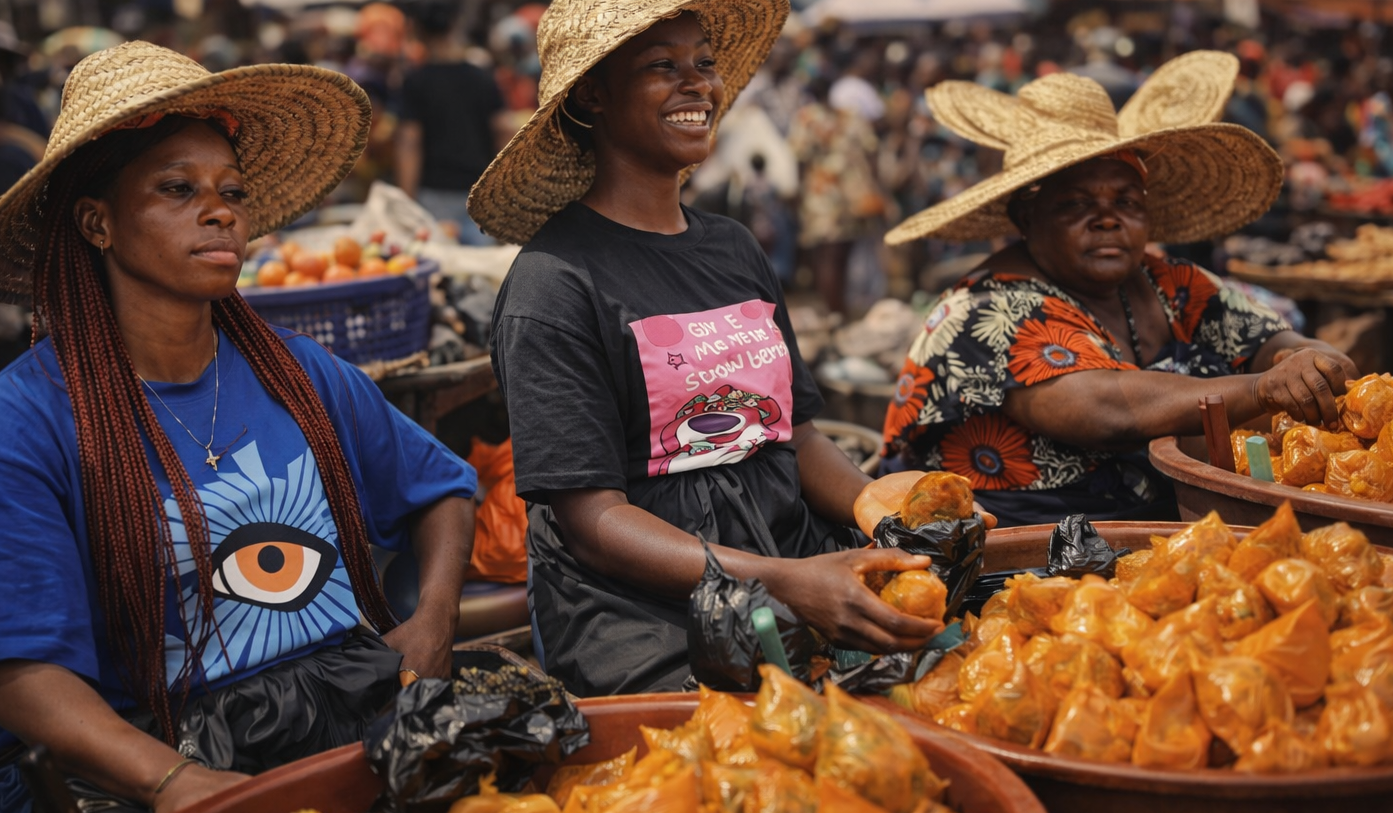
To step into a bustling open-air market anywhere in West Africa is to immediately subject one’s senses to a chaotic orchestra of sights, sounds, and smells. Yet, inside this overwhelming commercial rush lies a deeply entrenched social grid anchored by women. It is this exact intersection of labour, feminine resilience, and quiet kinship that fine art photographer Uche Rita Okolie masterfully captures in her piece, Market Sisters. Presented during the recent Society for Nigerian Artists Exhibition at the Kenneth Dike State Library in Awka, Anambra State, the photograph offers a compelling, deeply human look into the shared economies that keep urban African centers breathing.
At first glance, Okolie’s frame presents a familiar, everyday scene: three market women seated side-by-side behind wide trays of produce, shielded under broad woven straw hats while the blur of a busy market hums in the background. But where a casual observer might only see commerce, Okolie finds a theater of human relations. These women are not passive background figures swallowed by the marketplace; they entirely command the frame. Through a carefully orchestrated visual rhythm, Okolie elevates an ordinary day of trade into a profound testament to dignity. Broad Smile & Inward Openness
The true heartbeat of the image lies in its exploration of informal sisterhood. While the three women share the same tight trading space, Okolie captures three distinct emotional wavelengths. The woman on the left cuts a composed, inward figure, her gaze drifting away from the camera. In contrast, the central figure breaks into a broad, infectious smile, injecting immediate warmth and movement into the composition. To the right, the third woman anchors the trio with a steady, more reserved demeanor, her hand reaching toward her goods. Together, they form a perfect emotional triangle: reflection, joy, and endurance.
Okolie’s framing choices give the photograph its formal power. The wide straw hats create repeating circular patterns across the top of the frame, acting as an artistic link between the women while isolating them from the chaotic crowd behind. While these hats are purely practical shields against the unforgiving sun, Okolie transforms them into sculptural crowns, lending the seated traders an undeniable aura of authority.
Colour plays an equally vital role. A dense field of vibrant orange goods dominates the foreground, radiating warmth and abundance. Against this bright field, the women’s clothing introduces individual notes of blue, black, and patterned fabrics. Okolie uses this palette not merely for aesthetic appeal, but to steady the competing energies of the marketplace. The result is a scene that feels remarkably alive, yet anchored.
What makes Market Sisters stand out is its stubborn refusal to reduce these women to mere symbols of economic hardship. While the photograph does not hide the daily grind; the heat, the waiting, the sheer weight of survival, it refuses to flatten its subjects into pity. By capturing the central figure’s spontaneous smile, Okolie allows joy to exist directly inside the space of labour, rather than outside it. The image reminds us that the marketplace is not just an economic zone where money changes hands; it is a relational hub where gossip, glances, shared jokes, and informal safety nets constantly circulate. The sisterhood depicted here is practical, not sentimental. It is forged through the daily rhythm of sitting together, enduring the same public conditions, and holding space.
If the work has a minor vulnerability, it is that the visual pull of the blurred background and the tactile abundance of the foreground occasionally competes with the individual identities of the women. Yet, this minor tension produces its own rewarding effect. The women are not isolated portraits; they are entirely inseparable from the market environment itself.
Ultimately, Market Sisters functions as a brilliant study of social architecture. Through Okolie’s lens, the market women are rightfully placed at the very center of the city’s life; organizing goods, sustaining livelihoods, and shaping the emotional fabric of public spaces. It remains a confident, resonant contribution to contemporary African fine art photography, proving that the marketplace is sustained not just by trade, but by kinship.