
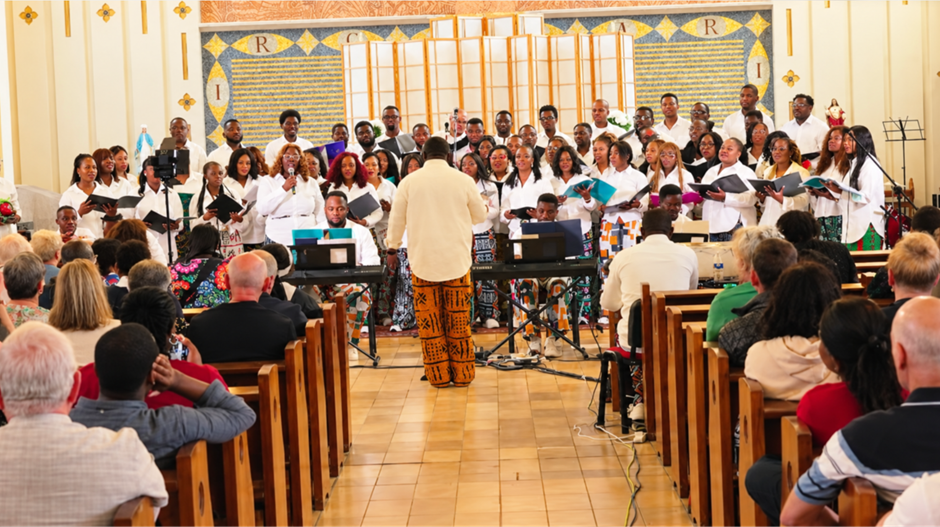
“Kumama,” the song, is an Afrocentric gospel music, sung in steads, shelters, churches, and diverse communities in Africa. The word, originating from Lingala, a well-spoken language in the Democratic Republic of the Congo means “Be praised.” After this has been reimagined by many singers, on July 31, 2026, Nigerian soloist, and singer, Esther Dike, backed up by the choir of St Mary’s RC Church, Clive Road, Failsworth, Manchester, M35 0NN, United Kingdom bring it back to life. The solo, “Kumama Papa” is arranged by Charles Onwunuya, from the original music released in 2022 which is credited to Grace Lokua and Prinx Emmanuel.
The piano chords lead solemnity, gentle strikes of the guitar strings, the cautious gaits of the orchestra and reverence. Setting in motion the beat, the chords get accompanied by drums. There are few strokes on the snare, and the tom rolls transitions to the rims, keeping crisp the beat. Another roll ushers in the orchestra, pushing up the tempo of the beat and lighting brightly the atmosphere. The agbamole-like sound tucks in culture into the beat, infusing it with an indigenous rhythmic sound, deep, adding a sonic African identity to it, too. All these prepare the way for not the orchestra alone, but for Esther Dike, her distinct voice, infectious calm, and solo.
Repetition is a tool used in the song, the most, to make the message stick with the listeners. The refrain, coming and going several moments gives the song a communal character, which also gives the audience a created space to be a part of the song, and this brings warmth, shared value and the deepening of love even in a religious setting. Even while the song was repeated in parts at some points, Esther’s performance adds to the harmony. As an experienced soloist and singer across two continents, weaving together the traditional culture of her land with the western sonic values of the UK has been her way.
Esther’s voice, added to the orchestra, isn’t a norm. Apart from her voice, her character during her performance contributes to the spiritual message and feel of the song. Using the song, Esther invites reflection, also weaving together deep retrospection and gratitude. Notably, the message of the song also infuses faith. At times, while human beings fight their battles and see victory as not forthcoming, then seeing it as near brings the song of praise. Esther understands this about how the Almighty works, hence her outpour of her depth during the presentation.
The arrangement of the song makes it easy for her, and the orchestra. While the song passes out its message, and the Esther-led performance inspires the audience, there are still some parts that call for correction of some technical shortcomings. The snare drum and toms lack clarity and tightness needed, and the muddiness in the sound, stemming from the technical unit’s handling of the instruments and microphones have some effects on the performance. Although, bearable, and does not totally cause a disruption, but should have been avoided.
Esther Dike sings “Kumama” with a voice that celebrates faith and gratitude and shows the power of praise. I felt the breath of the orchestra fill the room and give the song life and I heard the message of Esther Dike echo with many listeners. Even though some technical imperfections sometimes cloud the presentation the performance still holds its warmth and its cultural identity. Esther Dike reminds listeners that praise is not a response to victories already won but also an expression of faith, in victories yet to come.