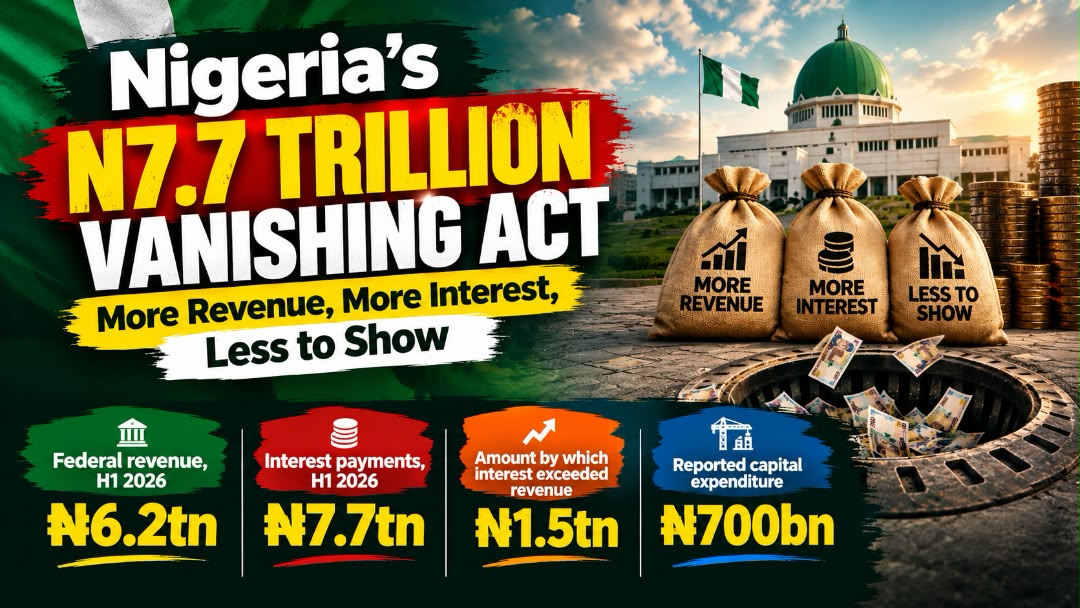
What makes Nigeria’s fiscal situation particularly troubling is the contradiction between the government’s growing financial obligations and citizens’ expectation that public revenue should translate into tangible public value. Nigeria’s fiscal story appears to have “voodoo” trends, owing to the fact that in just the first six months of 2026, it is alarming that the Federal Government spent N7.7 trillion on interest payments alone, against revenue of just N6.2 trillion. This has left most Nigerians confused because it paid creditors more in interest than it collected in revenue, leaving a N1.5 trillion gap before accounting for the many other responsibilities of government.
At this point, the more disturbing figure lies elsewhere. This signifies a magical and striking twist, the government spent N7.7 trillion on interest payments, while capital expenditure dropped to about N700 billion from N2.2 trillion in the same period of 2025, according to the World Bank’s October 2026 Nigeria Development Update.
The contrast is brutal. The interest bill was roughly 11 times reported capital expenditure. Meanwhile, another more troubling issue is that in a country struggling with infrastructure deficits, expensive electricity, inadequate public services and businesses fighting to remain productive, this raises a question the government cannot afford to evade. What does fiscal stability mean when the cost of servicing yesterday’s borrowing threatens to overshadow investment in tomorrow’s economy?
One point to take account of is that the figures do not establish that debt interest alone caused capital expenditure to fall. Nor does every reduction in public investment automatically represent waste. But the gap is too significant and practically too serious to be buried beneath reassuring claims about improved revenue collection or a narrowing fiscal deficit.
Nigeria’s revenue increased from N3.6 trillion in the first half of 2025 to N6.2 trillion in the first half of 2026, an increase of approximately 72 per cent. Yes, this could be said to be substantial progress. Meanwhile, interest payments jumped from N5.6 trillion to N7.7 trillion, a rise of about 37.5 percent. The government may be collecting more revenue, but the cost of servicing its debts continues to eat into its earnings, leaving it with little room to meet other pressing needs.
For every N100 collected in federal revenue, approximately N124 went towards interest. This does not mean Nigeria is necessarily insolvent, nor does it mean interest payments are the only claim on public finances. It does, however, expose a serious imbalance between the government’s revenue capacity and its debt obligations.
And when a government’s financial obligations grow so large that its freedom to invest becomes constrained, the consequences do not remain inside the Treasury. Beyond the treasury, there are ripple effects as they travel into unfinished roads, unreliable infrastructure, constrained public services and a business environment in which firms must absorb costs that more productive public investment could help reduce.
The real scandal, therefore, is not simply that Nigeria owes money; it is that the country must now answer a harder question. Are its borrowing decisions building an economy capable of carrying the debt, or are the costs of past and present borrowing progressively narrowing the resources available to build that economy?
Making a clear distinction in matters like this important and this is because borrowing is not necessarily irresponsible. Governments can use loans to finance infrastructure and other productive investments that create jobs, strengthen the economy and generate the revenue needed to repay the debt.
In many cases, the danger emerges when borrowing of N166.79 trillion accumulates without commensurate or equal growth in the economy’s ability to service it or when the returns on borrowed funds remain unclear. At that point, debt ceases to be merely a financing instrument and becomes a growing claim on future public resources.
Nigeria’s fiscal figures demand that this possibility be examined without sentiment or political convenience.
One of the encouraging points in the World Bank’s assessment is that the Federal Government’s fiscal deficit is getting smaller. The World Bank says the deficit fell from N11 trillion in the half of 2025 to N9.9 trillion in the same period of 2026.
The World Bank also warns that a drop, in capital spending and fewer money‑intensive projects are part of why Nigeria’s fiscal position looks better.
That qualification deserves more attention than it has received in the broader conversation about economic reform.
Also, it should be made known that a lower or smaller budget deficit can indicate stronger public finances. This happens when it results from higher revenue, more efficient expenditure and reduced financing needs, leading to less borrowing, while the interpretation changes when the improvement is accompanied by a steep contraction in capital spending.
It is more concerning to know that delayed road projects can leave businesses paying more to move goods. Think about how weak electricity infrastructure can force manufacturers to spend more on power. Bad transport networks make it costlier to get farm produce to market. And not enough money put into healthcare and education hurts the skills and energy of the workforce. These things add up and slow down growth.
It is even more concerning to know that postponed road projects can leave businesses paying more to move goods. Come to terms with how inadequate electricity infrastructure can force manufacturers to spend more on alternative power. Poor transport networks increase the cost of agricultural distribution, while insufficient investment in healthcare and education weakens human capital and productivity.
These consequences can eventually undermine the very revenue growth the government needs to reduce its dependence on borrowing.
The point is not that every naira allocated to capital expenditure must be spent regardless of project quality. Nigeria has a legitimate responsibility to eliminate wasteful contracts, abandoned projects, inflated costs and politically motivated expenditure. But cutting productive investment is not a substitute for fixing the fiscal system.
The government needs to prove whether the drop in spending on capital projects is because of insufficient money coming in, different choices about where to spend money or a planned move to reduce the amount of money the government spends more than it takes in. It also needs to explain which projects were hit what bills are still not. How the cuts will affect the economy in the future.
Without this explanation, a narrower deficit risks becoming an incomplete measure of progress.
It would be misleading to portray Nigeria’s fiscal position as though nothing has improved; there may likely be some improvement. Revenue increased substantially between the first halves of 2025 and 2026 no doubt, while the reported fiscal deficit narrowed. The World Bank also identified stronger corporate tax and independent revenue receipts, along with improved oil receipts, as factors supporting the revenue performance.
As a matter of fact these gains matter. In a real sense, this is to say that when a country collects more revenue locally, it is better placed to fund public services, thereby help the country to rely less on borrowing. Better tax management and improved compliance can also strengthen government finances and make the economy more resilient.
Meanwhile, the persistence of an interest bill exceeding federal revenue shows how difficult it is to convert those gains into meaningful fiscal breathing room.
Nigeria’s problem is not simply whether it can collect more money. Beyond this, it is whether the revenue it collects can sustainably cover its obligations while leaving sufficient resources for public investment and essential services.
To achieve such feat, that requires a closer examination of the composition and reliability of revenue. How much of the improvement comes from recurring tax receipts? In all of this, it will be required to ask, how much depends on oil prices, production volumes or one-off payments and are independent revenues being collected consistently? Are public enterprises remitting what they owe? Are tax exemptions, revenue leakages and poor compliance costing the government money it could collect without putting more pressure on taxpayers who already pay what they owe?
These questions matter because temporary revenue gains cannot safely support permanent spending commitments. Nor can the government rely indefinitely on favourable oil-market conditions to finance obligations that continue regardless of the direction of global prices.
In such a situation, it is better to make it clear that a sustainable fiscal plan should bring more people and businesses into the tax net, plug revenue leakages and make it easier for businesses to grow. Tax reforms must also be fair and predictable and not just about raising taxes in ways that leave households with less money to spend or discourage and further frustrate businesses from investing.
Tax policy should strengthen the capacity of the economy to produce and earn, not merely extract more from an already strained productive sector.
The rising cost of domestic borrowing is another critical part of the story. The World Bank identified elevated domestic borrowing costs as a factor contributing to the increase in interest payments. This creates implications that extend beyond the government’s accounts.
This is another aspect that calls for adequate scrutiny because when treasury bills and government bonds offer attractive risk-adjusted returns, banks and other investors may allocate more funds to government securities, depending on their liquidity needs, portfolio strategies, regulatory requirements and assessment of private-sector risks. In fact, to make it clearer, it would be said that under certain conditions, this can make it more difficult or expensive for businesses to secure financing.
To be fair enough, the effect should not be exaggerated because, on the flip side, government securities provide legitimate investment opportunities, support liquidity management and help finance public expenditure. It is still arguably the case that banks do not automatically abandon private-sector lending simply because government instruments offer attractive yields.
Nevertheless, the balance between financing the government and financing productive enterprise deserves scrutiny in an economy where businesses already face high operating costs, infrastructure deficits and significant financing constraints, as all these are depicted to be averse to the business environment.
A manufacturer deciding whether to expand production does not assess interest rates in isolation. First, what comes to mind is that it must consider electricity, logistics, foreign-exchange exposure, taxes, demand and, upon this, there must be consideration for the cost of capital. For small and medium-sized enterprises, expensive credit can make an otherwise viable investment commercially unattractive and easily out of business.
The more concerning part is that when productive firms cannot obtain affordable financing, their ability to expand output, employ workers and generate taxable income is weakened. If the government simultaneously struggles to finance the infrastructure that would reduce their operating costs, the economy faces a damaging combination of expensive private production and expensive public financing.
At this point, this is the cycle Nigeria must break because when borrowing becomes more expensive, the government spends more on interest and has less money to invest in infrastructure and other productive sectors. The government already knows that poor infrastructure then holds back productivity and business growth, as this makes it harder for the government to generate more revenue.
The solution is not to force interest rates down while ignoring inflation and economic realities. It is to tackle the problems that make borrowing so expensive in the first place, as this will eventually create a friendly environment.
Meanwhile, this means restoring confidence in the government’s finances, cutting avoidable borrowing, managing debt better and making sure borrowed money is put to good use and managed judiciously. To get it right the government must also work more closely with the CBN on economic policy, while allowing the bank to make monetary decisions independently.
Perhaps the biggest question is one Nigeria has not seriously answered. This is to say, what has the country actually gained from all the money it has borrowed over the years?
One outstanding fact is that the total amount of public debt is important, but it cannot in any way or by itself determine whether borrowing has been productive. Yes, a country may borrow heavily and still strengthen its economy if the funds finance viable infrastructure, productive assets and investments that expand future revenue, which is a fact that cannot be disputed. Another may borrow less but struggle if the money is poorly allocated or fails to generate lasting economic benefits, which is the case of Nigeria presently.
Nigeria needs a more rigorous public accounting of the relationship between borrowed funds and completed projects.
This happens to be one aspect of the problem in Nigeria because for major debt-financed projects, citizens should be able to identify and completely know the amount borrowed, the project’s original cost, the funds released, the completion status, the economic benefits expected and the actual results delivered. Where projects remain incomplete or significantly exceed their budgets, without much ado, the responsible authorities should explain the reasons and identify corrective action.
This is not simply an argument for better documentation. It is a demand for a different standard of accountability.
If borrowing is justified on the grounds that it will expand economic capacity, the government must demonstrate that the promised capacity is materialising. If a railway is financed, what improvements have occurred in transport efficiency and freight movement? If power infrastructure receives substantial funding, what measurable gains have followed in electricity reliability and productive output? If agricultural projects are financed, what has happened to yields, distribution costs and rural incomes? And, the same should be applied to the Minister of Works, David Umahi’s road projects.
The fact remains that in some circumstances, not every project will generate direct revenue for the government and some investments produce social benefits that cannot be measured solely in cash. In this, one thing still stands out, the public deserves a credible account of the economic and social returns that justify the debt incurred.
Without such scrutiny, successive administrations can inherit large repayment obligations while citizens struggle to identify the assets and benefits created by the borrowing. That is the accountability gap Nigeria must close.
The Federal Government and the National Assembly must move beyond treating budget approvals, revenue targets and borrowing authorisations as achievements in themselves.
This is because they must understand that a budget is a plan. Revenue is a resource. Borrowing is a financing decision. The answer here is that none is an economic outcome until public resources are translated into completed projects, functioning services and measurable improvements in productivity and welfare.
Fairly speaking, the government needs to clearly show how much it earns, how much goes into interest and debt repayments, how much it borrows and what is actually spent on capital projects. Beyond this, another important aspect is to ensure that these figures are published regularly and in a way that allows ordinary Nigerians, journalists, researchers and lawmakers to see whether government plans match what is delivered.
The Federal Ministry of Finance, the Debt Management Office and the Budget Office should explain how the N7.7 trillion interest bill was arrived at. In all honesty, it is not totally out of place if such a call is made because Nigerians deserve to completely know how much went towards domestic and foreign debt, also when the debts fall due and what it will cost to refinance existing loans.
Meanwhile, the government must deem it necessary to also publish a clear explanation of the decline in reported capital expenditure. They must identify delayed projects, outstanding contractor payments and the investments protected as priorities.
The National Assembly, for its part, must scrutinise borrowing proposals not merely by asking whether the government can raise funds. It must avoid making itself a rubber stamp for the 10th assembly and instead examine the purpose, terms, risks and expected returns of the financing. Legislative oversight must continue beyond approval to include implementation and the verification of results.
Debt management should prioritise prudent financing, transparent terms, careful maturity planning and a credible strategy for reducing unnecessary dependence on expensive short-term borrowing. Refinancing decisions must be assessed against actual market conditions, currency exposure and the risks of replacing one obligation with another.
At the same time, capital expenditure should be protected where projects offer strong economic and social returns. This does not mean spending without discipline. It means distinguishing productive investment from waste, and treating project completion and value for money as essential parts of fiscal reform.
The objective is not simply to spend more. It is to ensure that the country gets more development value from every naira it spends or borrows.
Nigeria’s economic outlook contains grounds for cautious optimism. The World Bank reported real GDP growth of 4.2 percent in the first half of 2026, compared with 3.9 percent and 3.5 percent in the corresponding periods of 2025 and 2024, respectively. It also noted improvements in fiscal and external conditions.
These developments should be acknowledged. Macroeconomic stability matters because persistent instability discourages investment, complicates business planning and undermines the purchasing power of households.
But growth and stability are not ends in themselves. Their ultimate value lies in the economic opportunities they create, the services they support and the improvements they deliver to people’s lives.
An economy can grow and still leave businesses struggling with poor infrastructure, few jobs and high production costs if the government fails to invest enough in areas that support growth. The same goes for government revenue. Collecting more money means little if much of it goes towards paying for debts built up over the years, leaving less to improve public services.
The relevant test is therefore not whether one indicator has improved. This, however, means is whether the fiscal system is becoming more capable of sustaining growth, meeting its obligations and delivering public value at the same time.
Nigeria must resist the temptation to celebrate revenue growth while overlooking the cost of borrowing, or to present a narrower deficit as conclusive proof of fiscal success without explaining the contraction in capital spending. Reform must be judged by its combined results.
Ultimately, Nigeria’s N7.7 trillion interest bill is not merely an accounting problem for government officials. It concerns the allocation of public resources and the economic opportunities available to citizens.
Every naira committed to interest is a legitimate payment under the government’s borrowing obligations. But every naira also has an opportunity cost in a country with substantial infrastructure and development needs. The responsibility of government is to manage these competing demands in a way that protects financial credibility without sacrificing the foundations of future prosperity.
The country cannot simply stop borrowing, ignore its obligations or assume that creditors should go unpaid. Nor can it continue borrowing without demonstrating that the resources are being deployed productively and that future repayment will be supported by a stronger economy.
The Federal Government must answer three questions with evidence rather than assurances. Why did interest payments exceed federal revenue in the first half of 2026? Why did capital spending drop so sharply, and what have Nigerians gained from all the money the government has borrowed and is still paying for?
The government must know that it needs to explain where the money went, show that public spending is delivering results and also ensure it finds a way to reduce the cost of borrowing without neglecting investments that could improve both people’s lives and grow the economy.
Nigeria does not need to choose between paying its creditors and building its future. It needs a fiscal strategy that makes both possible through stronger revenue mobilisation, more disciplined borrowing, better project execution and rigorous scrutiny of public expenditure.
It is imperative that the government explains this gap; if this is not done, the N7.7 trillion spent on interest payments against just N700 billion in capital spending will continue to raise serious questions about how Nigeria is choosing to spend its money.
A nation cannot borrow its way to prosperity if the cost of borrowing steadily consumes the resources required to build prosperity.
Blaise, a journalist and PR professional, writes from Lagos and can be reached via: blaise.udunze@gmail.com