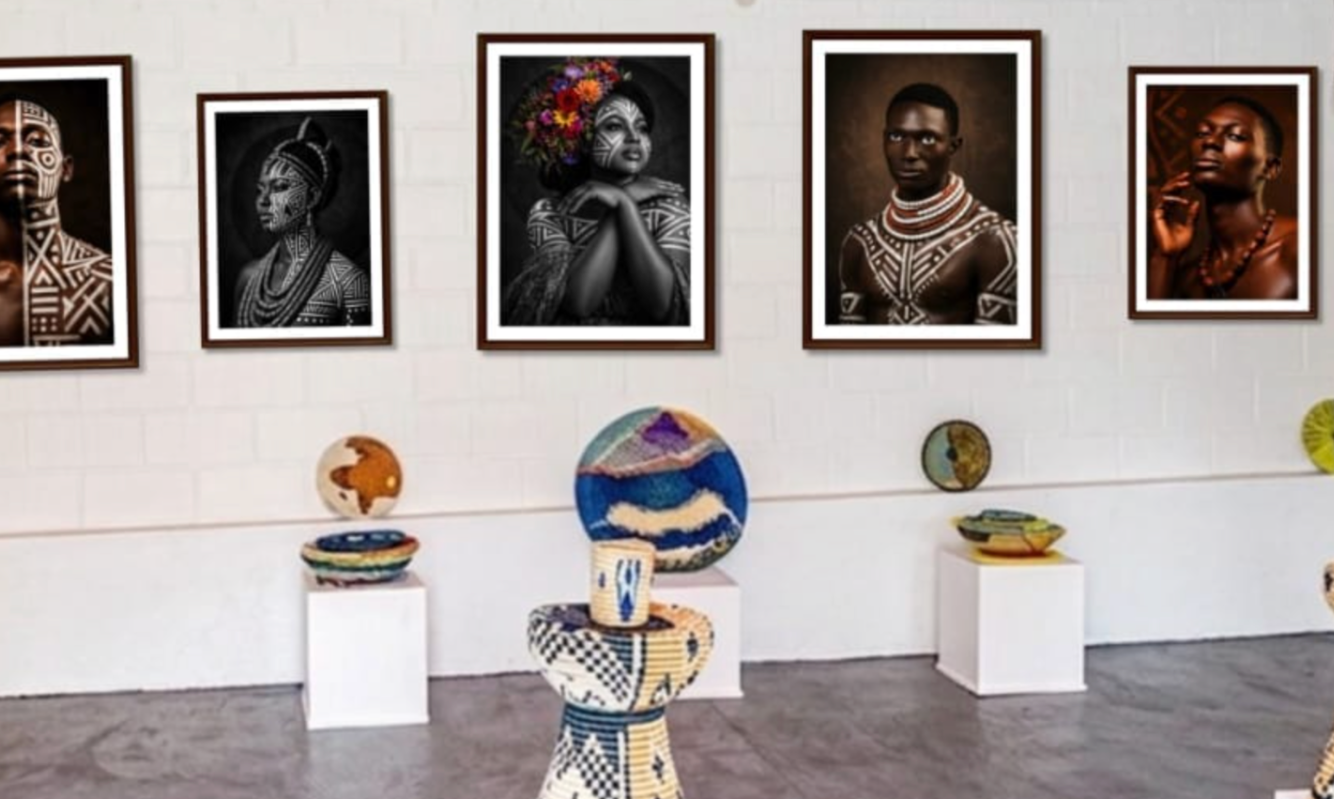
Miracle Okafor’s portraits are full of signs, but they are reluctant to explain themselves. In States of Presence, exhibited at MADS Kigali from 4 to 23 December 2023, painted geometries travel across faces and torsos, beads gather heavily around necks, flowers interrupt monochrome bodies and sitters look either directly at the camera or somewhere beyond it. Okafor, a visual artist whose practice fuses fine art photography and painting, treats the body as both portrait and pictorial surface: a place where identity can be constructed, carried and displayed without becoming fully available to interpretation.
Seen together, the works establish a consistent visual grammar. Dark grounds, controlled light, frontal and three-quarter poses, painted markings and elaborate adornment recur throughout the series, but Okafor varies their intensity enough to prevent repetition from becoming formula. What holds the photographs together is less a shared styling than a shared attitude towards presence. These subjects do not appear casually encountered. They have been deliberately composed, illuminated and positioned, as though entering the frame already conscious of how they wish to occupy it.
Miracle Okafor, States of Presence, 2023, installation view, MADS Kigali.
In one of the series’ most arresting portraits, a male sitter faces the camera while a white vertical line divides his body almost precisely in half. One side remains largely bare; the other is covered with circles, parallel strokes, crosses and angular forms. At first, the device appears to establish an obvious opposition between marked and unmarked, exposed and inscribed. Look longer and that division begins to fail. The line crosses one forehead, nose, mouth, neck and torso. Okafor turns what looks like separation into evidence of coexistence, allowing competing forms of representation to occupy the same body.
Painting changes the photograph in more than a decorative sense. White pigment reorganises anatomy into geometry. A circle redirects attention around an eye, parallel marks interrupt the contours of a cheek and angular lines convert the shoulder into a patterned field. Photographic light gives the body volume while painted forms repeatedly flatten it. That friction between the two mediums is central to Okafor’s method: photography describes the surface with precision, then painting unsettles the authority of that description.
Elsewhere, a woman photographed in black and white wears layers of beads around her neck and an elaborate arrangement rising around her head. Painted forms extend across her forehead, cheek, neck and shoulder. Removing colour intensifies the relationship between skin, pigment and adornment, making texture and line unusually pronounced. Yet for all the intricacy surrounding her, the sitter remains composed and looks away from the camera. This tension between visual elaboration and emotional restraint is one of Okafor’s more convincing strategies. His subjects are highly constructed without appearing consumed by their construction.
Another portrait pushes this strategy further. A woman rendered largely in monochrome is crowned by an extravagant arrangement of flowers retaining vivid reds, oranges, yellows and purples. Colour appears almost to have broken through the photograph. The effect could easily become ornamental, but Okafor balances the floral abundance against the sitter’s remarkable stillness. Her arms cross beneath her face while her gaze travels beyond the frame. The flowers provide movement and excess; the body answers with control. The tension allows ideas of vitality, transformation and self-fashioning to surface without becoming prescribed meanings.
Okafor’s investment in the body as a site of symbolic construction places his practice within a wider history of African and diasporic portraiture. There are distant correspondences with Rotimi Fani-Kayode’s understanding of the photographed body as psychologically and symbolically charged terrain, and with Omar Victor Diop’s use of highly constructed portraiture, styling and self-presentation. Yet Okafor’s emphasis falls elsewhere. His distinctive proposition emerges from the collision of photographic modelling with painted geometry: the camera gives flesh dimension while the painted mark converts that flesh into a surface carrying signs. The comparison is therefore useful less as a genealogy than as a way of locating Okafor within an ongoing conversation about who controls the representation of the Black body.
The question of control runs through the sitters’ gazes. Some meet the camera with conspicuous assurance; others direct their attention beyond it. A direct gaze can make an elaborately decorated figure unexpectedly resistant, while an averted one establishes psychological distance. Either way, Okafor denies the camera complete possession of its subjects. We can inspect skin, markings, beads, flowers and gesture in extraordinary detail, yet such visibility never guarantees knowledge of the person represented.
This is particularly important because the symbols themselves resist easy translation. The geometric markings and forms of adornment can evoke cultural memory, inheritance and African visual traditions, but Okafor does not present them as an ethnographic code. No interpretive key accompanies the circles, lines or repeated forms. Their apparent legibility becomes a trap: the viewer recognises them as signs and immediately wants to make them signify something definite. Okafor allows that impulse to remain frustrated.
Formally, the photographs depend on reduction as much as embellishment. Dark brown, grey and black backgrounds remove most competing information from the frame, while directional light models cheekbones, shoulders, lips and collarbones. Skin acquires a sculptural density against these subdued grounds. The resulting portraits can appear almost ceremonial, yet their force comes from the fact that the sitter remains more psychologically compelling than the objects and patterns surrounding them.
There are occasions when Okafor’s accumulated vocabulary of beads, pigment, flowers and styling approaches overstatement. Some images risk announcing their symbolic importance before the viewer has had time to discover it. But the strongest works counter this through formal discipline: sparse backgrounds, controlled expressions and tightly organised compositions pull attention back from spectacle to presence. Okafor is at his best when the signs appear abundant but their meanings remain uncertain.
Viewed as a body of work, States of Presence rejects the comforting photographic idea that a portrait reveals an essential self. Okafor proposes something less stable. Identity is assembled through surfaces, memories, gestures, inheritance and acts of self-presentation, yet none can contain the individual completely. A body can carry signs without becoming their definition; adornment can suggest belonging without fixing it; a face can be perfectly visible while retaining an interior life beyond the reach of the camera.
That tension gives States of Presence its coherence. Okafor’s fusion of fine art photography and painting works most convincingly when the two disciplines seem to challenge one another: light produces volume while painted geometry flattens it, photographic detail promises revelation while symbolism restores uncertainty. His subjects arrive elaborately presented and unmistakably visible, but they refuse to become entirely readable. In States of Presence, to be seen is not the same thing as being known.